KEY TAKEAWAYS
- IT hardware procurement covers acquiring, deploying, tracking and disposing of employee devices, because ISO 20400:2017 puts disposal inside the definition (ISO 20400:2017).
- Four models run in practice: centralised, decentralised, vendor-managed and lifecycle-based. Academic reviews find hybrid structures are the most common (Glock & Hochrein).
- Import duty is rarely the cost driver. A laptop pays 0% duty in the EU, the UK, the USA and India, while Brazil charges 16% (EC TARIC). Destination tax decides the landed cost.
- The 2026 memory shortage has changed planning. IDC forecasts global PC shipments down 11.3% and sees no relief before the end of 2027 (IDC).
IT hardware procurement is the process of specifying, buying, configuring, delivering, tracking and retiring the devices employees work on. The benchmark to plan against is blunt: the median procure-to-pay cycle for goods takes 40 days, from 4,112 responses to APQC's benchmarking programme (APQC).
A hire starting in three weeks sits inside that window, which is why so many IT teams work around their own process. This guide covers the four models companies run, a six-step workflow, the benefits and challenges of each, and the practices that hold up for globally distributed teams.
What IT Hardware Procurement Actually Means
Hardware procurement used to end at the invoice. It now covers a supply chain that runs from a hiring decision to a certified wipe, because the device leaves the building on day one and has to come back years later.
ISO puts that boundary in the definition. The process "considers the whole cycle from identification of needs through to the end of the life of goods, including disposal" (ISO 20400:2017, clause 3.18). CIPS draws the line differently: procurement is the long-term approach, purchasing is the short-term transaction, and the CIPS supply cycle runs to 13 steps ending in asset management (CIPS).
Geography changes the work more than volume does. Amazon Business surveyed 3,108 procurement decision-makers and found 52% buy for more than one location, and 57% of that group buy for more than one country (2024 State of Procurement Report).
Hiring one engineer in Germany, one in India and one in the USA therefore creates three different jobs. Germany charges 0% duty and 19% VAT. India charges 0% duty but requires BIS registration before clearance, and the USA charges state sales and use tax that a business cannot reclaim.
Different Types of IT Hardware Procurement Models
Companies pick a model based on size, maturity and how spread out their people are. Each of the four below trades speed against control in a different place.
Type 1: Centralised Procurement
One team owns every device purchase, which produces standard builds, one supplier record and comparable quotes. Research on purchasing organisation names three synergies that centralising creates: economies of scale, of process, and of information and learning (Kanepejs & Kirikova).
The costs are named just as clearly: maverick buying, weaker control over remote processes, overhead and slow response. The Hackett Group's 2019 Maverick Spend Report found that in IT and telecom, typical organisations follow the sourcing strategy on only 83% of spend, while leaders reach 95% (Hackett).
Type 2: Decentralised Procurement
Teams and managers buy their own devices, which buys speed and loses comparability. Rozemeijer and van Weele describe the result directly: "Due to the lack of coordination, however, it may appear that different business units deal with similar suppliers for similar products ending up with different prices and conditions" (TU/e repository).
The same pattern shows up in device buying as one account per market, such as Amazon for the UAE, one reseller in India and another in the UK. Very few companies sit at either pole, and both papers find that most run a hybrid.
Type 3: Vendor-Managed Procurement and Device as a Service
A provider handles sourcing and logistics, and Device as a Service goes further by bundling hardware, IT support and lifecycle management into one subscription (Intel). Read the contract mechanics before the brochure.
Dell describes PCaaS as "a combination of hardware, software and services aggregated into a financing solution delivered at a single price per seat per month", and Dell APEX PCaaS is a lease in which the lessor owns the equipment (Dell). Adding devices mid-term starts a fresh commitment: "if Customer added 500 new PCs midway through a 36-month DFS Agreement, the 500 new PCs would have a new, standalone commitment of an additional 36 months."
Apple runs no Device-as-a-Service offer at all. Its business programme is Apple Financial Services, a leasing programme with a planned refresh cycle of two to four years for Mac.
Type 4: Lifecycle-Based Procurement
The fourth model keeps ownership in-house and organises the work around the device rather than the purchase order, which is what hardware lifecycle management describes. Buying, configuring, delivering, servicing, collecting, storing, redeploying and reselling run as one workflow against one asset record.
Gartner makes the case for it: "there are front-end costs, such as procurement and training, and back-end costs, such as replacements, upgrades, retirement and disposal." A model that measures only the front end cannot price the whole device.
Step-by-Step IT Hardware Procurement Workflow
Each stage below produces a record the next stage depends on. The table gives the shape before the detail.
Stage timings come from APQC's open standards benchmarking, and each customs or tax requirement is sourced to the authority that sets it.
Step 1: Capture the Demand Signal Early
The request has to carry a country and a start date, because both change the lead time. APQC puts the median company at 2.0 days to turn a requisition into a purchase order, which is the fast part. The 2026 component market has stretched the outer edge: average commitment lead time for production materials reached 87 days in July 2026, up from 77 days in July 2024 (ISM).
Step 2: Approve Against a Standard Build
Approval works when the request maps to a build that already exists. Two or three approved configurations per role make quotes comparable and resale value calculable, while ten bespoke builds turn every country into a separate negotiation. APQC's April 2026 analysis puts the cost of processing one purchase order at $14 to more than $54 (APQC).
Step 3: Decide the Source Country Before the Supplier
The most consequential choice in the workflow is whether the device crosses a border. If it does, EU law requires that "the declarant shall be established in the customs territory of the Union", so a company with no EU establishment must appoint a customs representative. An EORI number is mandatory for every EU customs operation, and a company holds only one (European Commission).
The import VAT rule is where money quietly disappears. HMRC states that "import VAT may only be claimed by the owner of the goods", and adds that it "is aware of incorrect treatment by businesses whereby import VAT has been incorrectly deducted as input tax by non-owners of the goods" (HMRC VIT13300). Naming a vendor as importer of record can strand the VAT with a party that cannot reclaim it.
Step 4: Price the Landed Cost, Not the Unit Price
Duty is usually the smallest part of the bill. A laptop under CN 8471 30 00 00 has paid 0% EU import duty from any origin since 1 January 2000, the UK third country rate is 0.00%, the US General rate is Free, and India charges 0% basic customs duty. Brazil breaks the "duty-free everywhere" shortcut, because it is not a WTO Information Technology Agreement participant and charges 16%.
Tax and destination drive the number instead. EU law sets a minimum standard VAT rate of 15% and no maximum, so the rate differs in every member state, from 19% in Germany to 23% in Poland. Import VAT lands on customs value plus duty plus transport, so tax gets charged on shipping cost too. Product type matters as well: in India a laptop is taxed at 18% in total, while a monitor pays 32.278% and a smartphone 49.152%.
Two 2026 rule changes reset older cost models. The EU abolished the EUR 150 customs duty relief on 1 July 2026 and replaced it with a temporary EUR 3 per item duty running to 1 July 2028 (Council Regulation (EU) 2026/382). In the USA the $800 de minimis exemption is indefinitely suspended for every non-postal mode, so every shipment worth $800 or less now needs a formal or informal entry (CBP, 91 FR 37789).
Every duty figure here was checked on 12 August 2026, and the US regime moved four times in the eight months before that, so re-check any tariff line before it reaches a budget.
Step 5: Configure and Deliver Before Day One
Pre-configuration belongs in the purchase rather than after it. Enrolling the device through Apple Business Manager or Windows Autopilot before it ships means the employee unboxes a managed machine, which is what zero-touch deployment means in practice.
Transit commitments are published; clearance times are not. FedEx International Priority and UPS Worldwide Express both publish 1 to 3 business days, while DHL states only that "the customs clearance time varies depending on the country's customs authorities" (DHL). That is why shipping a laptop internationally works as an exception and fails as a model.
Late arrival has a measurable price. US employers spend an average of $46.60 per hour worked per private-industry employee (BLS), so a week of a new engineer waiting is a four-figure number.
Step 6: Track, Recover and Retire With Evidence
The record is the deliverable of the last stage. ISO/IEC 27001:2022 Annex A names the controls: A.5.9 "Inventory of information and other associated assets", A.5.11 "Return of assets", A.7.14 "Secure disposal or re-use of equipment" and A.8.1 "User endpoint devices". An auditor asks for the register, not the intention, which is the job an asset management tool exists to do.
Sanitisation guidance changed recently and most published advice has not caught up. NIST SP 800-88 Rev. 1 was withdrawn on 26 September 2025 and superseded by Rev. 2 (NIST). Rev. 2 keeps the three methods clear, purge and destroy, drops degaussing as a destroy technique, and repeats that a certificate of media disposition should be completed for each piece of media sanitised.
The consequences of skipping that certificate are documented. The SEC fined Morgan Stanley $35 million in 2022 over the disposal of devices holding data on about 15 million customers, after 42 servers went missing (SEC). In the UK, the High Court held in *Stadler v Currys Group Ltd* [2022] EWHC 160 (QB) that disposing of a device without wiping personal data "is a form of processing", which makes laptop retrieval a compliance step rather than a courtesy.
{{cta-primary}}
Key Challenges IT Teams Face in Hardware Procurement
Three problems come up in almost every globally distributed team, and following the right IT procurement process best practices can address them more systematically than a better spreadsheet.
Challenge 1: Component Supply Has Overtaken Demand Planning
The memory shortage is the dominant planning constraint of 2026. HP's CFO Karen Parkhill told investors that "memory and storage costs made up roughly 15% to 18% of our PC bill of materials. And we now currently estimate this to be roughly 35% for the year" (HP), and Dell said it "implemented pricing moves effective January 6 to reflect our higher input costs".
IDC expects global PC shipments to fall 11.3% in 2026 and Omdia expects 12%, both blaming supply rather than demand. Two findings matter for buyers: OEMs are cutting base RAM and SSD capacity, and large buyers keep getting supply while small buyers do not, because they cannot commit to large-volume contracts.
Challenge 2: Capacity Falls While the Work Rises
Deloitte's 2025 Global Chief Procurement Officer Survey found that even the most digitally mature procurement teams spend about two-thirds of their time on non-strategic work (Deloitte), and The Hackett Group reported in March 2026 that procurement workloads will rise 8% while head count and operating budgets fall.
Hardware sits at the wrong end of that squeeze. It is indirect spend with a physical tail, so it eats coordination hours without registering as strategic work, and that gap pushes teams into buying outside the process.
Challenge 3: Off-Contract Buying and Control Override
The Hackett Group defines maverick spend as "the buying of goods or services outside of a preferred buying channel, supplier or price when one has already been established", and 75% of the procurement professionals it surveyed named missing guided buying tools as a top cause.
The fraud data shows what happens when controls are absent rather than merely inconvenient. The ACFE's 2026 Report to the Nations examined 2,402 cases across 143 countries and found a median loss of $104,000 per case, with more than half of those cases involving a lack of internal controls or an override of existing ones (ACFE).
Benefits of Structured IT Hardware Procurement Systems
Devices Arrive Before the Start Date
A structured process turns delivery into a planning input. In a Dell-sponsored IDC study of 109 US organisations averaging 5,244 PCs each, time to deliver a new PC fell from 5.8 days to 3.4 days after a lifecycle service was introduced, and downtime cost fell from $97 to $56 per PC (IDC).
No independent benchmark exists for how long it takes to get a laptop to a new hire, from Gartner, Forrester, a government body or a journal. Nobody has measured it, so most companies cannot see what their own delay costs them.
Costs Become Comparable Across Markets
One build and one landed-cost format make two countries comparable for the first time. Without them, a quote that excludes freight gets weighed against one that includes duty, in a different currency, and the comparison is guesswork.
Fewer Suppliers, Faster Sourcing
Consolidation shows up in cycle time as well as price. The Hackett Group's 2023 analysis found that top performers complete sourcing 17% faster than peers, and use 3.6 times fewer suppliers per $1 billion of spend (Hackett).
The Exit Is Priced Before It Happens
A process that includes collection, wiping and resale turns a write-off into residual value, and it produces the certificate of media disposition per device that NIST SP 800-88 Rev. 2 asks for. ISO 27001 requires the disposal control itself rather than a certificate per serial number. The disposal load is real: in 2023 the EU collected 11.6 kg of waste electrical equipment per inhabitant, a 37.5% rate against a 65% target (Eurostat).
Best Practices for Efficient IT Hardware Procurement
Buy in the Destination Country Where You Can
Removing the border removes the customs step rather than managing it. The EORI question, the importer of record question and the unquotable clearance time all leave the schedule at once, and cross-border movement stays routine inside the European Economic Area.
Write the Standard Build Before the Next Hire
Two or three approved configurations per role, agreed with Finance, remove the most common source of delay. They also make resale value predictable, which decides whether a fleet refresh is affordable.
Report Arrivals Against Start Dates
An average transit figure hides the orders that missed their deadline, since one fast delivery cancels out one late one. Count instead how many devices landed on or before the employee's first day, by country, every month.
Audit the Register Against the Standard You Claim
Map the asset record to named controls, then test it. Any vendor still citing NIST SP 800-88 Rev. 1 or a "DoD three-pass wipe" is quoting withdrawn guidance, and IT procurement software keeps the record current as devices move.
Pro tip: send the same seven questions to every hardware vendor on your shortlist, in writing, and put the answers side by side.
1. What is the all-in cost per device, delivered, in each of the five countries listed, quoted in that country's currency?
2. Is the device bought inside the destination country or shipped across a border? If it crosses a border, who is the importer of record and who reclaims the import VAT?
3. What share of devices arrived before the employee's start date in those five countries last quarter, measured against the requested date rather than the date you confirmed?
4. Does adding devices mid-contract start a new term, and how long is that term?
5. What does it cost to collect, wipe and store one device when an employee leaves, per country?
6. Which sanitisation standard do you certify to, and will you supply a certificate of media disposition per serial number?
7. Which countries do you not cover, and what happens to a device in a market the customer exits?
Question 1 is the filter. A vendor that answers it with "it depends" is saying the price gets set after you commit, and question 3 separates a coverage map from a delivery record.
How Tequipy Supports Hardware Procurement Across the Device Lifecycle
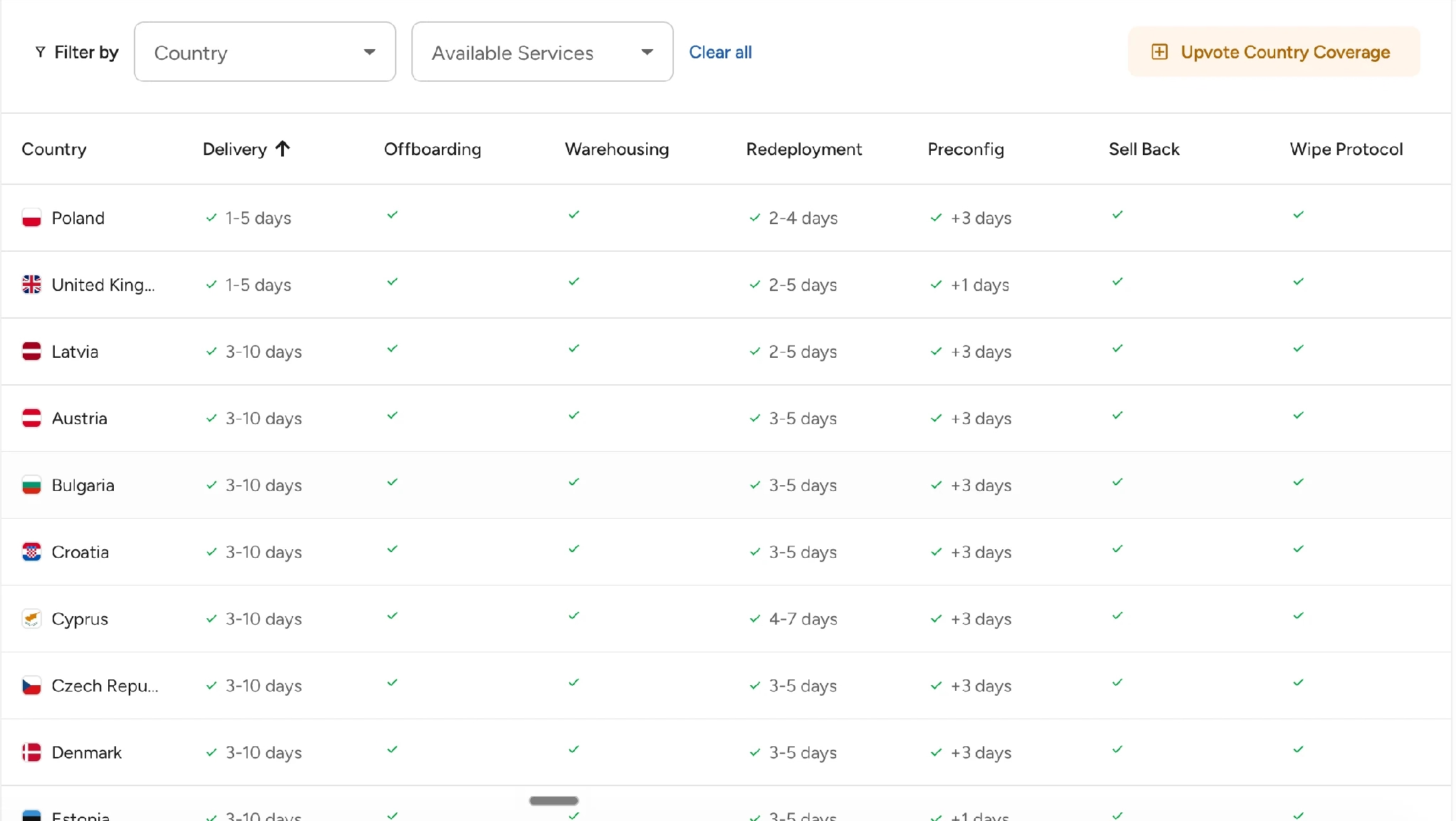
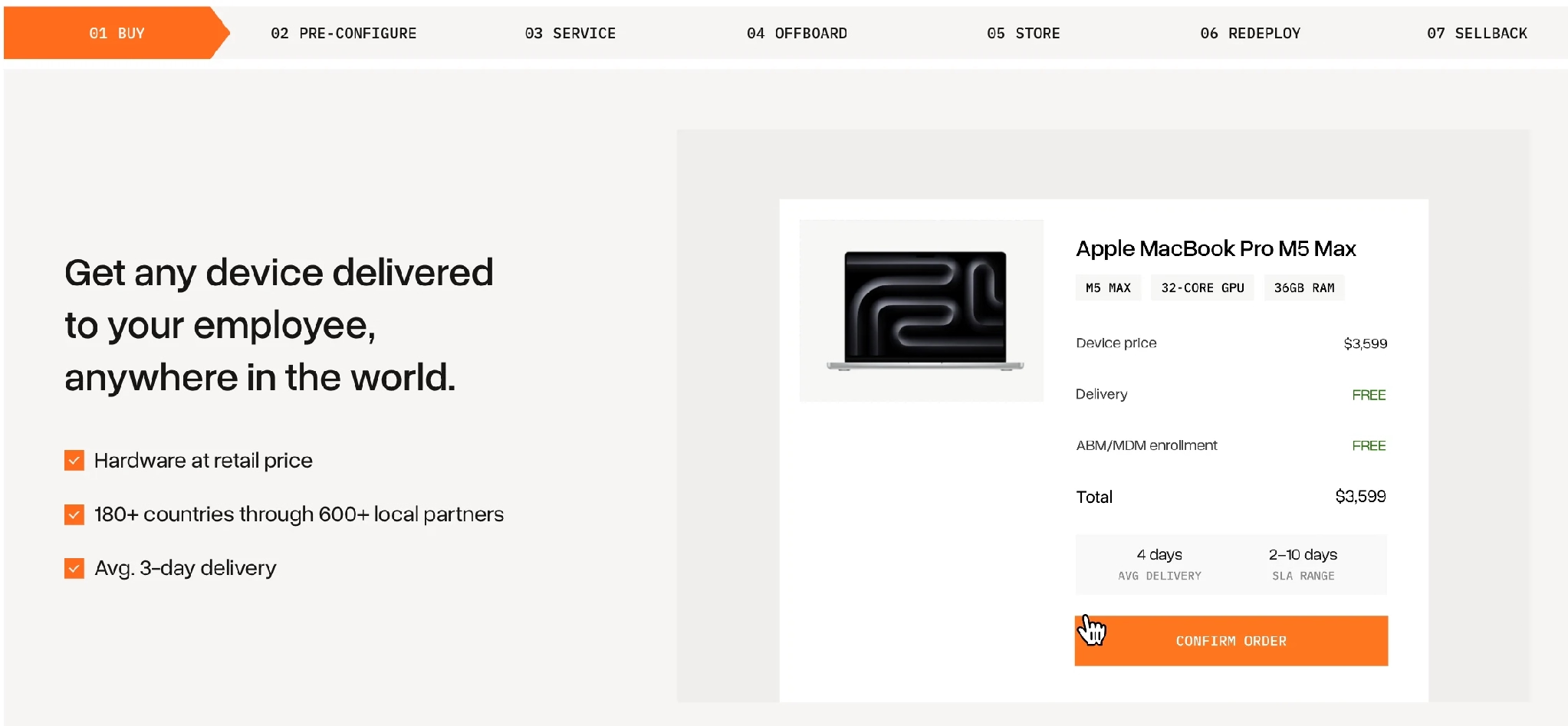
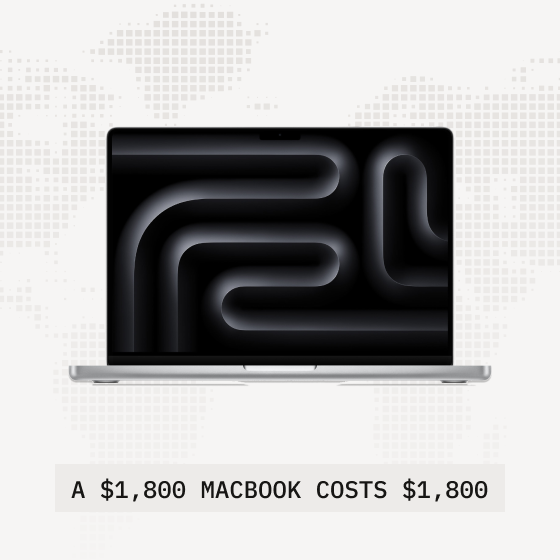
Tequipy runs hardware procurement as a lifecycle service rather than a reselling relationship. Its device procurement service fulfils orders through 600+ authorised local resellers across 180+ countries, at recommended retail price or lower with no hardware markup and delivery included, so the device is bought inside the employee's own country and no import step exists. This approach simplifies equipment procurement for distributed teams by reducing cross-border purchasing complexity. Delivery averages 3 business days with a 10-day cap.
Seven services run against one asset record: Buy, Pre-Configure, Service, Offboard, Store, Redeploy and Sellback. MDM enrollment via Apple Business Manager or Windows Autopilot is included with a device purchase at no charge, and every service also applies to hardware bought elsewhere. Tequipy holds ISO 27001 certification, keeps a full chain of custody per device, and offers a Blancco certified wipe or a certificate of destruction at offboarding. SOC 2 is in progress rather than held, so ask where it stands if a report is a IT procurement gate.
The published rate card is the part a procurement review cares about. The platform costs $99 per month flat at any fleet size, and it is free under 100 devices. Offboarding runs $70 to $150 per device by country, storage is $12 per device per month, and sellback returns 20% to 70% of initial value in cash.
Redeployment is the arithmetic that changes a refresh budget: offboarding, three months of storage and redeployment come to roughly $180 to $240 per device, against $1,500 to $2,500 to buy new. Payment terms carry a $5,000 limit and a week to settle after delivery, which works like a purchase order, and Tequipy does not lease, finance or rent hardware in any market.
Two limits belong in any shortlist. A device is stored and redeployed in the country it was collected in, with the EEA counted as a single region, so exiting a market means resale rather than a transfer. Coverage excludes Russia, Belarus and North Korea, and only those three, as set out on the global IT procurement page.
Booksy, Testing the Hardest Market First
Booksy employs more than 500 people across the US and Poland and expanded into the Philippines and Colombia. Rather than piloting in an easy market, it started where its logistics were worst. Its Director of Enterprise Technology and Security, Marcin Szydłowski, gives the reason in the Booksy case study: "We initially tested them in Latin America, a region where we faced logistical challenges."
That same case study page records 3,200+ hours saved on IT administration and 99% of devices delivered before the employee's start date. Copy the order of the test, not just the vendor choice, because a trial in a market that already works tells you nothing new.
TapTap Send, Three Purchasing Processes Down to One
TapTap Send has around 250 employees and had been running three separate purchasing processes. Consolidating them onto one platform produced 40+ hours a month saved and an average of $6,500 a month, with 100% device recovery (TapTap Send case study). Dimitrios Stergiou, Director of IT and Information Security, describes the result: "Their platform makes sourcing, configuring, and shipping devices to our global team incredibly simple and efficient."
RemoFirst reports the same recovery figure at a different shape of company: 30 countries in scope, 25+ hours and $3,500 a month saved, and about $2,000 per employee in prevented losses (RemoFirst case study). Gigs took the same route at 100 employees and avoided an IT logistics hire carrying a $60,000 to $80,000 salary (Gigs case study).
{{cta-primary}}
CONCLUSION
Final Words on Getting IT Hardware Procurement Right
IT hardware procurement stops being firefighting when buying, configuring, delivering, collecting and reselling run as one process against one record. The 2026 constraints all reward the same behaviour: decide the source country early, price the landed cost, keep the evidence.
The fastest way to test a change is one order in the market that caused the most trouble this year. Talk to the Tequipy team about that order, or read the companion guides to IT procurement services and the international procurement process.
FAQ
What is IT hardware procurement?
IT hardware procurement is the process of specifying, buying, configuring, delivering, tracking and disposing of the devices employees use. ISO 20400:2017 puts disposal inside the definition, so the process ends at the end of the device's life.
Is IT hardware procurement the same as purchasing?
No. CIPS defines procurement as the long-term approach to acquiring goods and services, and purchasing as the short-term transaction inside it. Purchasing raises the order; procurement owns the specification, the supplier, the delivery and the disposal.
Do you pay import duty on a laptop?
Usually not. A laptop pays 0% import duty in the EU, the UK, the USA and India, because those markets participate in the WTO Information Technology Agreement. Brazil is not a participant and charges 16%, so "duty-free everywhere" is wrong as written.
What is the difference between Device as a Service and lifecycle procurement?
Device as a Service bundles hardware and support into a subscription, and Dell's PCaaS is explicitly a lease in which the lessor owns the equipment. Lifecycle procurement keeps ownership with the buyer and organises the same stages as services bought individually.
How does Tequipy handle IT hardware procurement across countries?
Tequipy buys each device through an authorised local reseller in the employee's own country, across 180+ countries and 600+ resellers, at recommended retail price with delivery included. Because the device does not cross a border, there is no customs step.
Keep your current setup.
Just test us on one order.
AUTHOR
Before Tequipy, Tomek ran IT at Revolut, scaling from 100 employees in 2 offices to 5,000 across 17. He built the system that kept every laptop accounted for, then founded Tequipy – a platform that handles IT equipment logistics for distributed teams across 180+ countries.
As CEO, he runs operations and covers the founder layer: strategy, product, and the company-building that comes with both.
15 minutes. Your countries, your devices, your setup. No pitch.