KEY TAKEAWAYS
- Run the process as a fixed sequence: one approved build per role, one intake route, in-country sourcing, a three-document check before payment, then one report on arrivals against start dates.
- Split the three purchasing roles. Whoever orders, whoever confirms receipt and whoever releases payment should be three different people.
- Shrink the supplier list before negotiating unit price. Hackett's 2012 research priced running one supplier at $700 to $1,400 a year.
- Tequipy covers buying, configuration, delivery, collection, storage, redeployment and resale of hardware in 180+ countries, with every rate published.
IT procurement process best practices come down to sequence and control. Approve one build per role, route every request through one intake, buy inside the country where the person works, check three documents before paying, then report how many devices arrived before the start date.
The gap this creates is measurable. The Hackett Group's 2025 benchmark found that digital world class procurement teams run sourcing cycles 24% shorter than their peers, and lose 60% less savings to maverick buying and contract non-compliance. Each practice below carries the actions to take and the number that proves it landed.
IT Procurement Process Best Practices
Eight practices, ordered by weight. The first four set the cost and speed of every order. The last four stop losses that surface months later.
Approve One Build Per Role, Then Refuse Variations
Publish two to four standard configurations. Name model, memory, storage, keyboard layout and warranty term, since all five move availability market to market.
- Cap the list at four builds and name a fallback for stock gaps.
- Set a price ceiling per build.
- Route anything off-list through a written exception with a reason.
Proof: orders against an approved build pass 90% within two quarters.
Give Every Request One Route In
A request arriving by direct message cannot be counted, chased or forecast. Point everyone at one form and make the start date mandatory.
- Collect role, country, start date and build on that one form.
- Set a cut-off, for example ten working days before the person starts.
- Publish the queue so requesters stop chasing.
Proof: days from request to purchase order fall against last quarter.
Split Ordering, Receiving and Paying
Three jobs, three people. The Washington State Auditor's guide keeps procurement separate from receiving goods and from processing payments, noting that "These three distinct roles also correlate to the three-way match". GAO's checklist defines that match as the obligation, the receiving report and the invoice.
- Name a different person for ordering, receipt confirmation and payment.
- Log the serial number at receipt, never at the point of order.
- Block any hardware invoice carrying no purchase order number.
Proof: every paid hardware invoice has a matching logged receipt.
Pro tip: the three-way check is the practice growing teams skip most often, because two people can run a whole purchasing cycle and nobody notices until an invoice gets paid twice. Install it in an afternoon. First, write the three roles onto one page: requester and approver, receiver, payer. Second, make the receiver photograph the carton and log the serial number the day it lands. Third, block payment on any invoice with no purchase order number and no logged receipt. Fourth, count disputed invoices monthly and read the exceptions.
GAO's Green Book gives the reason in one sentence: "Segregation of duties helps prevent fraud, waste, and abuse in the entity by considering the need to separate authority, custody, and accounting in the organizational structure."
Buy Inside the Country Where the Person Works
A cross-border shipment adds a customs queue nobody in your company controls, plus duty and import VAT exposure. Sourcing in the destination country removes the border rather than managing it, which is how global IT procurement gets organised country by country.
- Ask each supplier which countries it actually delivered in last quarter.
- Require an all-in price per device per country, delivery included.
- Keep international shipping for exceptions and price it as one.
Proof: the share of orders fulfilled inside the destination country rises.
Shrink the Supplier List Before Negotiating Price
Every extra supplier carries overhead that never reaches an invoice. Hackett's 2012 research priced one supplier at $700 to $1,400 a year to source, onboard, transact with and manage. Companies with the fewest indirect suppliers per US$1bn of spend ran procurement on 44 full-time staff, against 121 at the crowded end.
- List every vendor that invoiced for hardware in the last twelve months.
- Retire any used fewer than three times, unless it is the only local option.
- Move that volume to the survivors, then reopen the price conversation.
Proof: supplier count falls while hardware spend holds steady.
Price the Whole Life of the Device Before Buying It
The purchase is one line in a longer bill. Collection, storage, repair, redeployment and resale all land later, and the CIPS Procurement and Supply Cycle agrees: receipt is step 10 of 13, asset management is step 13.
- Get collection, wipe and resale rates in writing before signing.
- Put a redeployment or resale assumption into each build's business case.
- Compare cycling an existing machine against buying new.
Proof: you can quote retirement cost as confidently as purchase cost, from published device buyback rates.
Put Contract Terms Where the Buyer Can See Them
Negotiated discounts leak when nobody at the point of order knows they exist. Hackett's 2012 paper put the first pass at contract and service-level non-compliance at savings of up to 1 to 2% of spending.
- Publish a one-page summary of each supplier's prices and service levels.
- Put the discount tier in the intake form, beside the build.
- Log any invoice priced above contract as a dispute.
Proof: disputed invoices as a share of invoices received drop each quarter.
Keep One Asset Register and Audit It Against Reality
ISO/IEC 19770-1:2017 specifies requirements for an IT asset management system, covering every type of IT asset and any size of organisation. Certification is optional; the register is what makes warranty claims, redeployment and resale possible.
- Record serial number, country, cost, holder and status per device.
- Reconcile the register against your enrolment list quarterly.
- Close every offboarding with an outcome in remote equipment management records.
Proof: devices with unknown status reach zero and stay there.
The Stages of the IT Procurement Process
Run the stages in order, give each a named owner, and write down the test that closes it. CIPS numbers thirteen steps, and the detail worth copying is where its cycle ends: receipt at step 10, then contract performance, supplier relationships and asset management.
The thirteen-step numbering above comes from CIPS.
Stages 1 and 2: Identify the Need, Then Specify Against a Standard
Make the hiring system the trigger. Once a start date exists, the request should exist too, with the role already mapped to an approved build.
Stage 3: Source and Price Per Country
Price the same build in every country you hire in, all-in, delivery included. Ask which currency each supplier invoices in, because a single-currency supplier has handed its exchange risk to your finance team.
Stages 4 and 5: Order, Receive, Then Configure
Raise a purchase order every time. On arrival, log the serial number and match the three documents. Enrolment through zero-touch deployment belongs before handover, while the device sits with the supplier.
Stage 6: Manage, Redeploy and Retire
A device leaves the register only with a recorded outcome: redeployed, resold, destroyed or lost. Book collection the day you process the leaver, because laptop retrieval gets harder every week.
What Tools Support IT Procurement
Five software categories touch the process, and one performs physical work. Map your practices onto the categories, then buy for the gaps left over.
Register requirements in row four follow ISO/IEC 19770-1:2017, and the sourcing rows follow the CIPS steps above.
Intake and Request Management Tools
A shared form and a queue. Most teams already own one inside a service desk or HR system, so the work is picking one route and closing the others.
Approval and Budgeting Tools
Approval routing and spend limits belong in a procurement or finance tool. Hardware platforms deliver devices; they do not police a budget.
Vendor, Contract and Asset Management Tools
Contract repositories hold the terms and registers hold the assets. IT procurement software sits between them, while hardware asset management software records who holds what.
Lifecycle and Logistics Platforms
The only category performing physical steps: buying, configuring, shipping, collecting, storing, redeploying, reselling. It replaces vendor coordination, never your purchasing controls.
Common IT Procurement Challenges (and How to Avoid Them)
One Person Holds Every Role
In a team of five, the same person specifies, orders, receives and approves the invoice. GAO's Green Book names the pattern and rejects hiring as the answer: "A smaller entity, however, faces greater challenges in segregating duties because of its concentration of responsibilities and authorities in the organizational structure. Management can respond to this increased risk through the design of the internal control system". Redesign instead: move receipt confirmation to whoever sits with the device, and payment release to finance.
Tail Spend Nobody Owns
BCG defines tail spend as the money going on purchases that make up roughly 80% of transactions and only 20% of total spend volume. Small orders, many suppliers, no owner.
BCG, citing a Hackett Group study, reported that more than 27% of companies running a tail-spend programme saw savings of 5% to 10%, and 30% saw at least 10%. Buyers describe the symptom in plainer words: "Prices are all over the place, hard to compare quotes across vendors." Name an owner, then fold the spend into the approved build list.
The Process Stops at Delivery
Procurement gets judged on the purchase and lives with the disposal. Devices go out, nobody records what came back, and the register drifts from reality. One IT manager described the end state in a single sentence: "We don't even know how many devices are unaccounted for." Make offboarding part of the process, with collection booked the day the leaver is processed.
Metrics That Show Your IT Procurement Is Working
CIPS defines procurement KPIs as "metrics that can be used to analyse internal and external procurement and supply activities", covering value, time, quality and cost. Six numbers cover hardware.
Rows three and four are the "variance factors" named on the same CIPS KPI page. Row two matches APQC's purchase order measure, whose values sit behind membership, so track it against your own baseline rather than an industry figure.
Keep two savings words apart when you report. The US Office of Management and Budget defines cost savings as "a reduction in actual expenditures below the projected level of costs to achieve a specific objective", and cost avoidance as "an action taken in the immediate time frame that will decrease costs in the future".
Running IT Procurement Across Multiple Countries
Four things change once the process crosses a border: who sources, how long it takes, who repairs, and who pays the tax.
Source Locally Instead of Shipping Across Borders
Duty is rarely the problem people expect. The WTO Information Technology Agreement requires each participant to "eliminate and bind customs duties at zero for all products specified in the Agreement", covering computers, semiconductors, software and most of their parts. The WTO records 81 participating members, approximately 97% of world trade in IT products, applied on a most-favoured-nation basis.
Paperwork and classification cause the delay instead. Per EU classification guidance, laptops under 10 kg classify to subheading 8471 30 00 00 and desktops to 8471 49 00 00.
Then settle the Incoterm. Incoterms 2020 is eleven rules from the International Chamber of Commerce, and trade.gov states that every rule names the party who obtains the import licence, completes customs formalities and pays for them. What the rules leave out is the trap: title transfer, payment method, and the documents a seller must hand you to clear customs at home.
Plan for Country-Specific Lead Times and Availability
Set expectations per country, then build the cut-off from your slowest market. No current public dataset gives customs clearance times by country, since the World Bank's comparable measure last collected data in May 2019.
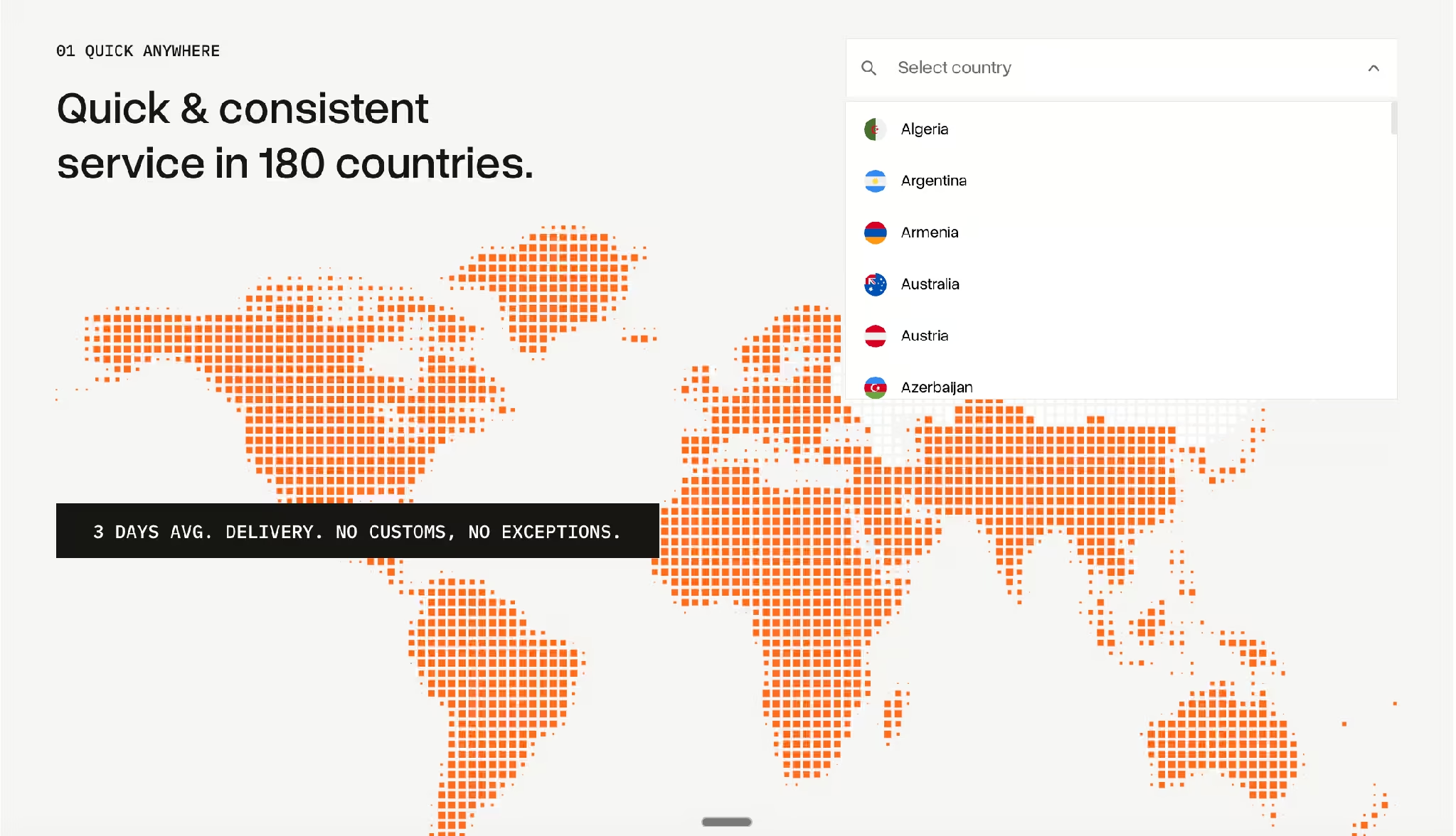
Worked example, India. Tequipy's own delivery data shows a worldwide average of 3 business days with a 10 business day cap, next-day delivery in major UK, EU and US cities, and around 6 days in India. Treat those as one provider's tracked figures rather than a market benchmark, ask your supplier for the same country breakdown, then give hiring managers a written cut-off date.
Secure Local Warranty, Repair and Replacement Coverage
A global service level on paper means very little when the employee sits in a country where the vendor has no partner. Repair is physical work, so ask physical questions before signing.
- Ask who performs the repair in each country, and where the depot sits.
- Ask for turnaround in business days, from pickup to a working machine.
- Agree what the person uses while the device is away.
One IT lead put the alternative plainly: "We're approaching local vendors in each country, it's extremely time consuming."
See what outsourcing IT procurement looks like across multiple countries.
Handle Multi-Entity Billing and Local Tax Rules
In the EU, the standard VAT rate must be no less than 15% with no maximum, and member states may apply up to two reduced rates as low as 5%. VAT falls on the final consumer, and registered businesses deduct tax paid on business purchases from the VAT they collected.
As reasoning rather than a sourced rule, a company with no local registration usually cannot recover VAT paid there, so the local rate becomes real cost. Ask finance which registrations exist per country before ordering, name the paying entity on every order, and consolidate invoices on a set cycle.
How Tequipy Fits Into an IT Procurement Process
Tequipy performs the physical steps and leaves the purchasing controls with you. Buying happens locally: an authorized reseller in the country where the employee lives fills the order, drawing on 600+ resellers and 180+ countries, minus Russia, Belarus and North Korea. Prices are recommended retail or lower, delivery included, no markup added. Repair turnaround averages 14 business days from pickup to a working laptop.
Cycling one existing device through collection, three months of storage and redeployment runs about $180 to $240, against $1,500 to $2,500 to buy a replacement. Buyers also get a $5,000 credit line with 7 calendar days after delivery to settle, which works like a purchase order. Hardware is never leased, financed or rented in any market, and each device is bought outright. Full rates sit on the pricing page.
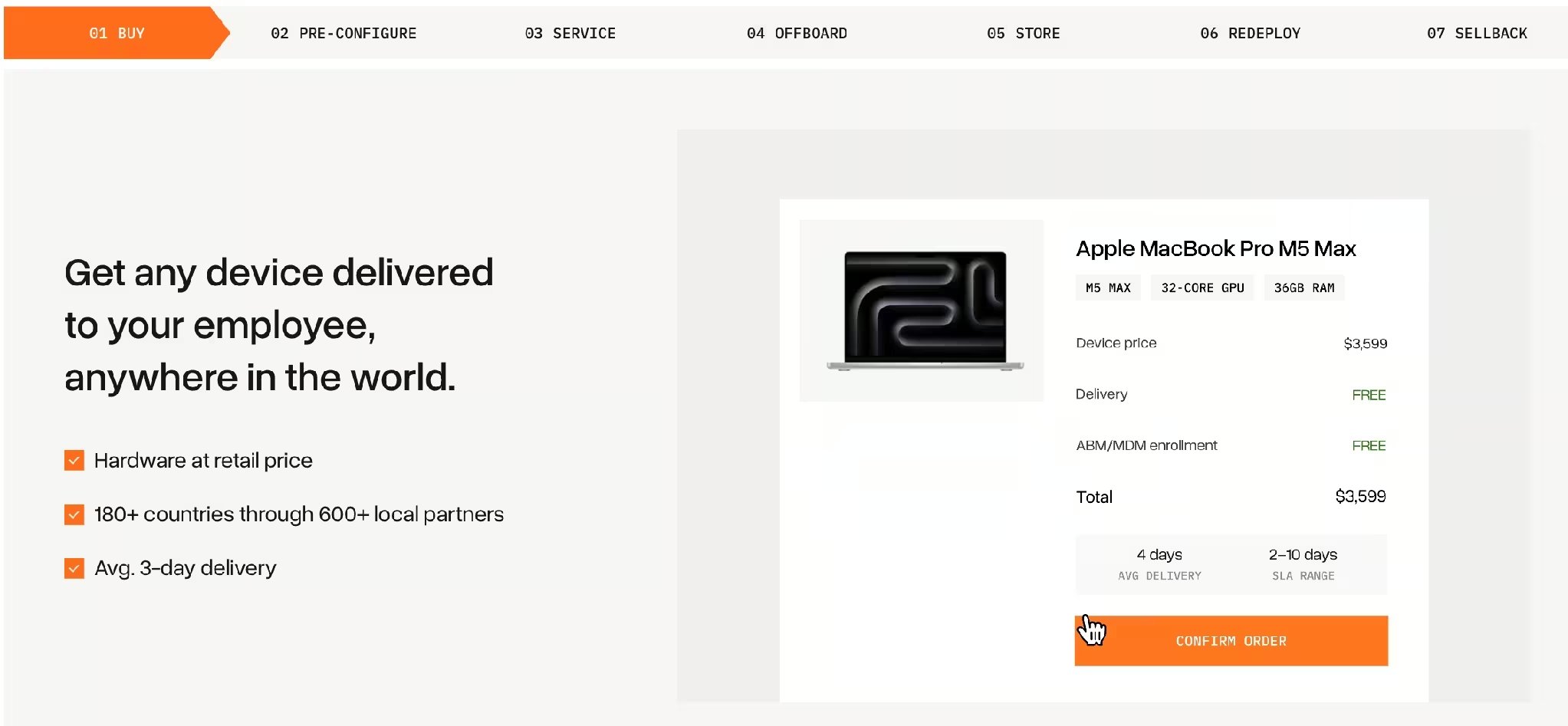
Four limits are worth knowing. Tequipy has no approval workflows and no budget controls, so requisition routing and spend limits stay in your procurement or finance tool. It is not an MDM either, and enrolment runs through Apple Business Manager or Windows Autopilot rather than a direct Jamf or Intune integration.
Service desk integration is API only. ISO 27001, GDPR hosting in Europe, per-device chain of custody and Blancco certified wipes are in place today, while SOC 2 remains in progress, so ask where that stands if a report is a procurement gate.
Published outcomes come from four customers. Booksy records 3,200+ hours of IT administration saved and 99% of devices delivered before the start date. TapTap Send folded three purchasing processes into one, reporting 40+ hours and $6,500 saved per month with every device recovered. At Gigs, a company of 100 people, the return was 100+ hours monthly and a skipped IT logistics hire priced at a $60,000 to $80,000 salary. RemoFirst covers 30 countries with every device returned.
{{cta-primary}}
Build an IT Procurement Process That Scales With You
Pick one practice and close it this week. The three-way check is the cheapest to install and the fastest to prove, because an hour matching last month's invoices against receipts shows how many pairs are missing. Then work outward: the approved build list, the single intake route, the country cut-off.
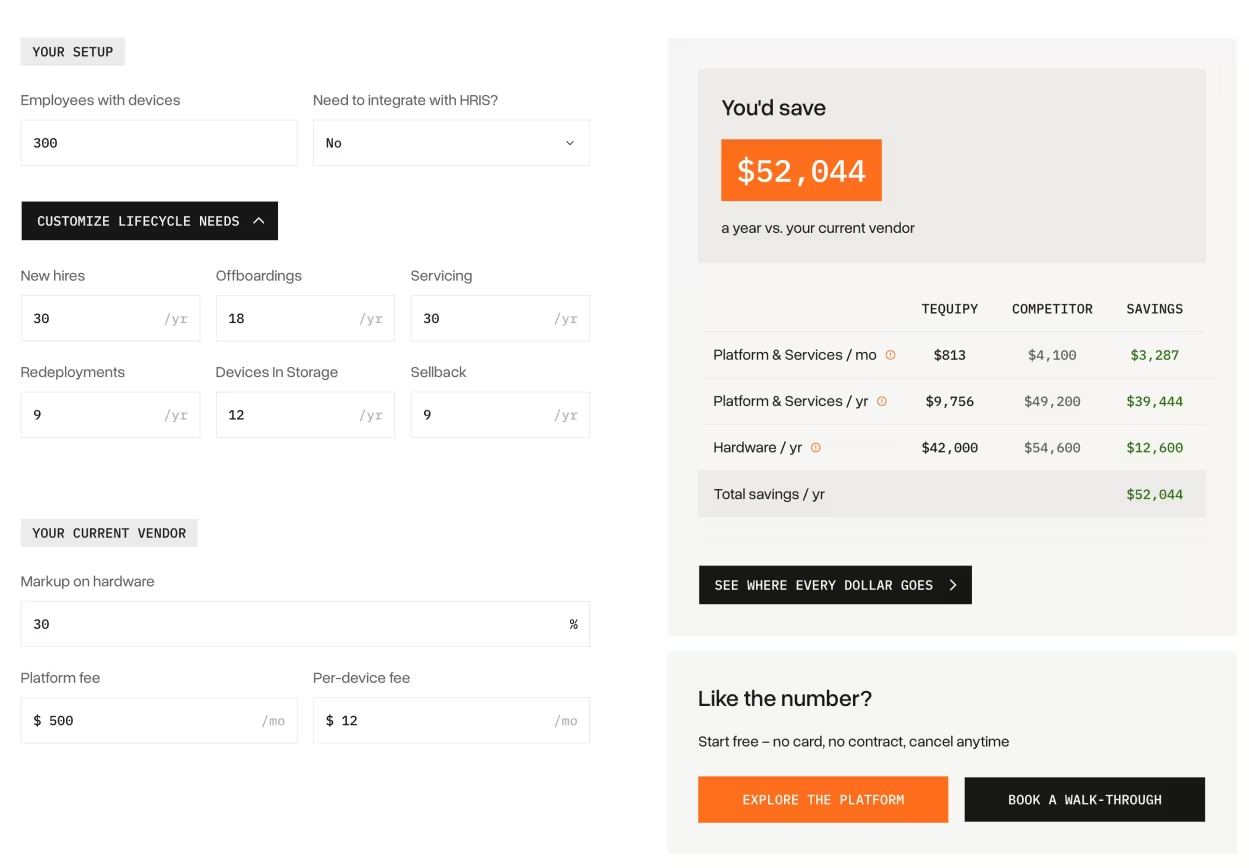
When physical steps are the bottleneck rather than the controls, price the route rather than the vendor. Run one hire through your hardest country and compare the all-in cost against your current path, or talk to Tequipy about that order.
{{cta-primary}}
CONCLUSION
What Is the IT Procurement Process?
The IT procurement process is the sequence a company follows to identify a technology need, specify it, source and price it, buy it, receive and deploy it, then manage the asset until retirement. It covers hardware, software and services. For a distributed team, sourcing and delivery split by country, and retirement becomes a logistics job.
FAQ
What are the main steps in the IT procurement process?
Six for hardware: identify the need, specify and approve a build, source and price it, order and receive it, configure and deploy it, then manage and retire the asset. CIPS runs a thirteen-step version ending in asset management.
What is the difference between IT procurement and IT purchasing?
Purchasing is the transaction: raise the order, receive the goods, pay the invoice. Procurement is the whole cycle around it, including specification, supplier selection, contract terms and asset management after delivery. Purchasing sits inside procurement.
Who is responsible for IT procurement in a company?
Usually shared. IT owns the specification, finance owns budget and payment, and a procurement or operations lead owns supplier selection. Below roughly 200 people, one person often holds several of those roles, which is the segregation problem to design around.
What should an IT procurement policy include?
Approved builds per role, the intake route and cut-off, approval thresholds, who may talk to suppliers, the three-document rule, data handling at offboarding, and the monthly metrics. ISO 20400 covers sustainable procurement, though it is guidance rather than a certifiable requirements standard.
How does IT procurement work for remote or distributed teams?
Sourcing moves in-country and retirement becomes shipping. A provider such as Tequipy buys through local resellers in 180+ countries, pre-configures devices for enrolment, then collects, stores, redeploys or resells them, including devices bought elsewhere.

Keep your current setup.
Just test us on one order.
AUTHOR
Before Tequipy, Tomek ran IT at Revolut, scaling from 100 employees in 2 offices to 5,000 across 17. He built the system that kept every laptop accounted for, then founded Tequipy – a platform that handles IT equipment logistics for distributed teams across 180+ countries.
As CEO, he runs operations and covers the founder layer: strategy, product, and the company-building that comes with both.
15 minutes. Your countries, your devices, your setup. No pitch.