KEY TAKEAWAYS
- Tequipy is the best laptop retrieval service for globally distributed teams – 99% device recovery rate, coverage in 180+ countries, courier pickup direct from the employee's door, and pricing at recommended retail price with no monthly platform fees. Best for: companies with remote employees across multiple countries,works whether you're hiring across 3 countries or 15+
- Workwize is best for US-centric companies, large teams with at least 150+ employees that want deep HRIS/MDM automation (80+ integrations) and are comfortable with a per-seat subscription. Be aware that retrieval coverage outside North America is materially limited.
- Firstbase is best for US, UK, EU, and Canada-based teams that want a polished lifecycle platform with leasing options – but comes with a substantial annual platform fee ($45K+) and gaps in Tier 2 regions (APAC, LATAM, MEA).
- GroWrk is best for US and LATAM-heavy teams that want a no-commitment, à la carte retrieval service without a subscription. Execution is strong in the Americas but uneven in other regions.
Your employee in Colombia just handed in their notice. The one in Kazakhstan is leaving next month. And somewhere in the Philippines, there's a company MacBook that's been sitting with an ex-employee for three months.
This is what poor laptop retrieval looks like in practice – and research shows only 71% of company-issued devices are successfully returned after employee offboarding. For a 200-person distributed team, that's nearly 60 laptops gone every cycle.
The best laptop retrieval services solve this with scheduled courier pickups, pre-paid return packaging, certified data wiping, and a full chain of custody – handled without IT having to chase anyone. In this guide, we compare the top options: what they do, where they work, what they cost, and who each one is actually built for.
How We Chose the Top Laptop Retrieval Services
We evaluated each service against four criteria that matter most to distributed IT and Ops teams:
Geographic coverage that actually works: not a headline country count, but real delivery and retrieval capability in the markets where remote teams actually hire: LATAM, APAC, Eastern Europe, the Middle East, and Central Asia.
Retrieval process quality: does the service handle courier scheduling, packaging, and employee communication, or does it push work back onto your team?
Total cost of ownership: hardware markup, platform fees, and per-retrieval pricing, not just the headline rate.
Data and security standards: certified data wiping, chain of custody documentation, and compliance certifications.
We cross-referenced vendor claims against verified customer reviews on G2, Capterra, and Trustpilot, as well as real-world feedback from IT and Ops teams across sales conversations.
7 Best Laptop Retrieval Services: Quickly Compared (NEW)
If your team is distributed across multiple countries and you need reliable retrieval with no surprises, Tequipy is worth testing first – no contract, no minimum, and your first order can go out in under 24 hours.
{{cta-primary}}
Tequipy: Best Laptop Retrieval Service for Global Remote Teams
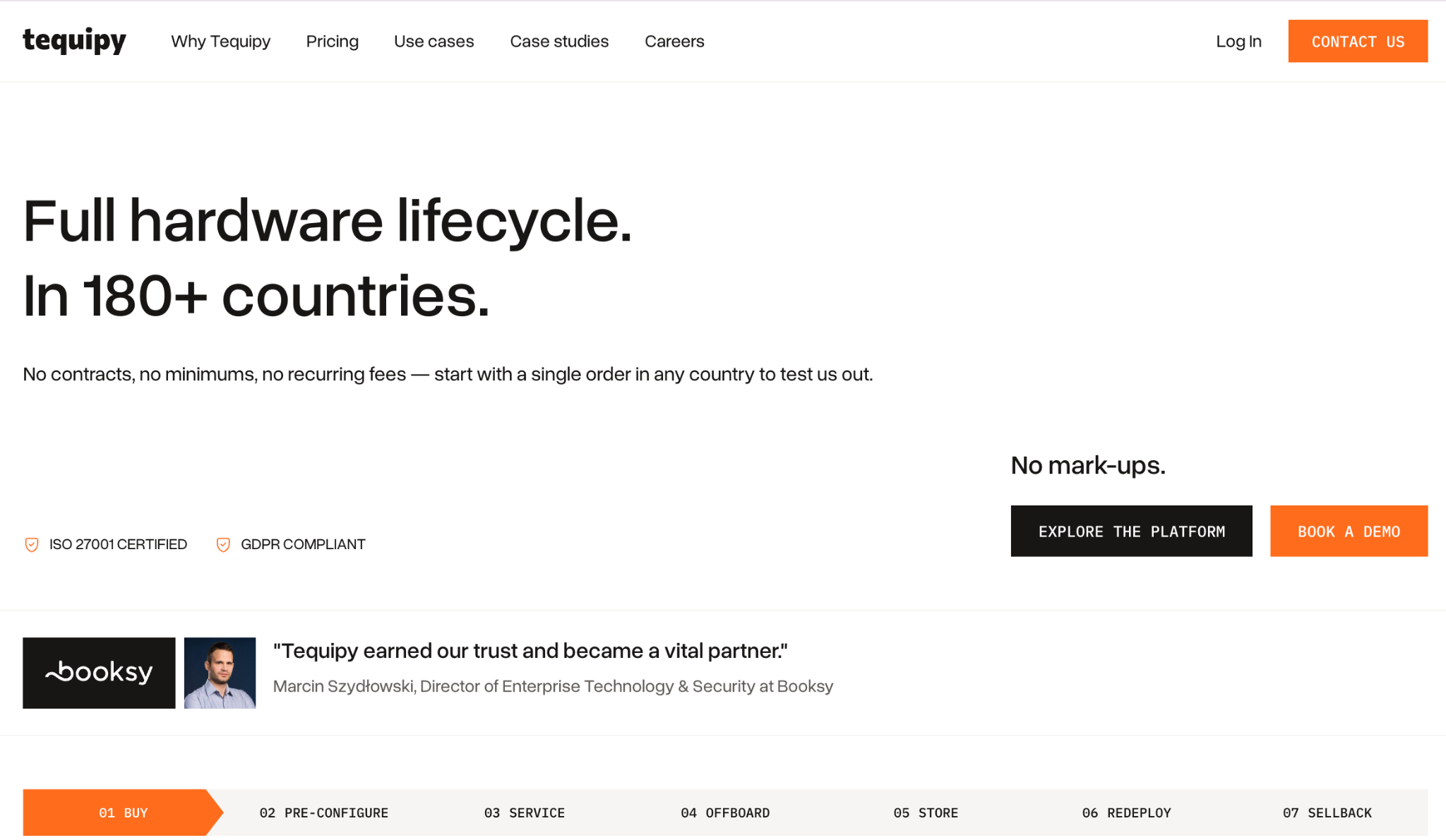
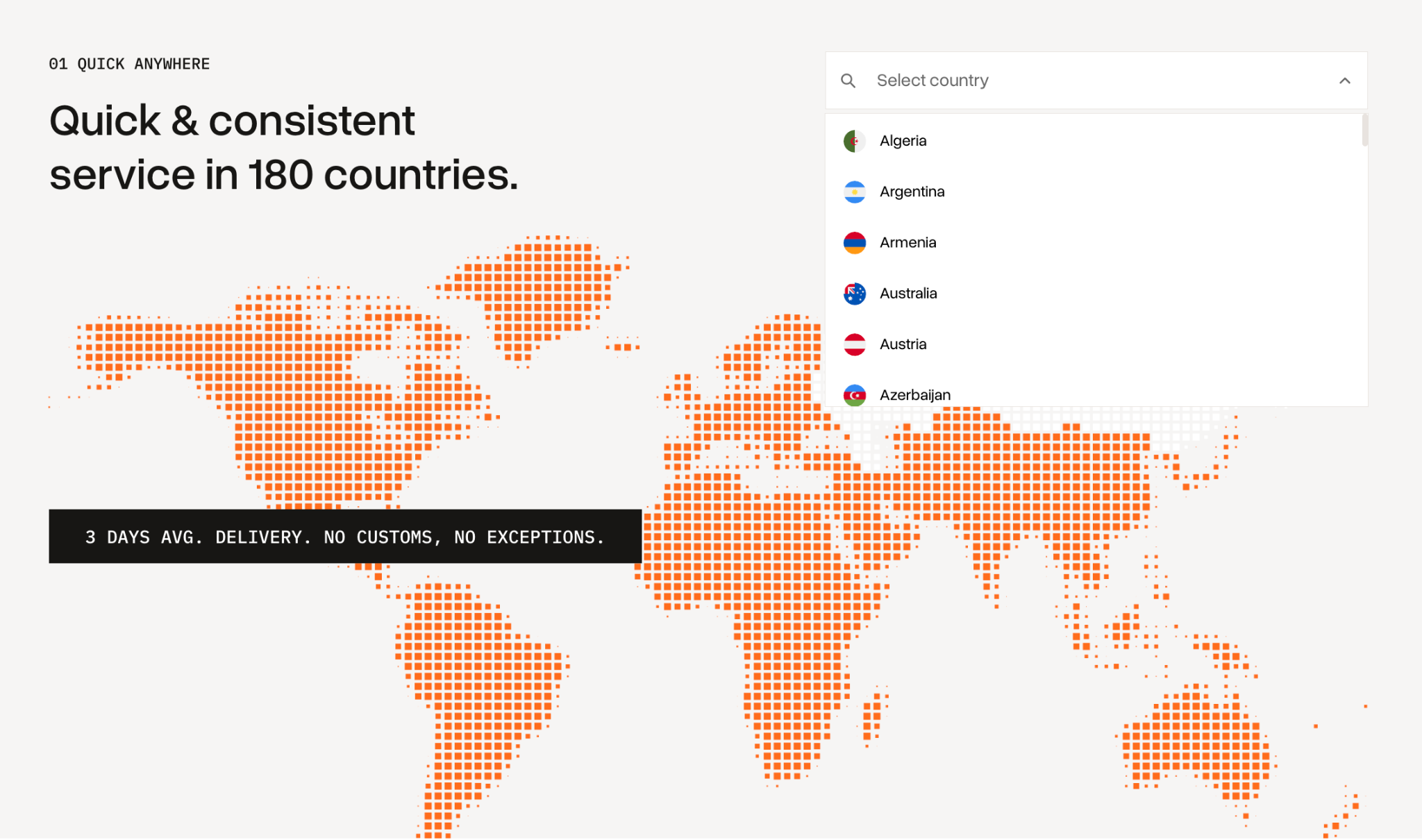
Tequipy is an end-to-end IT asset lifecycle management platform built for companies with employees in multiple countries, providing remote equipment management across the full device lifecycle. Unlike services that work smoothly in the US and then fall apart in Colombia or Kazakhstan, Tequipy sources devices locally through 600+ authorized resellers in 180+ countries – and retrieves them the same way: courier pickup from the employee's door, wherever they are.
The numbers that matter: 100% device recovery rate (vs. 71% market standard), 99% delivery before employee start date (vs. 58% market standard), and an average global delivery time of 3 business days. No monthly platform fees under 100 devices. No hardware markups. No long-term contracts.
Tequipy Key Features
Tequipy covers the full device lifecycle: buy, pre-configure, deploy, service, offboard, store, redeploy, and sell back. All services work on devices purchased through Tequipy or elsewhere – no lock-in.
Global Laptop Retrieval with 100% Recovery Rate
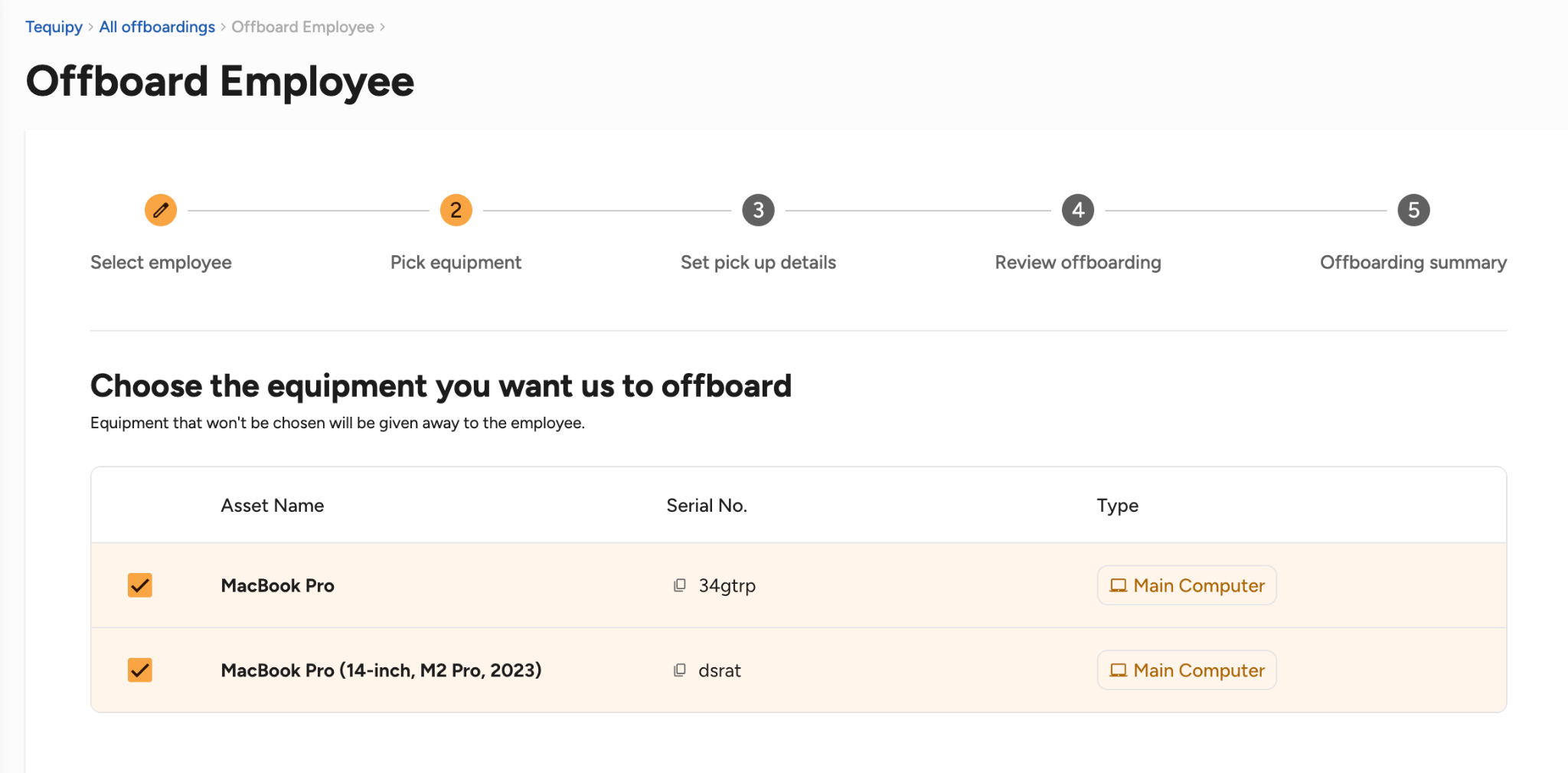
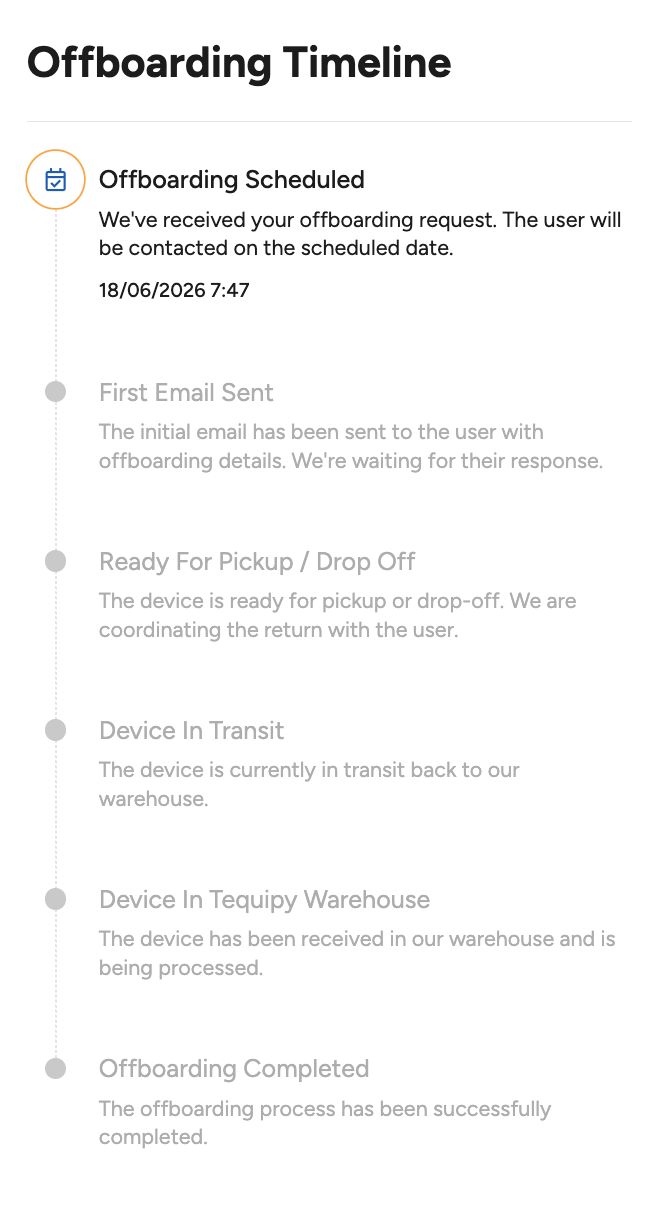
When an employee leaves, Tequipy handles everything: courier scheduling, packaging materials, pickup from the employee's home address, certified data wipe, and storage or redeployment. The full process can be managed through a laptop lifecycle management service without requiring the IT team to coordinate each step. The process runs in 180+ countries – including consistently difficult markets like Kazakhstan, Colombia, the Philippines, and Ukraine.
The industry average device recovery rate at offboarding is 71%, meaning roughly 3 in 10 company laptops disappear with departing employees. Tequipy's rate is 100% across its customer base. RemoFirst, an Employer of Record platform with employees across 30 countries, described the difference directly:
"Before working with them, we faced numerous logistical challenges – from figuring out how to collect and reset devices left behind after offboarding in Colombia, UK, or Kazakhstan." After switching to Tequipy: 100% recovery, every cycle.
The practical outcome: if a $1,500 laptop walks out the door with every 4th departing employee, a 200-person company loses roughly $7,500 per offboarding cycle in preventable asset losses. Tequipy customers report saving approximately $2,000 per employee in prevented losses (RemoFirst case study).
See how laptop lifecycle management handles retrieval at scale.
One-Click Offboarding: No Coordination Overhead
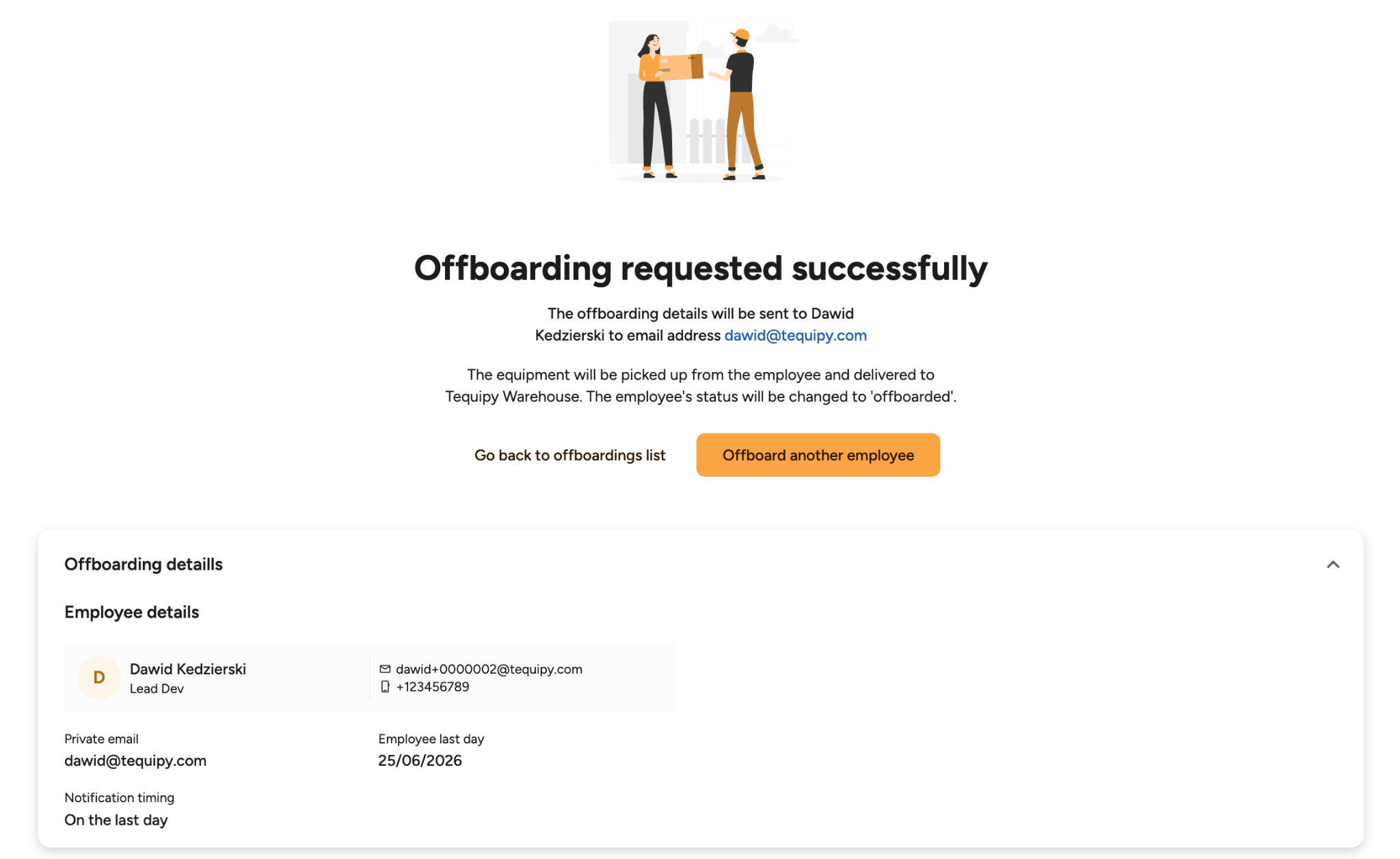
Most retrieval services require your IT team to chase courier schedules, send packaging, and follow up with departing employees. Tequipy automates the coordination layer. Once an offboarding is triggered (manually or via HRIS integration), the platform handles employee communication, courier booking, packaging dispatch, and status tracking – all visible in real time in one dashboard.
The impact on internal workload is measurable. TapTap Send, a fintech with 250+ employees across 13 countries, was running three separate procurement and offboarding processes before Tequipy. After consolidating: 40+ hours per month saved on IT management, $6,500/month in cost savings, and 100% device recovery across all geographies.
Gigs, a 100-person international startup, described managing IT logistics before Tequipy as "a constant headache." Post-Tequipy: "Now we don't have to worry about device logistics at all." The platform replaced what would otherwise have been a full-time IT logistics hire.
Dedicated Slack Channel: Retrieval Support That Responds in Minutes
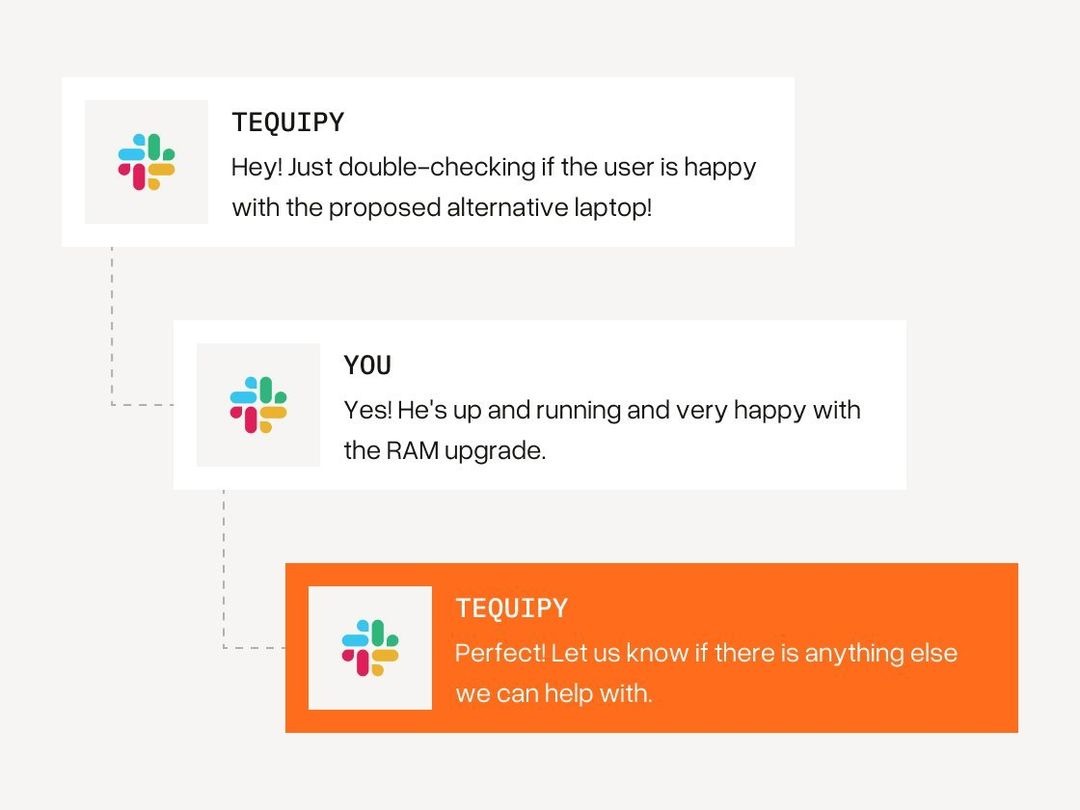
Every Tequipy customer gets a dedicated Slack channel with direct access to the team handling their account. Retrieval edge cases – a former employee who isn't responding, a courier issue in a non-standard country, a last-minute address change – get resolved in minutes, not via a ticketing system that takes days.
This is the most consistently cited strength across every Tequipy customer review.
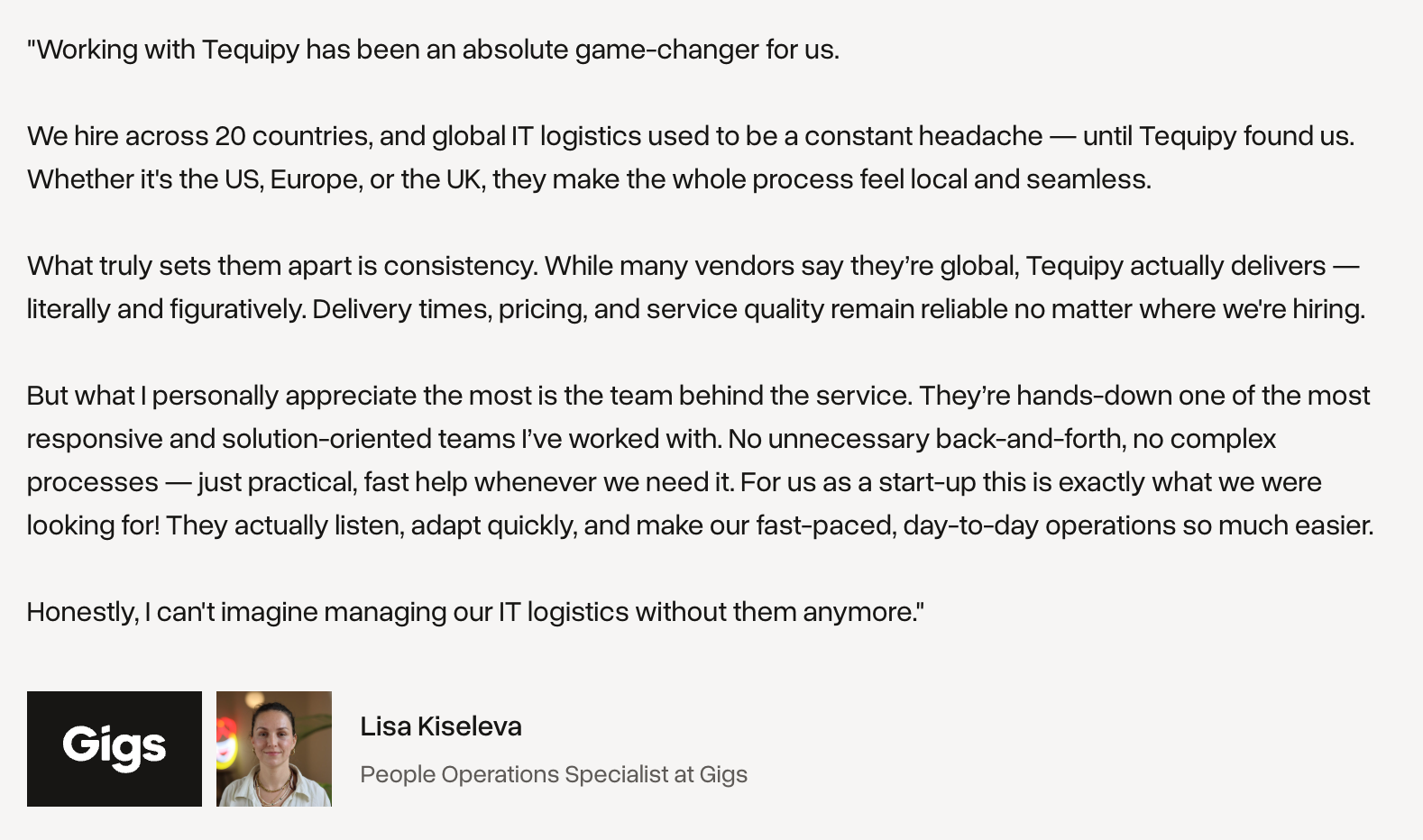
Gigs: "They're hands-down one of the most responsive and solution-oriented teams I've worked with. No unnecessary back-and-forth, no complex processes – just practical, fast help whenever we need it."
Booksy: "What sets them apart is their incredible responsiveness and true global reach."
For retrieval specifically, where timing matters (recovering a device before an ex-employee moves or discards it), the difference between a response in 10 minutes vs. two days is a device recovered vs. a device lost.
Tequipy Pricing
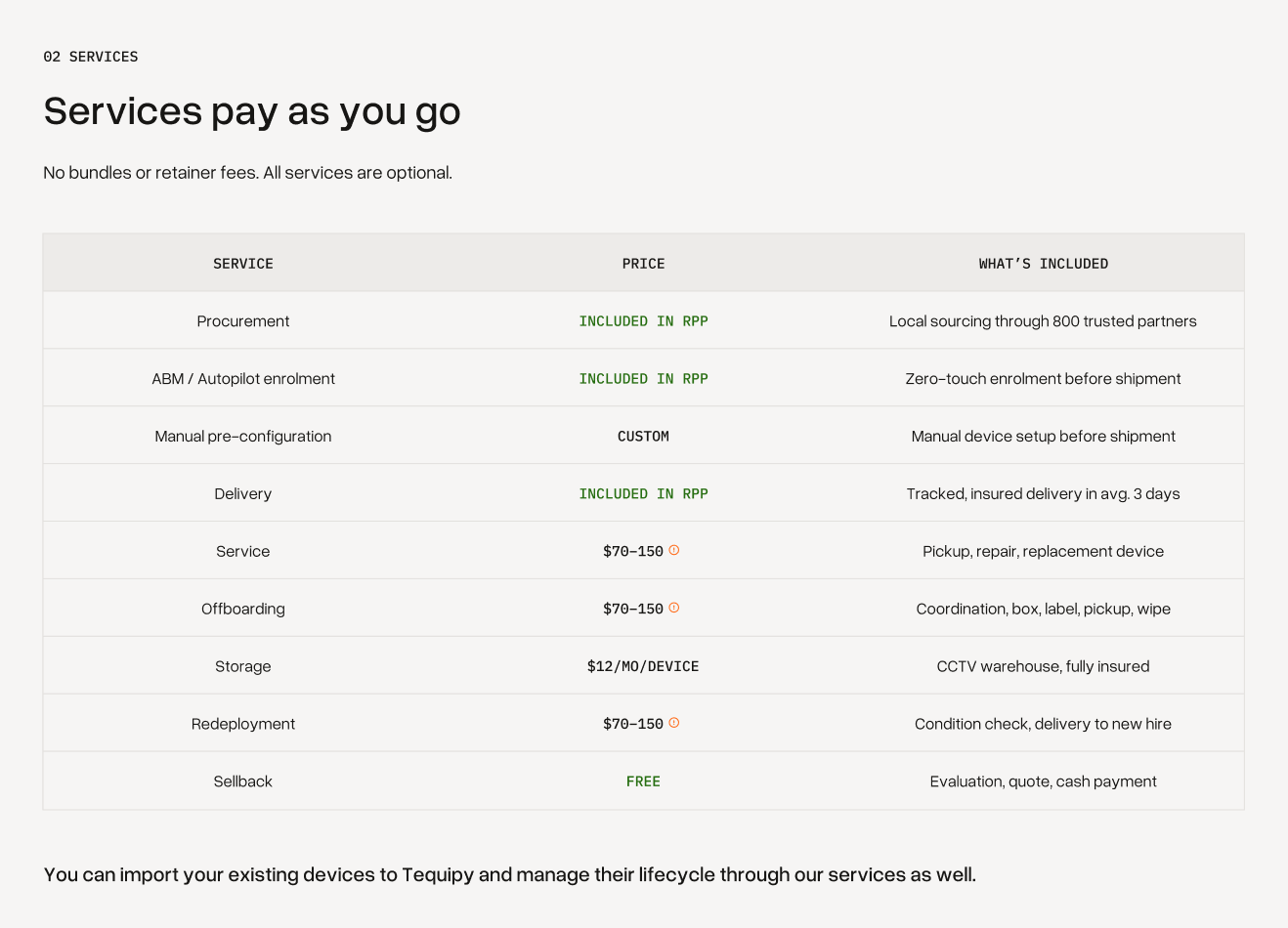
All pricing is pay-as-you-go. No annual commitment, no upfront services bundle, no per-seat fee.
Where Tequipy Shines
- 100% retrieval rate in 180+ countries: The only service in this list with a verified 100% global device recovery rate, including markets that other platforms explicitly don't cover (Central Asia, Caucasus, most of LATAM, Philippines). No pre-stocking required.
- RRP hardware pricing with no recurring platform fees: A $1,800 MacBook costs $1,800. No monthly per-seat subscription, no services retainer billed upfront. You pay for offboardings, storage, and redeployments when you use them – not as a standing commitment.
- Start in under 24 hours, no contract: Account setup takes less than a day. Place one retrieval order in any country and see the service for yourself before committing anything further.
Where Tequipy Falls Short
- No hardware leasing: Tequipy sells devices at RRP outright – it doesn't offer 36-month Device-as-a-Service financing. If converting hardware from CapEx to OpEx via leasing is a priority, Fleet or Firstbase are better fits.
- Fewer native HRIS integrations than some competitors: Tequipy works alongside your existing MDM (Jamf Pro / Jamf Now, Iru (Kandji), Microsoft Intune, Mosyle, Hexnode, and any other ABM‑compatible MDM solution) and integrates with major HRIS systems (HiBob, BambooHR and Workday, but the native integration catalogue is smaller than some of the competitors. If deep, automated workflow integration across a large HR tech stack is the primary use case, that's worth evaluating.
Tequipy Customer Reviews
"We've been partnering with Tequipy for over two years, and their support has been invaluable. They assist us with laptop deliveries, repairs, MDM, and retrievals across 30 countries where our team members are located. Before working with them, we faced numerous logistical challenges... Their team handles all of this smoothly and stress-free." – Lera Lykholiet, People Operations Specialist, RemoFirst

"Working with Tequipy has been an absolute game-changer for us. We hire across 20 countries, and global IT logistics used to be a constant headache – until Tequipy found us. I can't imagine managing our IT logistics without them anymore." – Lisa Kiseleva, People Operations Specialist, Gigs
Who Tequipy Is Best For
- Globally distributed teams with employees in hard-to-reach countries: If your workforce includes people in LATAM, Southeast Asia, the Middle East, Eastern Europe, or Central Asia – and you need to get equipment back from terminated employees reliably in all of those places – Tequipy is built specifically for this.
- IT and Ops teams that want to stop managing vendor relationships: Tequipy replaces a patchwork of local procurement and retrieval vendors with one Slack channel and one invoice. Companies like TapTap Send went from three separate procurement processes to one platform.
- Teams that want to test before committing: No contract, no minimum, no platform fee under 100 devices. Place one retrieval order in any country before deciding.
- Finance-conscious teams tired of markups and retainers: If you're currently paying a per-seat platform subscription or seeing 25–45% hardware markups, the cost comparison is worth running.
Workwize: Best for US-Centric Teams with Large HRIS/MDM Stack
Workwize is an Amsterdam-based IT asset management platform covering procurement, deployment, retrieval, and disposal. Founded in 2021 and backed by $15.4M in funding (including a $13M Series A in January 2025), it positions itself as a full-lifecycle solution for companies with 150+ employees. Its strongest card is integration depth: 80+ native HRIS and MDM connectors that automate onboarding and offboarding workflows in ways few platforms match.
Where it struggles is outside its warehouse hubs. Workwize runs a hybrid model: 13–14 regional warehouses for fast fulfillment, and a supplier network for everywhere else. For retrieval specifically, the company's own internal maps show decommissioning coverage shrinking to roughly 15–20 countries – a fraction of the 100+ countries marketed on its homepage.
Workwize Key Features
End-to-End Lifecycle Management
Workwize covers the full device lifecycle: procurement, MDM/ABM/Autopilot enrollment, deployment, repair (with replacement device shipped during repair), retrieval, certified data wiping, refurbishment, redeployment, and disposal. Devices can recover up to 45% of their original value through Workwize's resale program. Both Workwize and Firstbase cover the full device lifecycle, but their approach to retrieval, coverage, and resale differs. See how they compare in Firstbase vs Workwize.
One important caveat on retrieval: the platform's published "100+ countries" coverage applies to new-device shipping via the supplier network. Retrieval and decommissioning coverage is materially narrower: Workwize's own service maps show the decommission layer covering approximately the US, UK, Netherlands, Germany, France, Italy, parts of Scandinavia, Brazil, South Africa, India, and a few others.
In countries without a warehouse, the retrieval fallback is a shipment to a local office – not the productized courier-pickup-from-home flow that distributed teams need.
Learn how providing laptops to employees works across the full device lifecycle.
Deep HRIS and MDM Integration
This is Workwize's most differentiated feature. The platform integrates natively with 80+ HRIS systems – Workday, HiBob, BambooHR, Personio, Rippling, Gusto, ADP, UKG, Okta, JumpCloud, Microsoft Intune, Jamf, and many others.
When connected, onboarding and offboarding workflows trigger automatically: a new hire in HiBob fires a device order; a departure in Workday triggers a retrieval request. For IT teams that have already invested in a large HR tech stack, this automation layer is genuinely valuable.
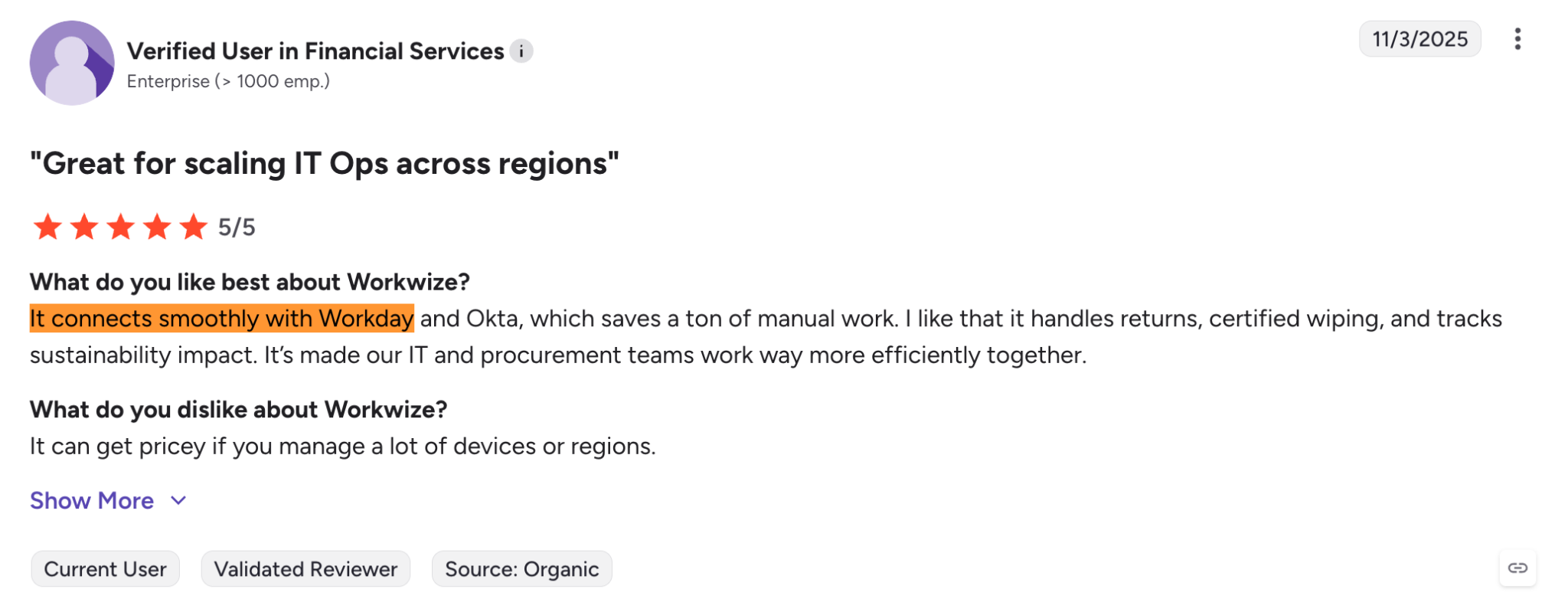
One G2 reviewer from a financial services company summarized it: "It connects smoothly with Workday and Okta, which saves a ton of manual work." Another described it as: "New hires get their stuff automatically, and offboarding happens without anyone from IT getting involved."
Self-Service Employee Portal
Employees can access Workwize's branded storefront to view their equipment, request peripherals, or initiate a return. IT admins control catalog contents and can pre-define approved equipment by role or department. The portal reduces inbound requests to the IT team for routine hardware tasks.
Workwize Pricing
Workwize pricing is not publicly disclosed – all figures are sourced from verified user reports on G2, Capterra, Reddit, and direct sales conversations, giving Workwize reviews added context around the platform’s actual cost. A 150-seat Professional deployment costs approximately €35,100/year in platform fees alone, before hardware markups and any line-item add-ons (shipping, warehouse, packaging fees – all reported by multiple users).
Where Workwize Shines
- HRIS/MDM integration breadth: 80+ native integrations is the deepest catalogue in this comparison. If your HR tech stack includes multiple systems and you want automatic trigger-based onboarding and offboarding, Workwize leads the field.
- Strong US performance: Multiple reviewers confirm the service works reliably in the US. Fast dispatch, accurate orders, and solid account management are consistently noted for American operations.
Where Workwize Falls Short
- Retrieval coverage collapses outside warehouse hubs: Users report 4–6 week delivery times in Europe and India, a one-month failure to deliver in Central Europe (Trustpilot), and a terminated contract after coverage failures in Egypt. The 100+ country headline does not apply to retrieval.
- Expensive and opaque: A 30% hardware markup, per-seat monthly fees, and additional line items for shipping, warehousing, and packaging have been flagged across multiple independent reviews. One Reddit user described it as: "They nickel and dime you to death."
Workwize Customer Reviews
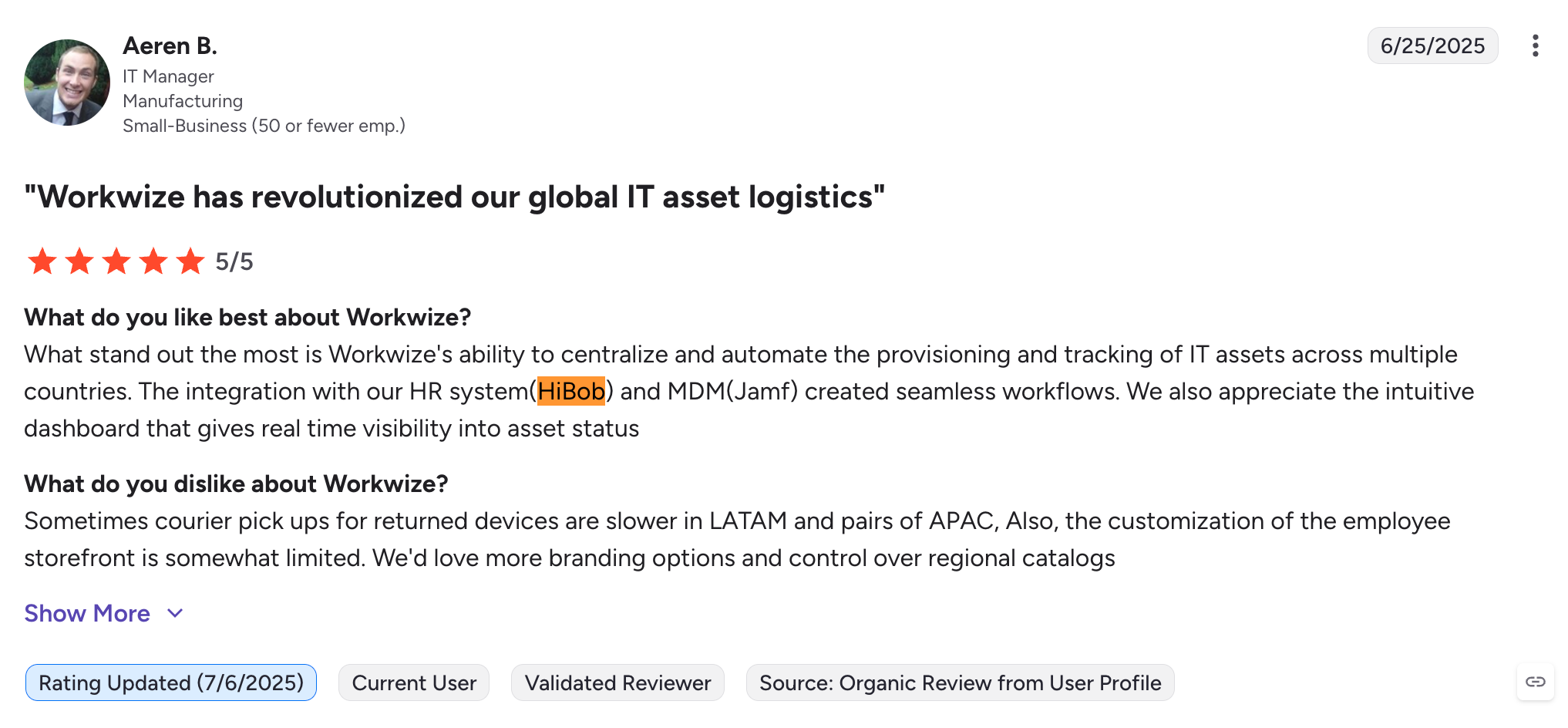
"The integration with our HR system (HiBob) and MDM (Jamf) created seamless workflows. We also appreciate the intuitive dashboard that gives real-time visibility into asset status." – Aeren B., G2
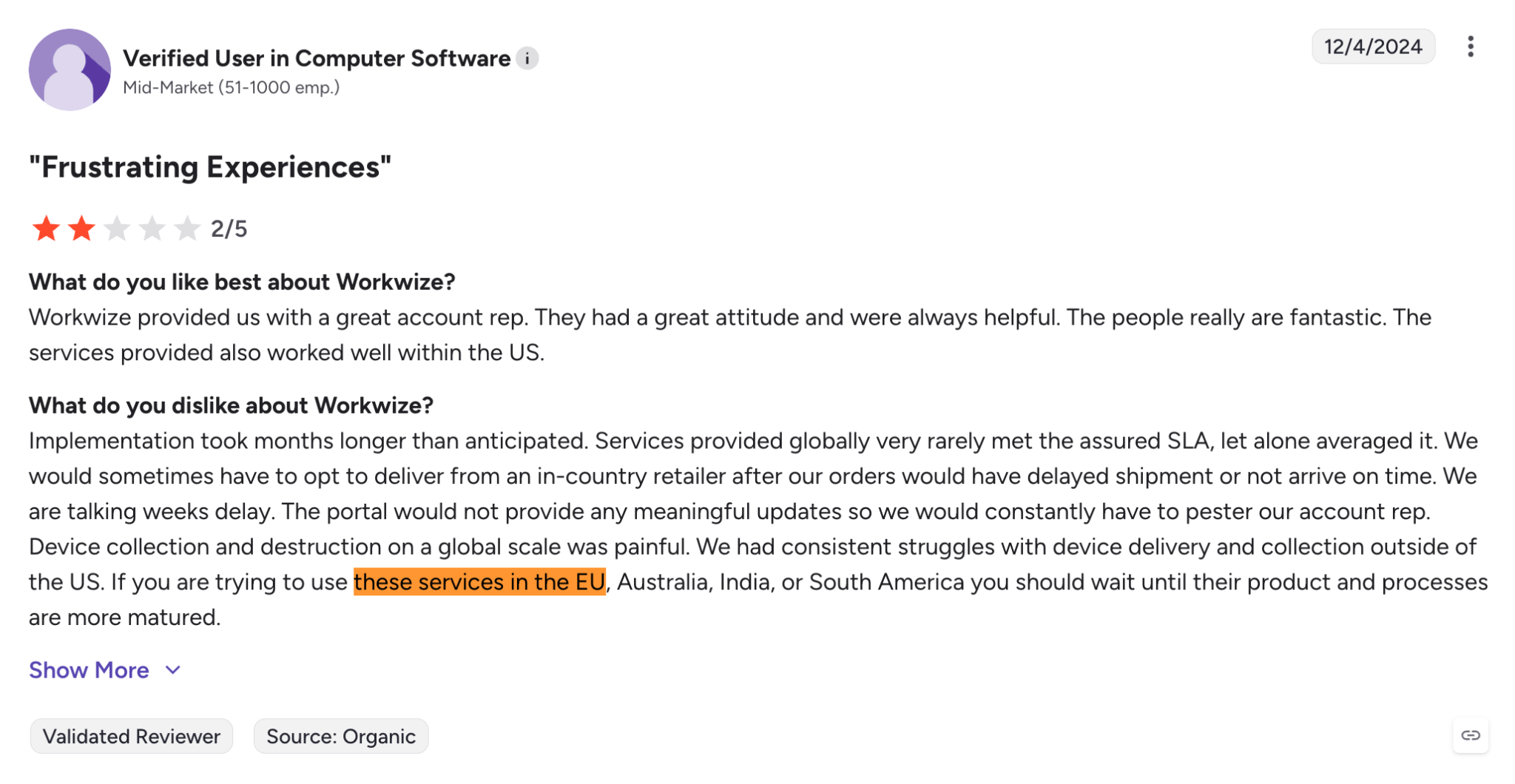
"If you are trying to use these services in the EU, Australia, India, or South America you should wait until their product and processes are more matured." – Verified Computer Software user, G2 (2/5 stars)
Who Workwize Is Best For
- US-centric companies with 150+ FTE that want deep HRIS/MDM automation and are comfortable paying a per-seat platform subscription.
- Teams for whom integration breadth is the #1 priority – if connecting Workday, HiBob, Rippling, Okta, and Jamf into a single automated workflow is the core requirement, Workwize has the deepest connector library.
- Not recommended for: teams with significant headcount in APAC, LATAM (outside Brazil), the Middle East, Eastern Europe, or Central Asia, or teams that want to start with a low-commitment pilot before locking into an annual contract.
Firstbase: Best for US/UK/EU Teams That Want Leasing Options
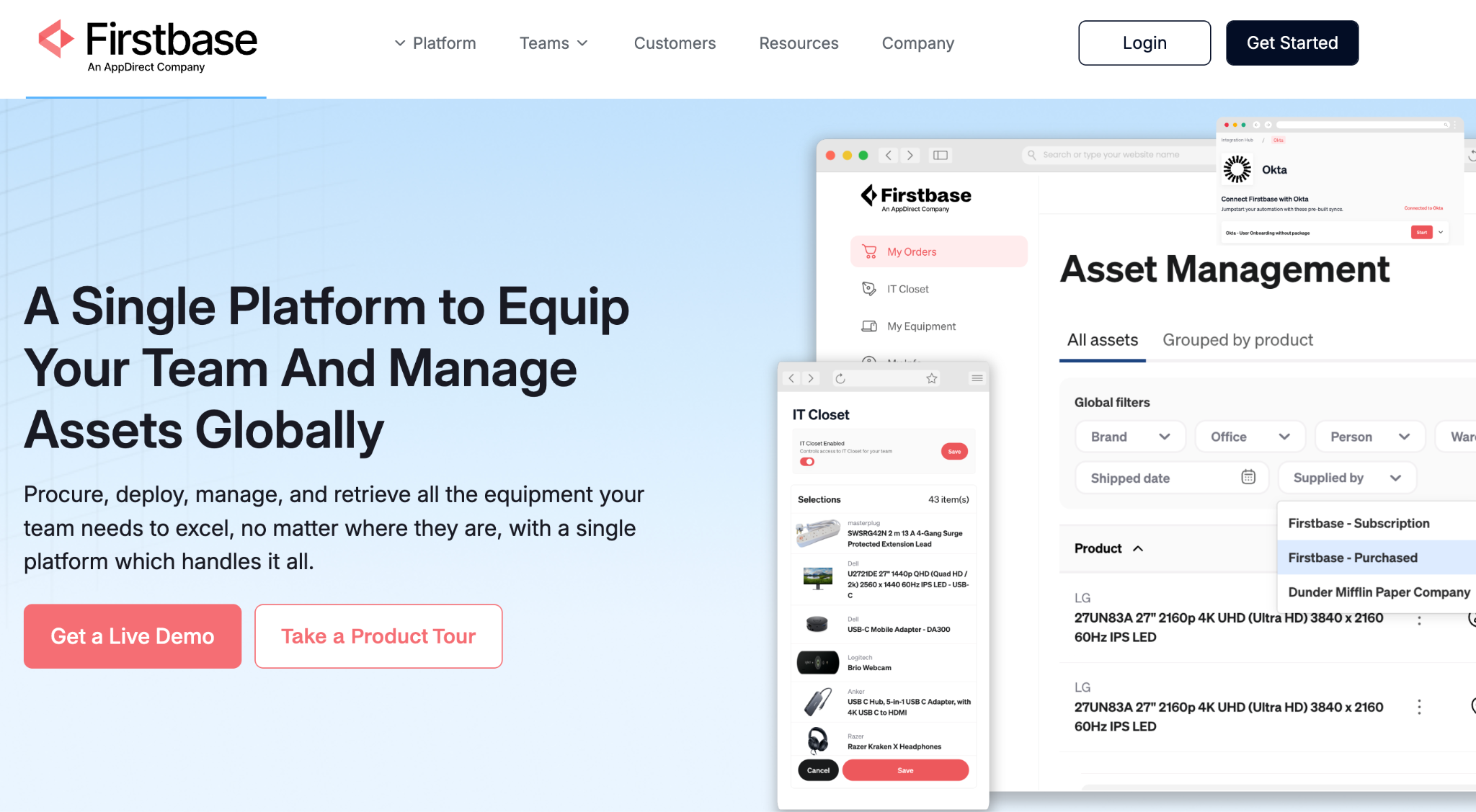
Firstbase is an IT asset management platform acquired by AppDirect in December 2024. It covers the full device lifecycle – procurement, zero-touch deployment, retrieval, certified data wiping, storage, redeployment, and ITAD – across what it describes as 150+ countries, with three procurement models: outright purchase, lease (24–36 month HaaS terms), and bring-your-own-device management.
In the four core regions – US, UK, EU, and Canada – Firstbase operates its own warehouses and delivers on its marketing claims reliably. Outside those regions (Tier 2: APAC, LATAM, MEA), the service is mediated through third-party partners, with material capability gaps: no BYOD shipments accepted, custom imaging not available, and returns processing limited to laptops and docks only.
Despite the "150+ country" headline, Firstbase's own support documentation openly describes this two-tier model.
Firstbase Key Features
Automated Retrieval Kits with 97%+ Recovery Rate
Firstbase's headline retrieval statistic is a 97%+ recovery rate – above the 71% industry standard but below Tequipy's 100%. The retrieval flow is well-regarded: when an employee offboards, Firstbase dispatches a kit with pre-paid return label, secure packaging, and step-by-step instructions. The employee drops it off or schedules a pickup; Firstbase handles wiping (NIST 800-88 compliant), storage, and redeployment.
Multiple G2 reviewers confirm this works well in Tier 1 regions. One IT specialist described it as: "When we have to collect a machine, Firstbase sends the whole return kit. It saves us the equivalent of an FTE every year." An IT support reviewer noted the retrieval process is particularly useful in difficult offboarding situations: "FirstBase acts as an effective intermediary between the company and the departing user."
In Tier 2 regions, retrieval is limited to laptops and docks only – no monitors, phones, or peripherals – and ITAD certificates of destruction are not available in five LATAM warehouses (Brazil, Mexico, Argentina, Colombia, Guatemala).
Zero-Touch Deployment with HRIS Integrations
Firstbase pre-enrolls devices in ABM (Apple Business Manager) or Windows Autopilot before they leave the warehouse, and integrates with 20+ HRIS systems including Workday, BambooHR, HiBob, ADP, Okta, and Rippling. A new hire created in the HRIS can trigger an automatic equipment package assignment and ship. One G2 reviewer described their Okta integration: "It creates new hire user accounts and auto-assigns equipment packages based on an employee's role or department, cutting down our manual work."
ITAD and Device Resale
Firstbase's ITAD program includes data wiping (Blancco), certified destruction, and remarketing – the company claims customers recover 40–65% of original device value through automated refurbishment and resale, applied as quarterly resale credits. This is one of the stronger end-of-life programs in the category, though it's only fully operational in Tier 1 markets.
Firstbase Pricing
Firstbase pricing is contact-sales only. The figures above come from a verified PriceLevel buyer report for a 501–1,000 employee US company, negotiated down from a $220,000 list price to $170,000/year. A Tequipy sales conversation with a long-term Firstbase customer described the entry commitment as "$80,000 just to sign with them, plus $100,000 action plans for prepaid services."
Where Firstbase Shines
- Best-in-class platform UX and customer support in Tier 1: Firstbase consistently earns some of the highest review scores in the category (G2: 4.8/5, 50 reviews). Reviewers cite an intuitive admin interface, excellent customer success management, and a product team that actively incorporates feedback.
- Hardware leasing (HaaS): Firstbase is one of the few platforms in this list offering genuine 24–36 month leasing across US, UK, EU, and Canada. For finance teams that want to move hardware off the balance sheet, this is a real differentiator.
Where Firstbase Falls Short
- Expensive entry commitment, no pilot path: There is no free trial, no single-order entry point, and no contract shorter than annual. Getting started with Firstbase means committing six figures before shipping a single device. Reddit users report being rejected outright for being too small.
- Tier 2 coverage gaps are documented: Multiple G2 reviews, Tequipy sales calls, and Firstbase's own support documentation confirm material retrieval limitations in APAC, LATAM, and MEA. Users report having to find Firstbase alternatives in markets that fall outside its warehouse footprint.
Firstbase Customer Reviews
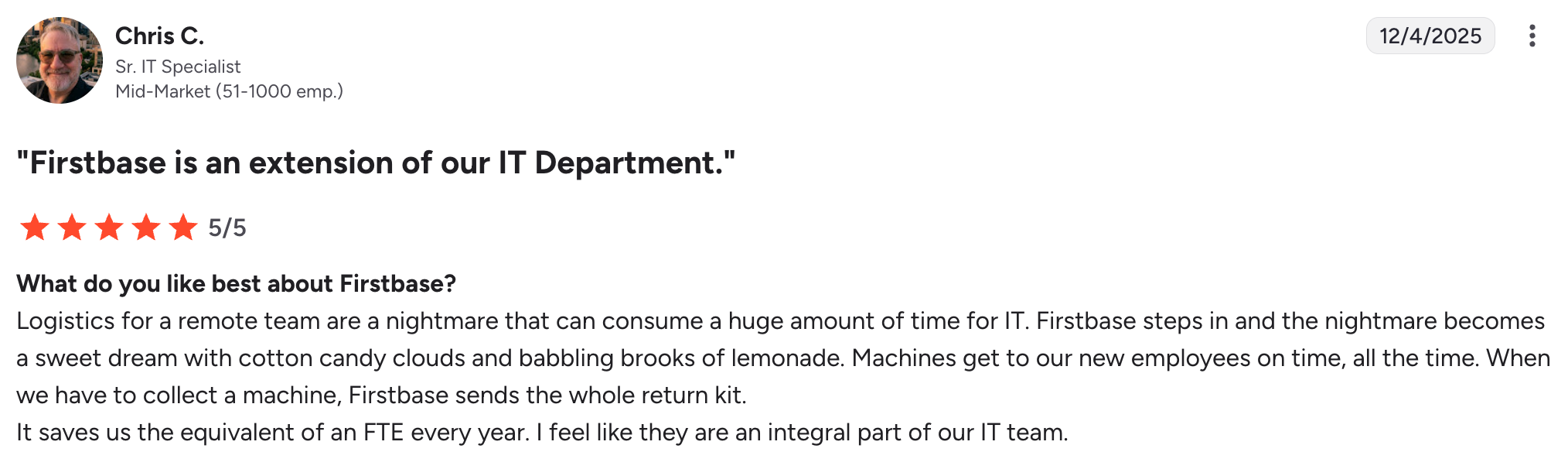
"It saves us the equivalent of an FTE every year. I feel like they are an integral part of our IT team." – Chris C., Sr. IT Specialist, G2
"As we grow in new markets, Firstbase isn't always available yet – we occasionally have use cases where Firstbase simply isn't an option." – John J., IT Support Engineer, G2

Compare Firstbase reviews before committing to a long-term lease.
Who Firstbase Is Best For
- Mid-to-large companies (200+ employees) operating primarily in the US, UK, EU, or Canada that want a polished lifecycle platform with leasing options and can absorb a $45K+ annual platform fee.
- Companies that prioritize hardware-as-a-service financing – Firstbase's 24–36 month leasing model is genuinely useful for teams that want predictable OpEx over upfront hardware CapEx.
- Not recommended for: companies with significant headcount in APAC, LATAM, MEA, or Eastern Europe; smaller teams for whom the platform-fee floor isn't justifiable; or any team that needs a low-commitment pilot before signing.
GroWrk: Best À La Carte Retrieval for US and LATAM Teams
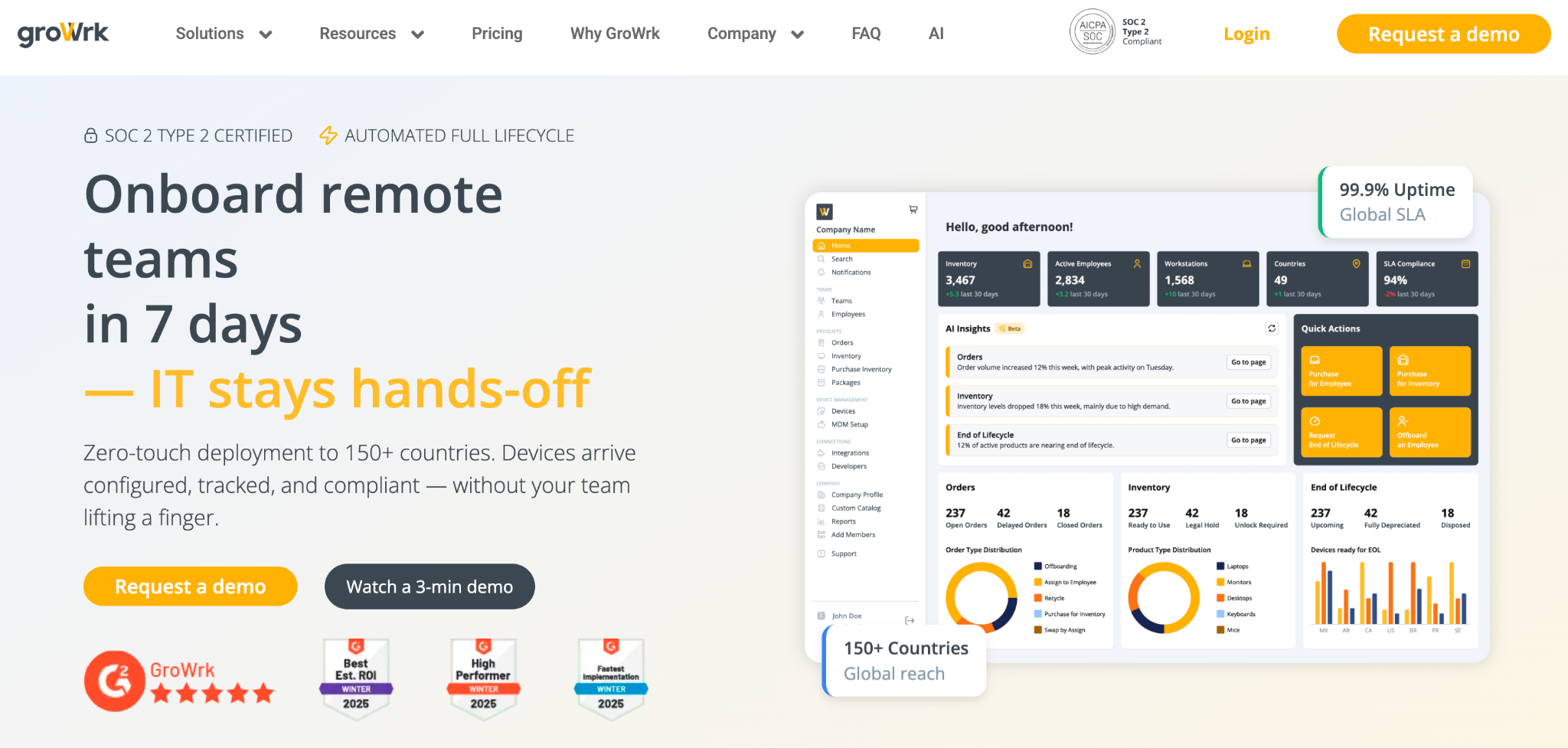
GroWrk is a San Diego-based IT lifecycle platform serving distributed teams across 150+ countries. Founded in 2019 and operationally bootstrapped since 2022 (cash-flow positive per investor Hustle Fund), it runs two commercial models side by side: a free À La Carte tier with pay-per-order pricing, and a Flex subscription with a 12-month contract and per-workstation monthly fee.
For teams that only need retrieval, storage, and procurement without a subscription commitment, the À La Carte tier is genuinely competitive.
The platform's strongest documented performance is in the US and LATAM – particularly Chile, Colombia, Brazil, Argentina, and Uruguay, where multiple G2 reviewers confirm consistent, reliable service.
Outside those regions, execution is less predictable: documented failures in Egypt (contract terminated), Central Europe (one-month delivery failure), and India (2-week SLAs requiring daily follow-up).
GroWrk Key Features
À La Carte Retrieval – No Contract Required
GroWrk's À La Carte tier covers global procurement, device retrieval, storage, global logistics, pre-configuration, remote wiping, and basic MDM enrollment – all with no platform fee, no workstation fee, and no contract. Offboardings are billed per transaction. This is the closest structural equivalent to Tequipy's model among the competitors in this list, and it's the right tier to evaluate for teams that want to test retrieval before committing to anything.
The À La Carte tier does not include MDM zero-touch deployment, HRIS integrations, a dedicated Customer Success Manager, the Employee Dashboard, multi-subsidiary billing, or buy-back services. All of those features require upgrading to Flex, which adds a 12-month contract and a per-workstation monthly fee.
Strong LATAM Coverage
GroWrk's most distinctive geographic strength is Latin America. Multiple G2 reviewers specifically call out reliable service across Chile, Colombia, Brazil, Argentina, and Uruguay. For companies hiring heavily in LATAM who need a no-commitment option for retrieval, GroWrk's À La Carte tier is a credible choice.
One reviewer with 3+ years on the platform described it: "My team members whether they are in Chile, Colombia, Brazil, Argentina, Uruguay – I can expect they'll receive similar service."
Dedicated Customer Success Management (Flex Only)
Flex customers get a named CSM who acts as the operational point of contact for all procurement, retrieval, and lifecycle questions. This is the feature most praised in GroWrk's G2 reviews – 18 out of 33 reviewers specifically mention customer support quality. The important caveat: this experience is locked behind the Flex subscription. À La Carte users don't get a dedicated CSM.
GroWrk Pricing
Hardware pricing is not publicly disclosed. A current GroWrk customer in a Tequipy sales conversation gave a specific comparison: a MacBook costing $1,700–$1,800 direct was quoted by GroWrk at $2,500–$2,600 – a $700–$800 markup per device, roughly 40–45%.
Where GroWrk Shines
- True no-commitment entry on À La Carte: Free platform access, pay-per-transaction retrieval and procurement, no contract. The lowest-friction way to test a retrieval service outside of Tequipy.
- Reliable LATAM performance: Consistently praised for US and LATAM coverage. For companies whose remote workforce is concentrated in the Americas, GroWrk's À La Carte tier is a genuinely viable option when comparing GroWrk alternatives.
Where GroWrk Falls Short
- Hardware markup of 25–45% is the category's worst-documented cost problem: Multiple independent sources – G2 reviewers, Reddit users, and direct Tequipy sales conversations – confirm GroWrk's hardware pricing runs well above RRP. One G2 reviewer described it as "often 2–3 times more expensive than buying it yourself." One Reddit user flagged that initial quotes didn't reflect total costs – "which just felt very deceptive."
- Execution outside US and LATAM is inconsistent: Egypt (contract terminated after service failure), Central Europe (one-month delivery failure), India (2-week SLAs). A 4–5 year GroWrk customer described a recent shipment that "took two months to get out the door."
GroWrk Customer Reviews
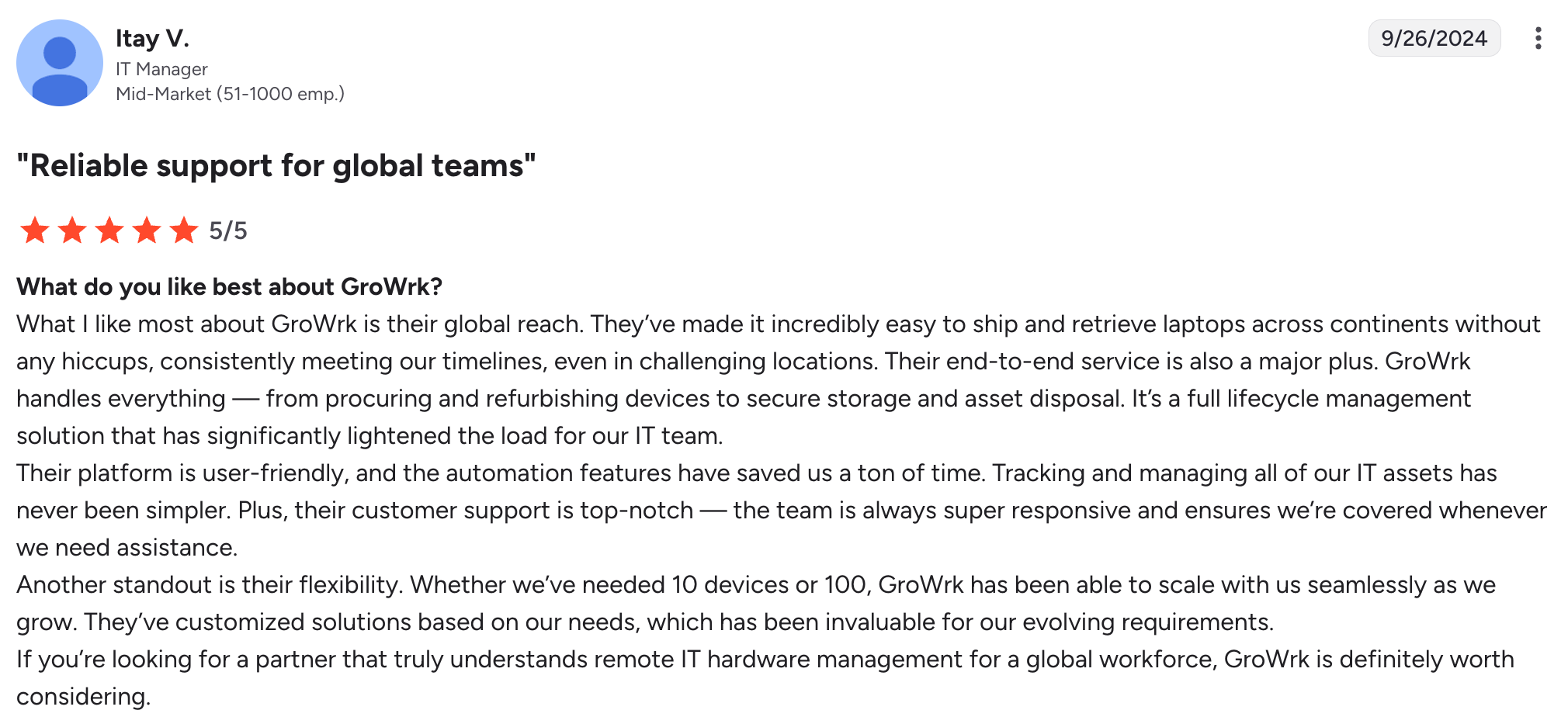
"GroWrk handles everything – from procuring and refurbishing devices to secure storage and asset disposal. It's a full lifecycle management solution." – Itay V., G2
"For our company the experience has been terrible, and overpriced. Prices that we were initially quoted didn't include the total costs, which just felt very deceptive." – u/bobotiger, r/sysadmin
Who GroWrk Is Best For
- US and LATAM-focused teams that want a no-commitment retrieval option: The À La Carte tier is a fair, low-friction starting point for companies whose hiring map is concentrated in North and South America.
- Teams evaluating Flex carefully: If your needs include MDM zero-touch, HRIS integrations, or a dedicated CSM, Flex may be worth evaluating – but test the hardware pricing and delivery times in your specific countries before signing a 12-month contract.
- Not recommended for: companies prioritizing hardware pricing transparency, teams with significant presence in APAC, Eastern Europe, the Middle East, or Africa, or any team that has been burned by opaque international logistics costs.
Deel IT (prev. Hofy): Best for Companies Already on Deel
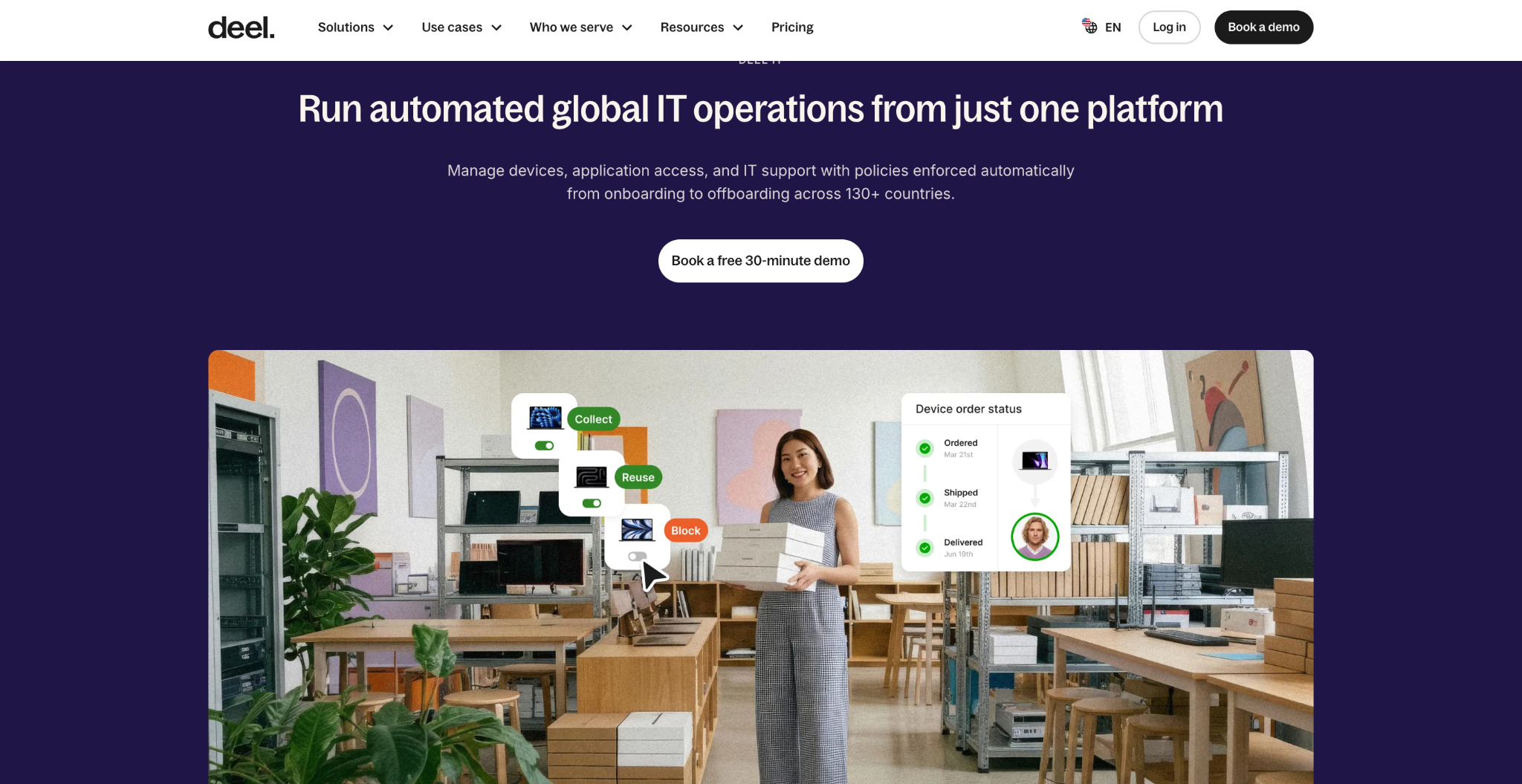
Deel IT is the hardware and device lifecycle arm of Deel – the workforce management platform serving 37,000+ companies across EOR, contractors, payroll, and benefits. Formerly known as Hofy (acquired July 2024, rebranded September 2024), Deel IT covers procurement, MDM pre-configuration, deployment, retrieval, storage, redeployment, and certified data erasure across 130+ countries, covering the core stages of device lifecycle management.
Its single biggest advantage – and the only reason to choose it over a standalone IT vendor – is the native integration with the broader Deel platform. If your company already uses Deel for EOR, contractors, or payroll, Deel IT means equipment logistics happen in the same portal, triggered by the same offboarding events, without a separate vendor relationship. That consolidation value is real.
Outside that specific context, Deel IT's pricing structure is as follows: a 25% published hardware markup that frequently reaches 40–50% in practice, per-seat platform fees billed upfront annually, a 12-month minimum contract on the purchase product, and a 36-month term on the lease product with 6-month prepayment. Multiple customers describe being effectively locked in by pre-paid service credits they can't use.
Deel IT Key Features
Deel Ecosystem Integration: Onboarding, offboarding, contractor conversion, payroll events, and equipment management all live in one portal. This is the moat – for Deel-native companies, adding IT to the relationship means no additional tool, no additional login, no additional vendor to manage.
MDM Pre-Configuration and Native Modules: Devices arrive enrolled in ABM or Autopilot. Deel also sells native MDM ($11/user/month), IAM ($13/user/month), and endpoint protection modules as add-ons to the core platform.
130+ Country Coverage: Broadly confirmed, with documented gaps in specific markets – Armenia not covered, EU-to-UK shipping failures, inconsistent execution in Colombia and India.
Deel IT Pricing
A real Deel IT quote for a 130-employee company came to $18,192 upfront for the first year – before a single device was ordered.
See how Hofy alternatives compare on pricing and flexibility.
Where Deel IT Shines
- Unbeatable for Deel-native companies: If Deel already manages your payroll, EOR, and contractors, Deel IT's single-portal experience is a genuine operational simplification that standalone IT vendors can't match.
Where Deel IT Falls Short
- Hardware markup and platform fees make it structurally expensive: A $2,000 laptop quoted at $3,300 (TapTap Send, pre-Tequipy) is a real, documented experience – not an outlier. The platform fee alone for a 130-person company is $15,600/year, paid upfront before any device is ordered.
- Lock-in is structural: 12-month contracts, 36-month leases with 6-month prepayment, and upfront service credits that customers describe as preventing them from switching mid-year.
Deel IT Customer Reviews
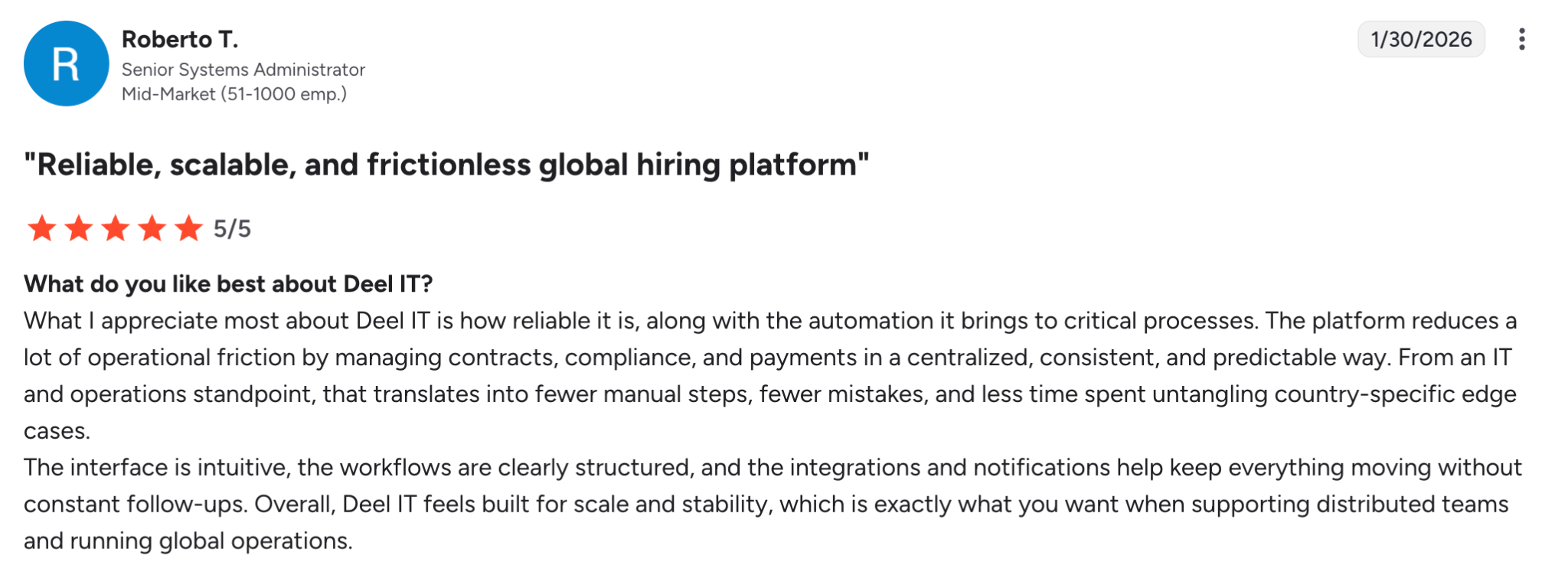
"Deel IT feels built for scale and stability, which is exactly what you want when supporting distributed teams and running global operations." – Roberto T., Senior Systems Admin, G2
"The device cost was like double what the actual device was. It's ridiculous." – Customer interview, Tequipy sales conversation
Who Deel IT Is Best For
- Companies deeply embedded in the Deel ecosystem – EOR, contractors, payroll – for whom a single-vendor IT experience justifies the pricing premium.
- Not recommended for: companies evaluating IT vendors independently of Deel; teams sensitive to hardware pricing; any company that wants to start without an annual commitment.
Allwhere: Good for US Retrieval, Limited Global Coverage
Allwhere is a Brooklyn-based IT lifecycle platform founded in 2021, covering 56 countries across North America, Latin America, Europe, ANZ, and two Asian markets. It operates with no platform fee, no minimums, and no long-term contracts – a commercial model that closely mirrors Tequipy's. Its dashboard and tracking UI is well-regarded, and US retrieval performance is specifically praised by multiple customers.
The limitation is geographic. Allwhere's 56-country footprint excludes all of MENA, all of Africa, all of CIS/Caucasus (Ukraine, Georgia, Armenia, Azerbaijan, Kazakhstan), all of Asia outside India and the Philippines, and most of non-EU Europe, including Norway and Switzerland. One Reddit user reported being told post-contract that Allwhere couldn't deliver to a country they'd been pitched as covered. A customer using Allwhere in both the US and UK described service as "significantly better in the US."
Best for: US-headquartered companies hiring primarily inside Allwhere's 56 listed countries, where geographic edge cases aren't a concern and the priority is a clean platform with no recurring fees.
Not a fit for: any company with hiring in MENA, Africa, Central Asia, the Caucasus, or most of Asia beyond the four listed countries. For those use cases, Allwhere has a documented pattern of either not covering the country or delivering inconsistently compared to its core US performance.
Fleet: Best for Western European SMEs That Want Leasing
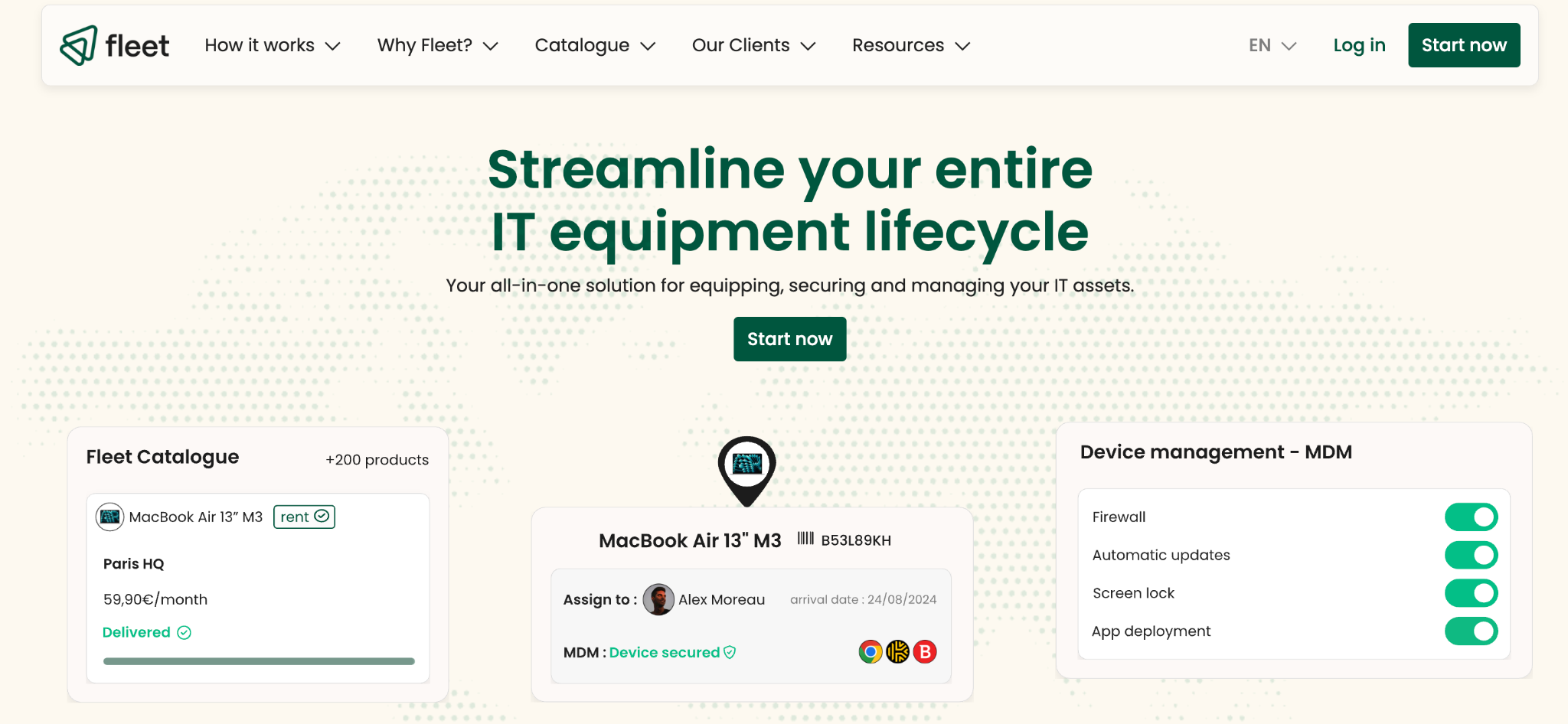
Fleet is a Paris-based Device-as-a-Service platform founded in 2019, operating primarily in France, Spain, Germany, the UK, and a handful of additional Western European markets plus the US. In February 2026, it closed its first LBO at a €100M valuation after seven years of bootstrapped growth – a signal of strong unit economics in its home market.
Fleet's core offer is a 36-month operational lease financed through third-party financial partners: the company handles procurement, MDM enrollment, warranty management, and end-of-life (refurb, donate, or recycle), bundled into a fixed monthly lease rate. It also sells an IT management tier at €9.90/device/month (including MDM, AI support copilot, and 24/7 helpdesk) and a Secure tier at €24.90/device/month that adds managed EDR and shadow IT detection.
One Tequipy prospect currently using Fleet for procurement reported a 20–30% hardware markup over retail, rising to approximately 50% effective when MDM and support services bundled into the lease aren't needed. A Trustpilot reviewer flagged the core positioning problem: "Misleading ad – it's not rental, it's leasing" – meaning the 36-month financial commitment is more committal than Fleet's "flexible monthly" marketing implies.
Best for: SMEs in France, Spain, Germany, and the UK (5–200 employees) that want a bundled procurement + MDM + cybersecurity vendor and prefer converting hardware CapEx to predictable monthly OpEx via a 36-month lease.
Not a fit for: companies hiring outside Western Europe and the US; teams that want to own devices outright at RRP without a financing structure; or any company that needs retrieval and redeployment as discrete, per-event services across a wide country footprint.
{{cta-primary}}
How to Choose the Best Laptop Retrieval Service
The right laptop retrieval service depends on three things: where your employees are, how much coordination you're willing to own internally, and what you're prepared to commit to commercially before you've seen the service work. Here's how to evaluate each dimension.
Geographic Coverage: In Practice, Not Just on Paper
Every service in this list claims global coverage. The number that matters isn't the headline country count – it's whether the service can execute a full retrieval workflow (courier pickup, certified wipe, chain of custody documentation) in the specific countries where your employees actually are.
The gap between marketed and real coverage shows up consistently in this category. Workwize publishes "100+ countries" on its homepage but its own internal service maps show decommissioning coverage in roughly 15–20 markets.
Firstbase markets "150+ countries" and documents a two-tier model in its own support pages – full service in US/UK/EU/Canada, partner-mediated with material limitations everywhere else.
GroWrk's strongest verified performance is in the US and LATAM; Egypt and Central Europe have documented failures. Allwhere works well in its 56 listed countries but excludes all of MENA, Africa, and Central Asia.
Shipping devices abroad too? See how to ship a laptop internationally.
How to test this before committing: List the five countries where you have the most remote employees, prioritizing the ones where you've had logistics problems before. Ask each vendor to confirm full retrieval capability (courier pickup to employee's door, certified wipe, storage or redeployment) in every one. Then test on your hardest country with a single order before signing anything.
Retrieval Process Quality: What You Own vs. What They Own
A retrieval service is only as good as what happens when a device needs to come back. There are two very different models operating under the same "retrieval service" label:
The productized model handles everything: courier scheduling, packaging dispatch to the employee, employee communication, pickup confirmation, transit tracking, certified data wipe, and storage or redeployment – with real-time visibility in a dashboard and a team you can message when something goes sideways. Your IT team places the order and watches it complete.
The coordination model requires your team to manage the moving parts: chasing the employee, arranging the courier, confirming the address, following up when the pickup is missed. The vendor provides a label and a wipe certificate. The logistics are yours.
The distinction matters most when the employee isn't cooperating, is in a country without a physical office, or has already moved. That's precisely when retrieval fails in practice – and it's where the industry's 71% recovery rate comes from.
Look for services that explicitly describe their employee communication process: how many times they contact the departing employee, what happens if there's no response, and whether there's an escalation path that doesn't require your team to get involved.
Tequipy's standard retrieval process pings the employee three times over three weeks. If there's no response, the customer's team is notified with Tequipy CC'd, and a formal notice about device ownership follows.
In practice, the escalation has only been needed twice across thousands of retrievals. For context: only 55% of companies fully secure access to unrecovered devices after offboarding – the retrieval problem is also a security problem.
Pricing Structure: What You Pay When You Don't Use It
The most important pricing question for a retrieval service is what you pay in months when nothing happens.
Several services in this category bill a per-seat monthly fee – sometimes called a "cost-to-field" fee, a "workstation management fee," or a "platform subscription" – regardless of whether any devices were ordered, retrieved, or stored that month.
Workwize's Professional tier runs approximately €19.50/seat/month. Deel IT charges $10/seat/month billed upfront annually.
Firstbase's platform subscription starts at ~$45,000/year for up to 1,000 employees. These fees are billed whether your headcount grew by 20 people or stayed flat.
On top of platform fees, most competitors in this list mark up hardware above RRP: Workwize at approximately 30%, GroWrk at 25–45%, Deel IT at 25% (floor) to 50%+ in harder markets, Fleet at 20–30%. Hardware markup compounds with every device order.
The alternative model charges only for what's actually used: a per-retrieval fee when a device is recovered, a storage fee per device per month while it's warehoused, a redeployment fee when it ships to a new hire. No standing commitment.
For teams with variable hiring cycles – a burst of onboarding in Q1, slower months through summer – pay-as-you-go retrieval pricing means your IT cost tracks your actual activity.
A subscription charges the same in February as it does in March, whether you had one departure or twenty.
Tequipy's retrieval pricing is $70–$150 per device, storage at $10–$12/device/month, redeployment at $70–$150. Platform access is free under 100 devices and $99/month flat above that – not per seat, not per user. There are no upfront commitments.
Contract Commitment: Can You Test Before You Pay?
Laptop retrieval is a service that's hard to evaluate from a demo. The real test is whether the courier shows up, whether the device arrives in good condition, whether the wipe certificate is accurate, and whether someone answers in minutes when the pickup goes wrong.
Several services in this list require a significant commitment before you can run that test: Firstbase's minimum entry commitment starts at ~$80,000 in upfront fees based on verified user reports.
Workwize has a 150-FTE minimum and an annual contract. Deel IT bills a full year upfront on contract signing. Fleet's default is a 36-month financial lease.
For a retrieval service specifically – where the question is whether it works in Kazakhstan or the Philippines before you commit to using it globally – this is backwards. The right sequence is: test in one country, confirm the process works end to end, then expand. That sequence requires a vendor willing to let you start with one order and no commitment.
Questions to ask every vendor before signing:
- Can I place a single retrieval order in one country before signing a contract?
- What is the minimum annual commitment?
- Are platform fees billed even if no retrievals happen in a given month?
- What is the retrieval process in a country without a warehouse?
- What happens if a device isn't returned – who escalates, and how?
CONCLUSION
Simplify Laptop Returns for Remote Teams with Tequipy
Recovering laptops from remote employees across multiple countries doesn't have to be a manual, anxiety-inducing process. The right retrieval service handles courier scheduling, employee communication, certified data wiping, and asset tracking – so your IT team places the order and watches it complete, rather than chasing it.
The services in this list cover a range of use cases. Workwize is the right call for US-centric teams that want deep HRIS automation and are comfortable with a per-seat subscription.
Firstbase fits mid-to-large companies in core English-speaking markets that want hardware leasing. GroWrk works well for US and LATAM teams that want no-commitment, à la carte retrieval. Deel IT makes sense if you're already running payroll and EOR through Deel.
For globally distributed teams – particularly those with employees in LATAM, Southeast Asia, the Middle East, Eastern Europe, or Central Asia – Tequipy is built for exactly this. 100% device recovery rate. 180+ countries. No contracts. No hardware markup. A dedicated Slack channel where questions get answered in minutes.
The fastest way to evaluate it: place one retrieval order in the country that's given you the most trouble. No contract, no minimum, no platform fee until you hit 100 devices. If it works where everything else has failed, the rest of your countries get easier.
FAQ
What is a laptop retrieval service?
A laptop retrieval service manages the return of company-issued devices from departing employees. It handles courier scheduling, packaging, pickup from the employee's address, certified data wiping, and documentation – so IT teams don't need to coordinate the process manually. The best services operate globally, provide a full chain of custody, and maintain recovery rates well above the 71% industry standard.
How do companies recover laptops from remote employees?
Most companies use a managed retrieval service that dispatches packaging materials to the employee, books a courier pickup at their home address, and handles all communication and tracking. The alternative – asking employees to ship devices back themselves – produces the industry's 71% recovery rate. Services like Tequipy, which handle the full coordination layer including employee follow-up and escalation, consistently achieve higher recovery rates.
How much does laptop retrieval typically cost?
Costs vary significantly by model. Pay-as-you-go services like Tequipy charge $70–$150 per retrieval, $10–$12/device/month for storage, and $70–$150 for redeployment – with no standing platform fee under 100 devices. Subscription-based services like Workwize bundle retrieval into a per-seat monthly fee (approximately €19.50/seat/month for 150+ FTE), which means you pay regardless of retrieval volume. Firstbase's total annual commitment typically starts above $170,000 for mid-market companies.
What happens to data on retrieved laptops?
Reputable retrieval services perform certified data wiping – typically to NIST 800-88 standard – and provide a certificate of destruction for compliance documentation. This is a non-negotiable requirement for companies with SOC 2, ISO 27001, or GDPR obligations. Confirm that the service provides wiping certificates in every country where you operate, not just in core markets – some providers only offer certified ITAD in Tier 1 regions.
Can retrieval services recover laptops from difficult countries?
Yes – but not equally. Services with in-country local partner networks (rather than central warehouse hubs) can execute retrievals in markets that regional-warehouse models don't reach. Tequipy has a documented 100% recovery rate across 180+ countries, including markets like Kazakhstan, Colombia, the Philippines, and Ukraine. For any country outside Western Europe and North America, ask the vendor to confirm full retrieval capability – courier pickup, certified wipe, and chain of custody – before committing.

Keep your current setup.
Just test us on one order.
AUTHOR
Before Tequipy, Tomek ran IT at Revolut, scaling from 100 employees in 2 offices to 5,000 across 17. He built the system that kept every laptop accounted for, then founded Tequipy – a platform that handles IT equipment logistics for distributed teams across 180+ countries.
As CEO, he runs operations and covers the founder layer: strategy, product, and the company-building that comes with both.
15 minutes. Your countries, your devices, your setup. No pitch.