KEY TAKEAWAYS
- Equipment procurement runs from naming a need to scrapping or selling the asset, because ISO 20400:2017 puts disposal inside the definition (ISO 20400).
- Under 2 CFR 200.1 an item counts as equipment once it lasts over a year and costs $10,000 or more per unit (Cornell LII).
- Capital assets run on a slower clock: 171 days of average commitment lead time in August 2026, against 48 for maintenance supplies (ISM).
- Buying usually wins over a long hold, and the ranking reverses with the discount rate: one worked example favours the lease at 6% and the purchase at 4% (Penn State Extension).
Equipment procurement is the process of naming what a business needs, choosing who supplies it, buying it, and running it to the end of its life. The same six steps cover a forklift, a van and a fleet of laptops; what changes is the size of the cheque and the clock.
This guide walks those six steps, prices buying against leasing and renting, and ends with a reusable checklist.
What Is Equipment Procurement?
Equipment procurement is the process of identifying a physical asset a business needs, selecting a supplier, buying it, and managing it until it leaves the books. It sits inside procurement, which CIPS defines as "the buying of goods and services that enable an organisation to operate its supply chains, in a profitable and ethical manner". ISO 20400:2017 runs the same cycle "through to the end of the life of goods, including disposal".
The term covers almost everything a company owns and operates:
- Machinery and plant: excavators, presses, forklifts, production lines.
- Vehicles: vans, trucks, company cars, trailers.
- Facilities: HVAC units, generators, lifts, security systems.
- Office equipment and furniture: desks, chairs, printers.
- Laboratory, medical and test equipment.
- IT hardware: laptops, monitors, phones, docks, networking gear.
US federal rules cut across that list with a financial test. Under 2 CFR 200.1 equipment means "tangible personal property (including information technology systems) having a useful life of more than one year", plus a per-unit cost at or above the lower of the buyer's capitalisation level or $10,000 (Cornell LII). Cost and lifespan decide the category, not the shape of the object.
The Equipment Procurement Process
Six steps carry a purchase from a request to a recorded asset, and most of the work is writing something down. Teams that run it well codify it, which is what IT procurement process best practices do for hardware.
Step 1: Define the Need and Write One Requirements Document
Start with the job the asset has to do, in numbers: capacity, duty cycle, the floor it stands on, the power available, who operates it, and the date it must be running. Write that once and have operations, finance and procurement approve the same version, because when three vendors quote against three descriptions the cheapest has usually read the specification most loosely.
Answer first: what can this asset do that the current setup cannot?
Step 2: Set the Budget and the Whole-Life Cost
The purchase price opens the budget rather than defining it. Installation, training, consumables, maintenance, insurance, spare parts, downtime and resale value belong on the same line. Depreciation moves it furthest, and as one commenter in r/smallbusiness put it, "consider including the amortization of the depreciating asset in the total cost of ownership, as depreciation significantly impacts the true cost of ownership".
Answer first: what does one year of ownership cost, every year you keep it?
Step 3: Source the Market and Qualify Suppliers
Equipment sourcing starts with a longer list than you need. Check each candidate for financial stability, parts availability, service coverage where the asset will sit, and the lead time for your configuration rather than the catalogue model. Service geography is the qualifier people skip, and it applies just as hard to IT equipment suppliers in every country where somebody works.
Answer first: who repairs this when it fails, and how far away are they?
Step 4: Request Quotes and Compare Like for Like
Send the same requirements document to every shortlisted supplier, and ask for the delivered price in destination currency with tax, freight, installation and warranty on separate lines. Equipment purchasing goes wrong most often here, because volume, configuration and destination all move the price while only one is usually on the page. Volume has the clearest arithmetic, which is the logic behind bulk laptop orders.
Answer first: same specification, destination and date on every quote?
Step 5: Negotiate the Terms and Raise the Order
Price is one term among several. The payment schedule, the delivery date and the remedy if it slips, warranty length, spare parts pricing and the service response window are all negotiable, and they outlive the discount. Anyone running an international procurement process must also name the importer of record, because that party can reclaim the import VAT.
Answer first: what happens, in writing, if delivery slips a month?
Step 6: Take Delivery, Inspect and Record the Asset
Inspect on arrival against the requirements document and the acceptance test, while the delivery note can still be signed with a comment on it. Then record the asset: serial number, location, owner, warranty start, maintenance interval and retirement date. An asset missing from the register is one nobody will service, collect or sell, which is where this hands over to IT asset lifecycle management.
Answer first: is the serial number in a register, with an owner and an end date?
Pro tip: plan capital assets on the capital clock. In its August 2026 report the Institute for Supply Management put the average commitment lead time at 171 days for capital expenditures, 84 days for production materials and 48 days for maintenance, repair and operating supplies (ISM).
ISM measures a commitment horizon rather than a delivery date, so read 171 days as the point by which the decision has to be made. A machine wanted on the floor in June needs its specification agreed in January.
Buying vs Leasing vs Renting Equipment
Most pages here give three columns of adjectives. The version worth reading has numbers, and the numbers change places. Penn State Extension worked the comparison on a $50,000 skid steer, a five-year lease at $10,500 a year against buying outright. At about 6%, "The lease would appear as a better option by $1,141 in today's dollars". Move the interest rate down to 4% and the ranking reverses, with "the purchase would be better by $960" (Penn State Extension).
Those are farm figures and they do not carry across to a laptop or a press. The method does: price both as a present value at your cost of capital.
Buy and lease columns follow the economics at Penn State Extension and Iowa State Extension. The rent column carries no figure because none is published.
Iowa State reaches the same place from the ownership side: "If you have enough money to purchase machinery outright, you will usually spend less in the long run by owning it." It also names what the smaller payment buys, since "At the end of the lease period, you have nothing except the right to exercise the purchase option." One tax point belongs with it: the IRS treats a finance lease as a conditional sales contract, so that asset sits on your own depreciation schedule.
Renting has no published economics at all, and nobody should pretend otherwise. What exists is practitioner judgement. A commenter in r/Construction reduced the decision to a question about the business: "Am I in business to maintain equipment or to do construction work?" A second reply in that thread named the risk a cost table hides: "What if you can't find the tool you need to rent and you gotta get the job done today?"
Paying a premium to protect cash is defensible too, which is the case made in the top reply in r/smallbusiness.
Resale is where most comparisons stop early. An owned asset holds value at the end of its life, and that belongs in the buy column from the start: for laptops it arrives as a device buyback price, and companies providing laptops to employees often buy refurbished at the other end.
Common Equipment Procurement Challenges
Four problems recur on nearly every purchase, and no approval form solves them.
Budgets get approved on the purchase price and spent on the whole life. Finance sees the invoice; the business pays for maintenance, downtime and the resale value nobody modelled. Iowa State gives the rule in one line: "Make your decision based on total after-tax cost as well as near-term cash flow requirements" (Iowa State).
Delivery dates slip because the commitment horizon was never in the plan. Capital assets are committed roughly 24 weeks ahead on ISM's August 2026 reading, against seven for maintenance supplies. Work backwards from the date the asset must be running, and put that date in the requirements document.
The same item costs a different amount in every country you buy it in. Of 3,108 procurement decision-makers questioned for the Amazon Business 2024 report, 52% buy for several locations and 57% of those buy across borders. Customs then moved twice during 2026: the USA suspended its $800 de minimis exemption for every non-postal mode (CBP, 91 FR 37789), and the EU abolished the EUR 150 duty relief on 1 July 2026 (Council Regulation 2026/382).
Duty is not zero everywhere either: Brazil charges 16% on IT hardware while the EU, the UK, the USA and India charge nothing. Price landed cost per destination, which is what IT logistics absorbs.
Nothing comes back at the end. A 2022 Capterra survey of 287 HR staff found that "71% of HR workers who offboarded employees in the past year say at least one employee didn't return company-owned equipment, like a laptop or smartphone", worth $1,963 on average. That counts employers with at least one non-returning leaver, not a rate of loss across a fleet. Decide the collection route at purchase, which is what a laptop retrieval service is for.
IT Equipment Procurement for Distributed Teams
The regulation that defines equipment also explains why a laptop fleet behaves differently. Under 2 CFR 200.1 a computing device "is a supply if the acquisition cost is below the lesser of the capitalization level established by the recipient or subrecipient for financial statement purposes or $10,000" (Cornell LII). Cheap, numerous, mobile and short-lived is a different rhythm from expensive, rare and bolted to a floor.
Three things change once the assets are laptops and the people sit in different countries. Sourcing moves into the destination country, because a border crossing adds customs risk to every order, not one. The device has to arrive already enrolled in a management system, and collection needs planning ahead, because the leaver and the laptop sit where the company may have no office.
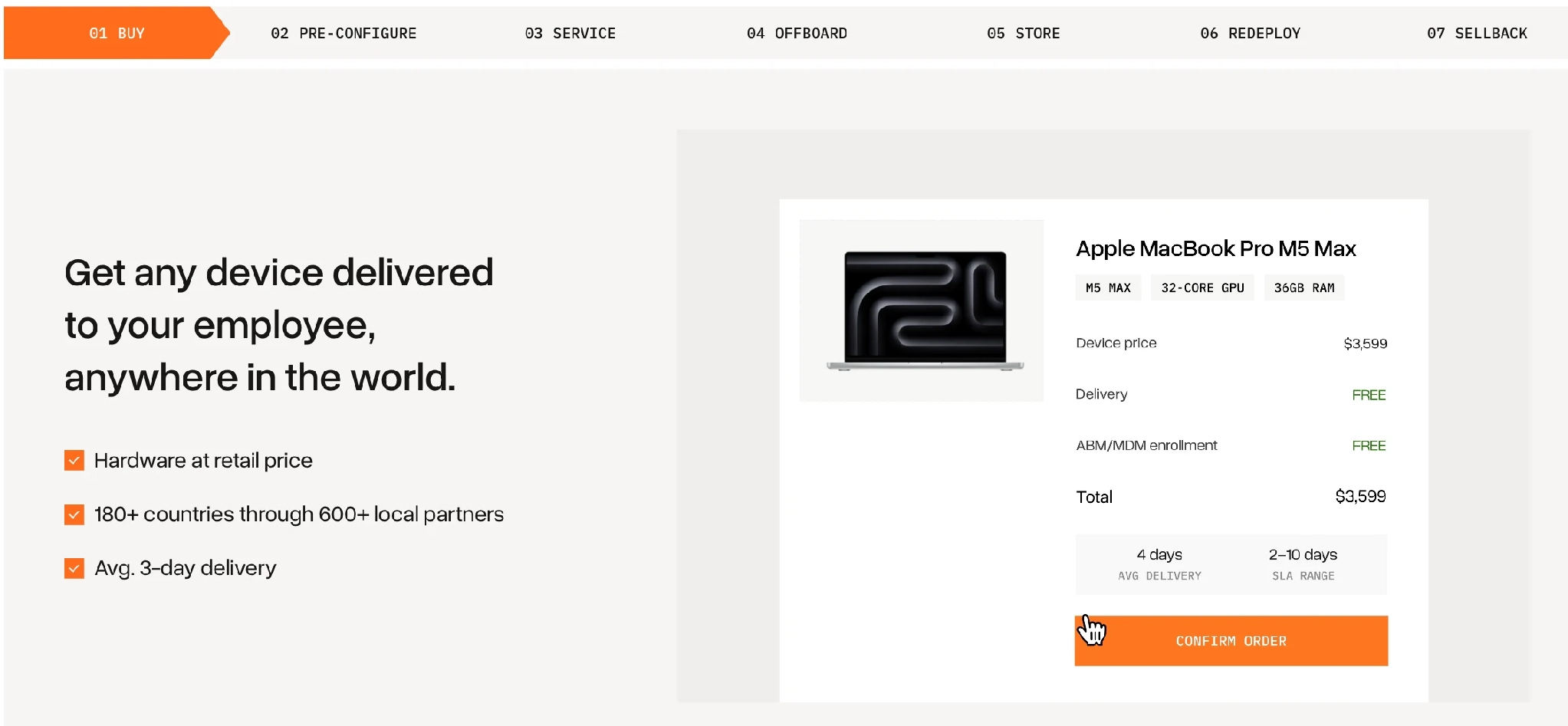
Tequipy runs IT equipment procurement as one platform for that shape of company. Devices are bought through 600+ authorised local resellers in 180+ countries at recommended retail price with no markup and delivery included, so the laptop never crosses a border. Delivery averages 3 business days, capped at 10.
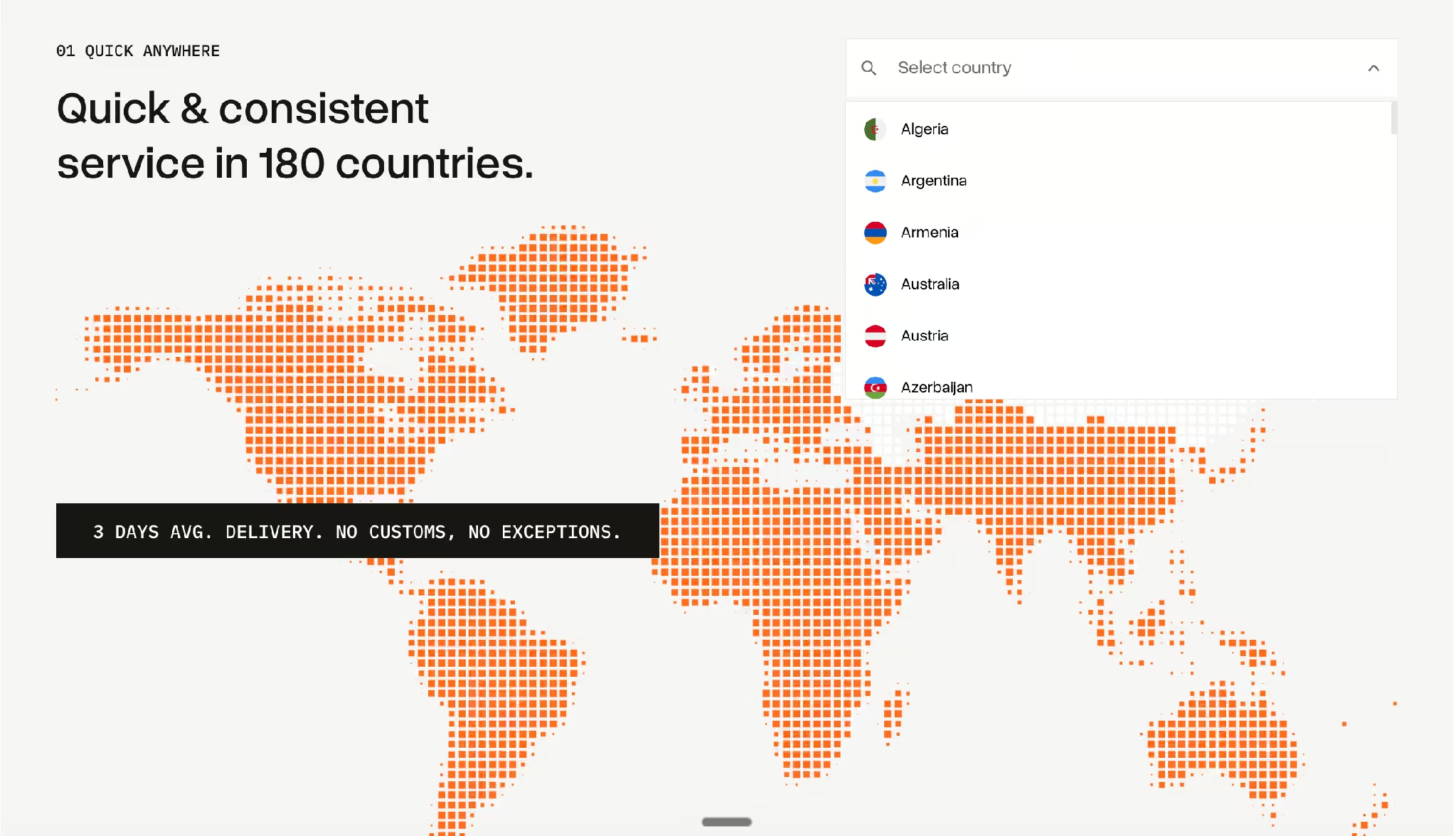
Equipping a hire abroad inside a week runs like this. The request carries a country and a start date, the device is sourced from a reseller inside that country and enrolled through Apple Business Manager or Windows Autopilot before dispatch, and the serial number reaches the register on delivery. That enrolment step is zero touch deployment.
Every commercial term sits on the published rate card. Platform access costs a flat $99 a month whatever the fleet size, with no charge below 100 devices. Offboarding is $70 to $150 a device depending on country, storage $12 a month, and sellback pays 20% to 70% of initial value in cash.
Hardware is sold outright and never leased, financed or rented, in any country Tequipy operates in, so a finance team that wants the fleet off the balance sheet should look elsewhere. Payment flexibility is one thing only: a $5,000 credit line settled within seven days of delivery.
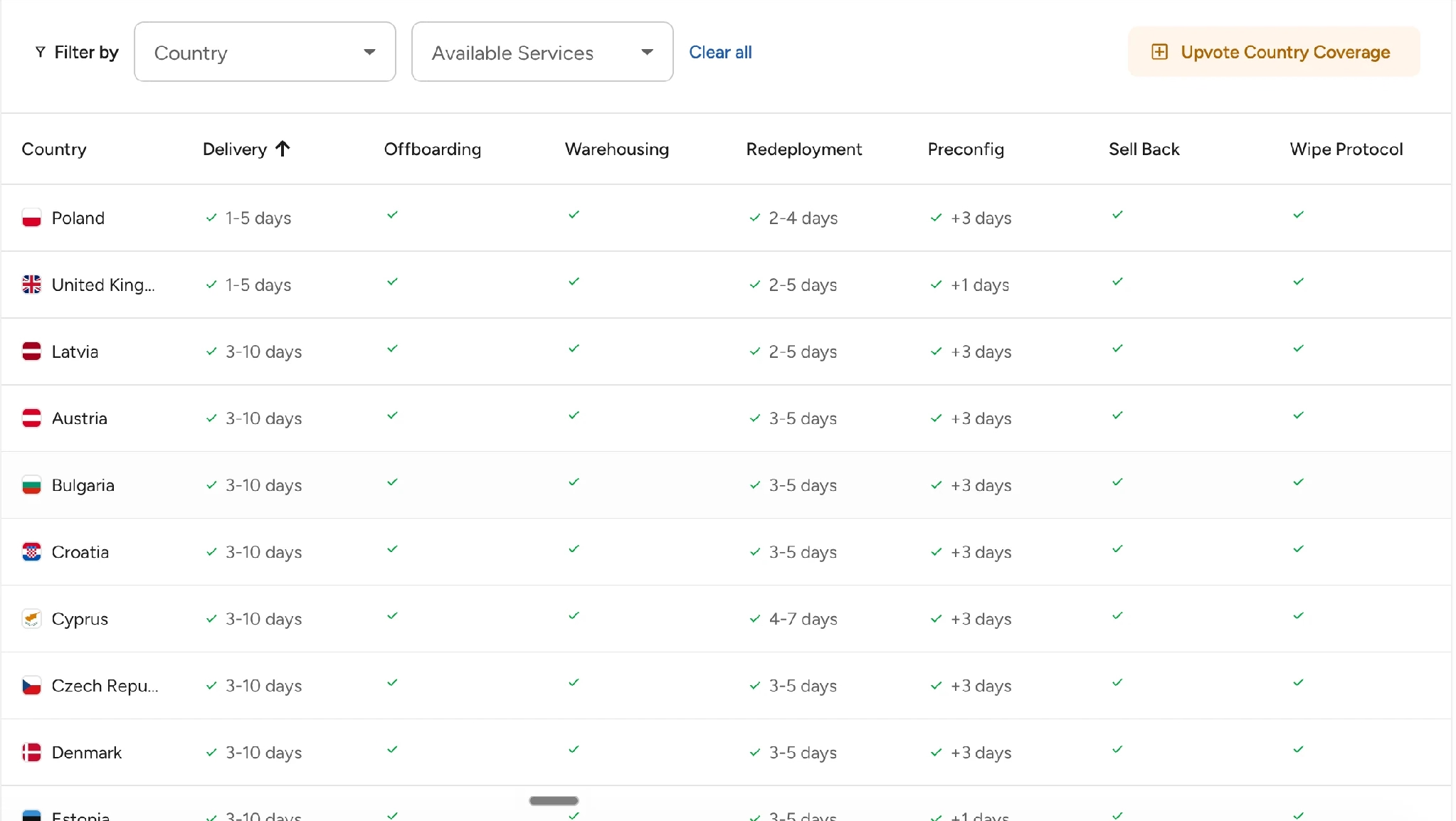
The results show up as time rather than as a discount. Booksy saved an estimated 3,200 hours on IT administration and records 99% of equipment delivered before the employee's start date (Booksy case study). Marcin Szydłowski, who runs enterprise technology and security there, explains where the trial started: "We initially tested them in Latin America, a region where we faced logistical challenges."
TapTap Send consolidated three purchasing processes onto one, saving 40+ hours and about $6,500 a month (TapTap Send case study). Every service works on hardware bought elsewhere too, so one order through global device procurement can test it.
Equipment Procurement Checklist
Copy this equipment procurement checklist into your process, one decision per line.
Before you commit
- Write one requirements document that operations, finance and procurement all approve.
- State the date the asset must be running, then subtract the category lead time.
- Price the whole life: purchase, installation, training, maintenance, insurance, downtime, resale.
- Decide buy, lease or rent on after-tax cost and near-term cash flow.
- Check who owns the asset at the end, and who may service it.
- Name the destination country before choosing a supplier.
While the order is running
- Take quotes on one specification, in destination currency, tax and freight itemised.
- Get the delivery date, the slippage remedy and the acceptance test in writing.
- Confirm the importer of record on any order that crosses a border.
After delivery
- Inspect against the specification on arrival, and photograph any damage.
- Add the asset to the register with location, owner, serial number and retirement date.
- Book the first service and record the maintenance interval.
- Set the resale route when you record the purchase, and keep the evidence: wipe certificate, buyer, date.
For hardware, the after-delivery lines can be bought as IT procurement services rather than staffed, and the repeating work runs as laptop procurement.
{{cta-primary}}
CONCLUSION
Put Your IT Procurement on Autopilot With Tequipy
Equipment procurement stops being firefighting when the specification, the quote, the delivery and the disposal all point at one record. The six steps work for a press, a van or 400 laptops; what differs is how far the asset travels.
If hardware is the part eating your team's week, the cheapest test is one order into whichever country caused the most trouble this year. Put that order in front of the Tequipy team, or see how global IT procurement runs across 180+ countries.
FAQ
What is equipment procurement?
Equipment procurement is the process of identifying a physical asset a business needs, evaluating suppliers, buying it, and managing it to the end of its life. CIPS defines the wider discipline as buying the goods and services that let an organisation run its supply chains; ISO 20400:2017 includes disposal.
What are the six steps in the equipment procurement process?
Define the need in one requirements document, set the budget on whole-life cost, qualify suppliers, request comparable quotes, negotiate terms and raise the order, then inspect and record the asset on delivery.
Is it better to buy or lease equipment?
Over a long hold, buying usually costs less: Iowa State University Extension says outright purchase generally wins for machinery kept five to ten years or more. The ranking is sensitive to the discount rate, and Penn State's worked example favours the lease at 6% but the purchase at 4%.
What should an equipment procurement checklist include?
Group it into before, during and after. Before: requirements document, whole-life budget, lead time, the buy against lease against rent decision, destination country. During: comparable quotes, a written delivery date with a remedy. After: inspection, a register entry and a disposal route.
How do distributed teams handle IT equipment procurement in other countries?
They buy inside the destination country rather than shipping across borders, and devices arrive already enrolled in a management system. Tequipy does both through 600+ local resellers in 180+ countries at recommended retail price.
Keep your current setup.
Just test us on one order.
AUTHOR
Before Tequipy, Tomek ran IT at Revolut, scaling from 100 employees in 2 offices to 5,000 across 17. He built the system that kept every laptop accounted for, then founded Tequipy – a platform that handles IT equipment logistics for distributed teams across 180+ countries.
As CEO, he runs operations and covers the founder layer: strategy, product, and the company-building that comes with both.
15 minutes. Your countries, your devices, your setup. No pitch.