KEY TAKEAWAYS
- Every tool here records hardware. None of them moves any. Whichever one you pick, you still need an answer for sourcing a machine where you have no legal entity, getting it to a new hire before their start date, collecting it from a leaver, wiping it to a certificate and turning it back into cash. Fleets go missing during those physical steps. The vendors' own customers, reviewers and documentation say so.
- AssetSonar (by EZO) is the strongest mid-market register when you also need software licence data, with per-asset pricing published openly and the widest MDM sync here.
- Lansweeper is the discovery engine, the deepest scanner here across Windows, Mac, Linux, servers, switches and OT gear. Its paid floor is a 2,000-asset band, and long-term customers document steep repricing on r/Lansweeper.
- For globally distributed teams, the missing layer is a service rather than a tool: Tequipy. Nobody at head office ever handles the machine. Tequipy buys it locally in 180+ countries, enrols it in your MDM, delivers it, collects it from the leaver and wipes it, and each step updates the record as it happens. The platform fee is $99 a month flat for unlimited devices, with no per-seat charge. One order to start, no contract.
- ServiceNow HAM Pro is for enterprise governance and audit evidence. A separately licensed, quote-only SKU, and one r/servicenow practitioner put implementation at several times the licence cost.
- InvGate and Reftab are the budget entries. InvGate gives SMBs discovery plus a CMDB at $1,499 a year flat; Reftab is a cheap custody register that takes hardware data from other systems' discovery agents. Snipe-IT is free if you host it yourself.
Your hardware asset management software says a MacBook Pro is in Bogotá with a developer who left in March. Nobody can confirm that is still true, and nobody can get the machine back. The register was accurate the day somebody typed it. The row and the laptop drifted apart the moment the device left the office.
IT leads who have talked to us put it flatter than any vendor would: "We don't even know how many devices are unaccounted for." A ServiceNow practitioner running HAM and SAM Pro at scale told peers to report on "the number of laptops that you can't account for" in a candid r/servicenow thread from July 2025.
This guide compares eight tools on the two questions that decide whether a register stays honest: how data gets into it, and who updates it when a device physically moves. Every vendor here answers the second question the same way, and the answer is a person.
8 Best Hardware Asset Management Software Tools at a Glance
The last column matters most. Six of these eight publish an entry price for a product smaller than the one you end up buying. Discovery, integrations and audit logs sit a tier or two higher.
Every entry price above is the vendor's own published rate, read in August 2026: AssetSonar's per-asset rates, Lansweeper's asset bands, InvGate's flat Starter tier, Reftab's four tiers, Snipe-IT's hosting plans, AssetTiger's trial and paid steps and Tequipy's service rates. ServiceNow publishes none.
Read the "how data gets in" column against your own fleet. A credentialed network scanner and a custody register that waits for typing are two different products, and the difference shows most when the machines live in people's homes.
Then notice what no column here can show. Not one of these products performs a physical step. Every row above assumes somebody has already bought the device, sent it to the right address and got it back. That somebody is on your payroll.
What Hardware Asset Management Software Does, and Where It Stops
Four jobs define this category. A tool discovers devices through credentialed scans, an agent, an API pull from an MDM, or an uploaded spreadsheet. It reconciles those into one record per machine, deduplicating on serial numbers. It tracks custody and state: assigned to a person, in a location, under warranty until a date. And it reports, which is where the licence positions, end-of-life exposure and audit evidence come from.
The good tools here are genuinely good. Lansweeper finds kit nobody remembered buying, down to UPSes and PLCs. ServiceNow HAM Pro models the lifecycle with purchase orders, stockrooms and disposal certificates. AssetSonar reconciles agent data, network scans and MDM feeds into one verified record.
What stops is the physical work. None of these products sources a laptop where you have no legal entity, enrols it in your MDM before a start date, ships it to a home address, collects it from a leaver, warehouses it, wipes it to a certificate or turns it back into cash.
That work has a price, and it appears on none of the licence lines above. In Capterra's 2022 offboarding survey, "71% say at least one employee didn't return company-owned equipment, like a laptop or smartphone", and the HR respondents in that survey estimated the loss at $1,963 of equipment per non-returning employee on average. The same research found hybrid and remote employees 17% more likely than on-site staff to keep the kit.
A register that is 100% accurate still loses the laptop. It gives you the serial, the model, the person who left in March and the address the machine went to, then waits for somebody to go and collect it.
A sysadmin advising an SMB buyer in a June 2026 r/sysadmin thread got the ordering right: "Inventory is one thing, but onboarding, offboarding, returns, repairs, redeployments, and disposal are where we found we were spending most of our time."
Hiring abroad does not create this problem. A leaver in Manchester keeps a laptop as easily as a leaver in Bogotá, and getting it back is your job either way. A border changes the cost and the difficulty. That is why the process usually breaks on the first hire in a country where you have no entity, no reseller account and nobody to hand a laptop to.
The evidence for the boundary comes from the vendors' own communities.
A ServiceNow practitioner, to another ServiceNow practitioner. Asked about ITAM alternatives, one r/servicenow member cut past the tooling question: "If you don't have the processes in place for ITAM, HAM Pro is going to be wasted money. ITSM-AM is the best place to start. No SW solution is going to do ITAM for you." A practitioner wrote that last sentence in an August 2024 r/servicenow comment. It is the category boundary in their own words.
Reftab buys the physical returns from another company. Reftab needed a way to get devices back, so it integrated with a retrieval company. Its own integrations page reads: "Reftab integrates with Retriever to simplify laptop returns during employee offboarding. Trigger return workflows from Reftab and keep asset records updated as devices are shipped back." Reftab triggers the return. Hello Retriever supplies the couriers, on a separate account. Its pricing page lists shipping to US, Canadian and UK addresses only, with the EU on the roadmap.
Hello Retriever Reviews can help buyers assess that retrieval layer separately.
An AssetSonar customer named the gap unprompted. The thread was about tracking assets across more than 200 remote employees, and the customer wrote: "We use AssetSonar too. Their agent is great and is very lightweight. The only limitation is remote offboarding which I am hoping they can support soon." That line comes from AssetSonar's own customer in an r/sysadmin thread.
An AssetSonar advocate split the market for us. An account posting AssetSonar recommendations framed the choice this way in an r/CIO evaluation thread: "Workwize is good if you're more logistics-focused but we ended up using AssetSonar since it's simpler and better for real time visibility, assigning devices, also keeping offboarding clean." Read what that recommendation separates. Real-time visibility and physical logistics are two products, and no reviewer in this category confuses them.
A Lansweeper reviewer said the quiet part about remote work. Rating it 7 out of 10 in a November 2025 TrustRadius review, an IT administrator wrote: "If you have a smaller team and need to find all assets that are on your LAN, this tool streamlines and greatly speeds that process up. It's easy to enter credentials and let it scan. If your business happens to be primarily remote, I have not found a great use case for those assets that Lansweeper could address."
Five accounts reach the same place. Three come from vendors' own communities and two from vendors' own documentation. The missing work is physical, so it needs a different kind of product from anything in this list. Somebody has to buy the machine in the country the new hire lives in, get it to their door already configured, and get it back when they leave.
Buying, shipping and collecting devices is the service layer, and Tequipy works there. A register records what happened to a device. Tequipy is the party that buys, ships and collects it. A customer puts it more bluntly than we would. One enterprise reviewer on Tequipy's G2 profile calls Tequipy "a reliable source of truth" for equipment. Every tool in this list makes that claim about itself.
AssetSonar (by EZO): Best for Mid-Market Registers That Also Track Software
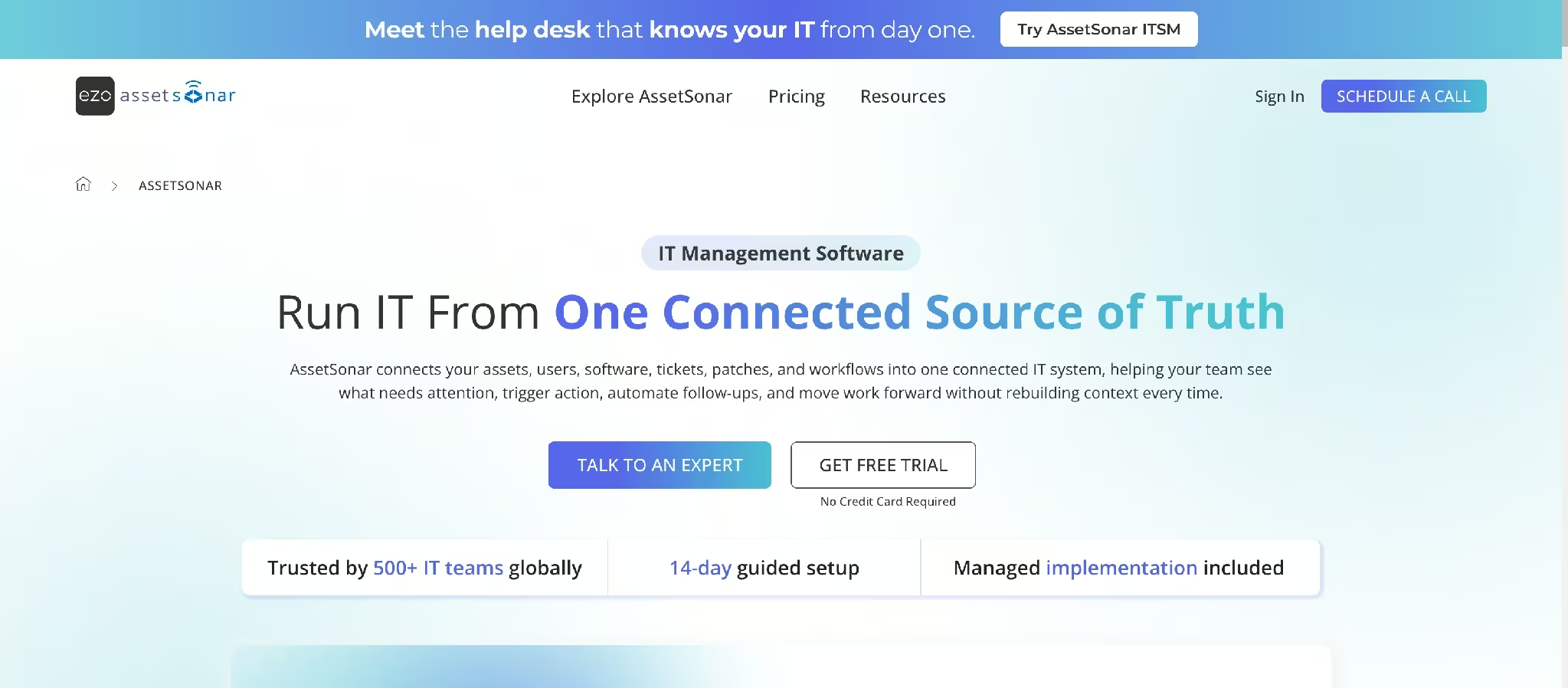
AssetSonar is the ITAM product from EZO, an Austin company. It traded as EZ Web Enterprises until it renamed itself EZO in January 2023. Gartner's vendor record puts it at 51 to 200 staff and under $50M revenue.
Key Features
Hardware arrives four ways: an installable agent built on OSQuery, network discovery, MDM integrations and barcode scanning. The MDM list is the widest here, covering Intune, Jamf Pro, Kandji, Mosyle, SCCM, Google Endpoint Management, JumpCloud and Apple Business Manager, all named on its integrations directory. Above it sit check-in and check-out, automatic custody transfer, reservations, warranty pulls from Dell and Lenovo, patch data and an Advanced SAM add-on. AssetSonar buys nothing for you. It imports purchase-order metadata from CDW after you buy from CDW.
Pricing
List prices are published, packages start at 100 assets, and there is no self-serve checkout.
Rates confirmed on the AssetSonar pricing page in August 2026, which also quotes implementation at 7 to 14 days, included.
Where AssetSonar Shines
- MDM breadth is the deciding factor: an IT team lead in a November 2025 G2 review wrote "I really like the integrations with our MDMs, as other competitors are missing key integrations or are not as advanced as AssetSonar."
- Discovery and custody on one licence: scanners skip custody, and custody registers skip discovery. One per-asset price for both is why mid-market teams choose it.
- Support carries the setup: its customer-support sub-score of 4.58 on Software Advice, read in August 2026, is the highest of that profile's four dimensions.
Where AssetSonar Falls Short
- Setup takes longer than the marketing suggests: even a vendor-invited reviewer wrote "The setup is complicated. I feel we have a great deployment at the moment and we couldn't have done it without our EZO team to help us" in a December 2025 G2 review.
- Reporting frustrates daily users: a December 2025 G2 reviewer says "Pulling reports is uncomfortable because you have to pull all of the items ever used in AssetSonar and then add them to an Excel sheet and filter."
- Remote offboarding sits outside the product: the AssetSonar customer quoted earlier named it as the one limitation they had hit.
Reviews
G2 shows 4.5 from 76 reviews as of August 2026, and only three of them sit at three stars or below. Capterra's 4.6 from 38 agrees. GetApp and Software Advice repeat that 4.6 from the same 38-review pool, so count it once. Many reviews are vendor-invited.
Best For
- Mid-market IT teams: roughly 100 to 1,000 assets, wanting discovery and custody in one tool.
- Teams already inside Jamf, Intune, Kandji, Okta or Zendesk: the record reconciles against all of them.
- Buyers with software asset management on the list: licence utilisation matters as much as the hardware count.
Your own team still buys every machine AssetSonar records, gets it to the person it belongs to, and gets it back when they leave.
Lansweeper: Best for Deep Network, Cloud and OT Discovery
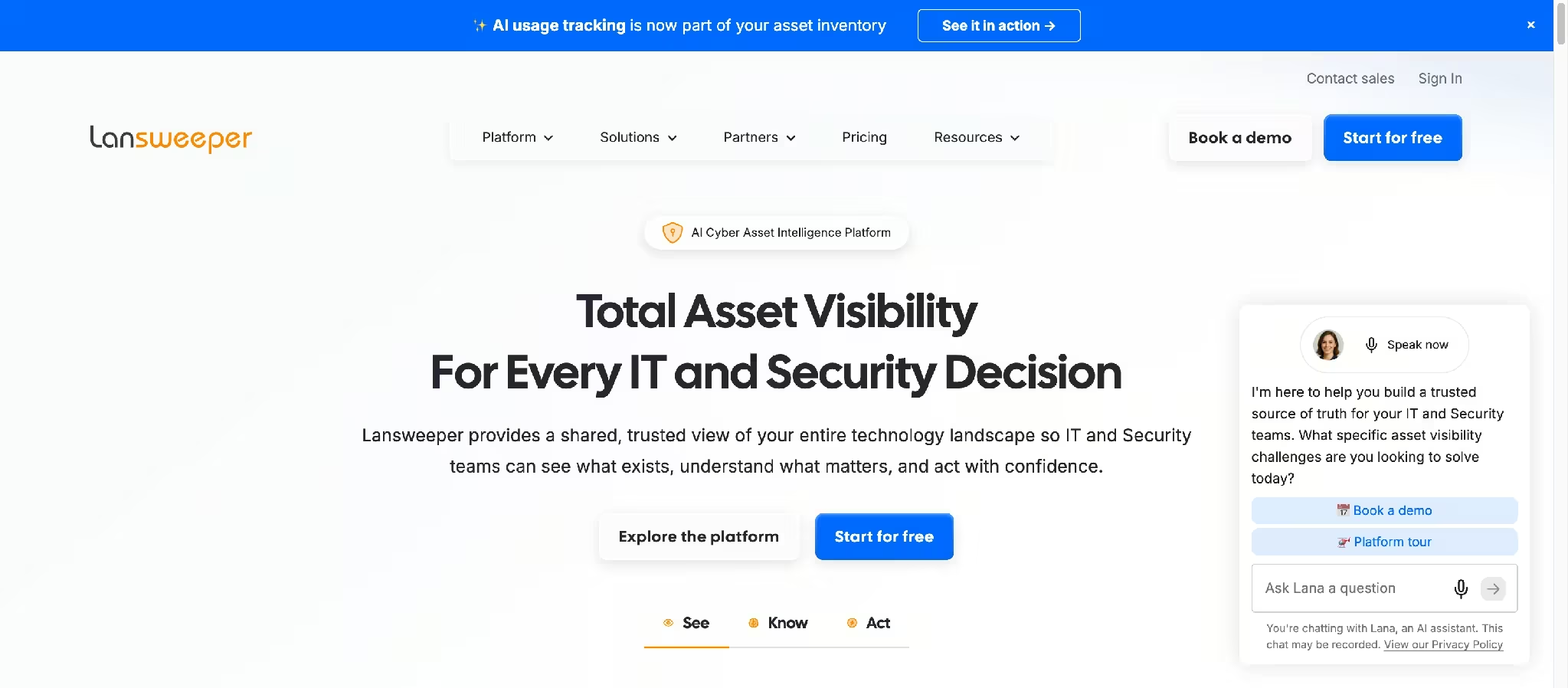
Lansweeper is the oldest product here, founded in Belgium in 2004. Its own about page claims 400+ team members and more than 30,000 environments. The marketing now says "Cyber Asset Intelligence"; the engine underneath is a scanner.
Key Features
Its asset discovery page lists six discovery mechanisms, and they cover the awkward cases: credentialed scans for software versions and patch levels, a passive Traffic Sensor with credential-free recognition for fragile OT, cloud APIs for AWS, Azure and Google Cloud, an IT Agent for roaming Windows, macOS and Linux machines, connectors for SCCM and Intune, and CSV upload. Above that sit a large report library with custom SQL, switch-port and topology mapping, and end-of-life Lifecycle Insights on Pro and above.
Pricing
Billing is annual on every paid tier, asset licences do not stack, and auto-renewal is the default.
Tiers confirmed on the Lansweeper pricing page in August 2026. Software asset management is an add-on Starter cannot buy, and full API and webhook access is Enterprise only.
Where Lansweeper Shines
- Scanning breadth nothing else here matches: servers, printers, switches, routers, UPSes, monitors, VMs, cloud instances and PLCs alongside laptops. Even a one-star reviewer conceded the core in a June 2026 G2 review: "In the on-premises version, the solution is mature."
- Audit evidence on demand: a support analyst credited the reporting engine in a June 2022 TrustRadius review: "Lansweeper enabled us to successfully pass 5 Microsoft audits in compliance."
- A free tier that is genuinely free: discovery for 100 assets, unlimited seats, and an operations director who wrote "This was up and running within 30 mins" in a December 2023 Capterra review.
Where Lansweeper Falls Short
- Customers have documented the repricing in invoice numbers: a ten-year customer posted their history in a November 2024 r/Lansweeper thread: "from 2020 and 236 € to 3.000€ this year ... price is more 1.200% higher than before", on an estate the same commenter puts at "perhaps 20 % more assets" across those four years. A K-12 district reported the same shape in an April 2024 renewal-increase thread: "Our renewal only a few years back was $800... our renewal quote this year is $8,000..."
- A 2,000-asset floor smaller estates pay anyway: "Yeah, we have about 800 assets but had to move to the 2000 asset one. Such a pain", one admin wrote in an r/sysadmin renewal thread.
- Renewal unresponsiveness still reported in 2026: a decade-long user opened a July 2026 r/sysadmin thread with "Recently, we are unable to renew our license because it feels impossible to get a response from their sales team", and a second user confirmed "We managed to renew our license early this year but it wasn't easy".
Reviews
The engine scores well while the commercial relationship scores badly. Ratings sit at G2 4.4 from 68 reviews, Capterra 4.5 from 75, TrustRadius 8.7 from 107 and Gartner Peer Insights 4.4 (261), read in August 2026. Gartner is the cleanest signal at that volume, with 91% at four or five stars.
Best For
- Estates with substantial on-network infrastructure: mixed fleets of servers, switches and virtual machines.
- OT and IT-OT convergence environments: passive discovery matters when you cannot credential-scan a PLC.
- Organisations with a data-residency requirement: the classic product still installs on-premises, with Cloud layered on top.
A credentialed scan cannot see a laptop in a drawer in Manila. Getting that laptop back takes a phone call, and no report will make it for you.
Tequipy: Best for Globally Distributed Teams That Need Devices Bought, Delivered and Collected
Four accounts above stop at the same point. A ServiceNow practitioner told a peer no software will do ITAM for them. Reftab bought couriers from another company. An AssetSonar customer named remote offboarding as the one thing missing. A Lansweeper reviewer found no use case for a primarily remote fleet. All four describe work rather than data, and an article about asset software has to say who does that work.
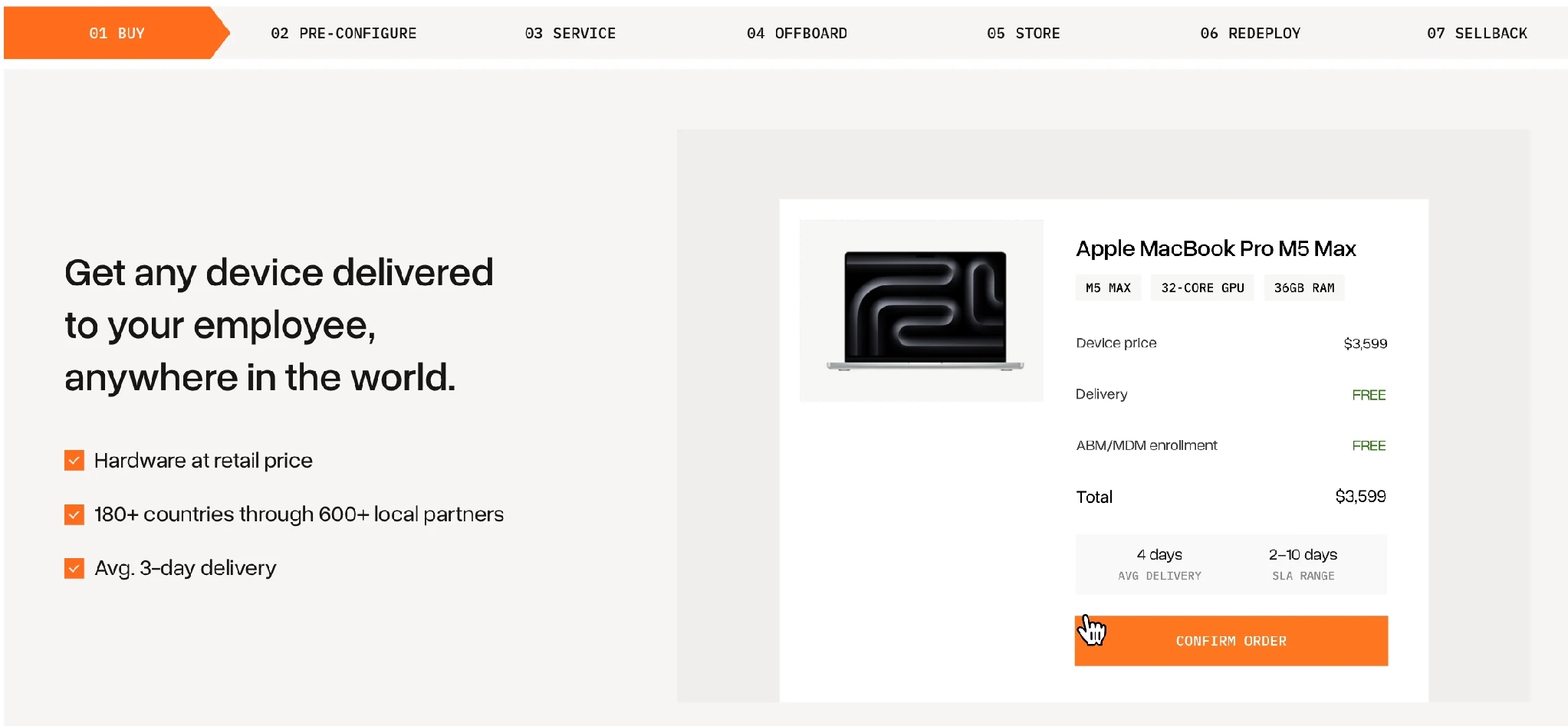
Tequipy's device lifecycle service exists because its co-founder solved that problem once already. He ran IT at Revolut while it grew from 100 employees in 2 offices to 5,000 across 17. The rotation ran to around 300 people a week and not one laptop went missing. That system became the company. Tequipy buys, configures, ships and collects the device, so each step updates the record as it happens and nobody has to type it in afterwards.
Key Features
Local Sourcing at Retail Price in 180+ Countries
Buying happens locally. 600+ authorized resellers cover the countries employees actually live in, at recommended retail price or lower with delivery included. Delivery averages 3 business days and is capped at 10. Local buying keeps customs out of the path to a new hire in Nigeria, Brazil or Kazakhstan. Booksy tested Latin America first, its hardest region: "We initially tested them in Latin America, a region where we faced logistical challenges", says Marcin Szydłowski, Director of Enterprise Technology and Security.
Configuration Before the Start Date, Not After It
Zero-touch deployment comes free with a device purchase: Apple Business Manager setup, a serial assigned to a named user, MDM enrolment over the air. The machine arrives managed, so no joiner holds a laptop your MDM has never seen. Tequipy's own tracked figure is 99% of devices delivered before the employee's start date. It is a headline metric on the Booksy case study.
Offboarding, Storage, Redeployment and Resale as Priced Services
None of the registers above performs this work. Tequipy collects the device by courier from a leaver's home, assesses its condition, wipes it, warehouses it, then redeploys it or sells it for cash. RemoFirst employs about 250 people and reports 100% of company-issued devices returned, with close to $2,000 per employee protected. Its case study covers "laptop deliveries, repairs, MDM, and retrievals across 30 countries". Offboarding through the laptop retrieval service, three months of storage and a redeployment cost $180 to $240 together. A replacement costs $1,500 to $2,500.
Pricing
The platform fee is $99 a month flat for unlimited devices, with no per-seat charge, so it reads the same on an invoice for 200 machines and one for 5,000. Hardware carries no markup either: an $1,800 MacBook costs $1,800. Physical services are charged per event, only when you use them, so a month with no moves costs nothing.
Rates sit on the Tequipy pricing page, with no long-term contracts, minimums or volume requirements. The same page runs a calculator that compares those rates against what your current vendor charges, so you can price Tequipy without asking anyone for a quote. ServiceNow, by contrast, publishes nothing at all.
The flat fee matters most on a large fleet. A 2,000-device estate on AssetSonar's per-asset rate of $0.75 comes to $1,500 a month before the software add-on, and the same estate on InvGate's Pro band of $5 per IP device per year comes to $10,000 a year. The Tequipy platform line reads $99 either way.
Where Tequipy Shines
- The record is a by-product of the work: serials captured at purchase, delivery confirmed on arrival, condition logged on collection, a wipe certificate produced when the wipe happens.
- Delivery in the countries where other vendors failed: 180+ countries and 600+ local resellers. Booksy, with more than 500 employees, needed new hires equipped "in places like the Philippines or Colombia", which its Director of Enterprise Technology and Security says "was always a challenge before".
- One process instead of three: TapTap Send consolidated three purchasing processes for a team of more than 250 people, and reports 40+ hours and $6,500 a month saved with 100% of devices recovered.
- It replaces a hire rather than a vendor line: at 100 employees hiring across 20 countries, Gigs avoided an IT logistics hire while saving 100+ hours a month, against a $60,000 to $80,000 salary.
- Chain of custody you can hand an auditor: ISO 27001 certified, penetration tested, a full audit trail per device, and Blancco certified wipes where required.
- No lock-in to devices bought through Tequipy: every service works on hardware you already own, so it stacks on the register you keep.
Where Tequipy Falls Short
- It is not a general-purpose ITAM platform: Tequipy tracks the fleet it manages. It does not scan networks, fingerprint OT devices, map switch ports, discover cloud instances, run a CMDB with relationship mapping, or produce audit-grade software licence positions. Where those are the requirement, buy one of the tools above and Tequipy sits beside it.
- Invoices need reading before you pay them: the enterprise reviewer who rates Tequipy 4.5 for responsiveness and global coverage writes in a 31 July 2026 review that "Sometimes there are errors on the invoices, so we need to double check them from time to time". Request the per-event breakdown for your first two months and read every line of it.
- A specific make and model is not always in stock: the same reviewer reports occasional shortages of a particular laptop model. Check availability for the exact configuration you standardise on before you order in volume.
- Warranty data has no field of its own yet: a mid-market reviewer calls the platform the best-looking ITAM interface they have used, in a 5 August 2026 review. The same reviewer wants a configuration item for warranty information and calls that "essential for full lifecycle management". Confirm where it stands with the team if warranty tracking is a gate for you.
- SOC 2 is still in progress: ISO 27001 certification and penetration test reports are available today. If a SOC 2 report is a gate in your procurement process, ask the team where that certification currently stands.
Reviews
The public profile is new and small, and its composition is the part worth reading. G2 shows 4.8 from 3 reviews as of August 2026: two from enterprises above 1,000 employees and one from a mid-market company of 51 to 1,000 people. Not one is from a small business.
An enterprise left an organic review on 31 July 2026, rated 4.5. It names what the reviewer no longer has to run: "It really stands out that I don't need to have a local IT department in every country we operate in." The same reviewer names hiring in Colombia or the Philippines without worrying how the equipment is delivered and configured.
A financial-services enterprise left a 5-star review on 23 July 2026 through a G2 invite. It credits procurement, zero-touch provisioning, repairs, offboarding, storage, redeployment and buyback "in a single platform, instead of forcing IT teams to coordinate across multiple vendors". It also names Apple Business Manager and Windows Autopilot enrolment, so "employees can receive managed devices from day one, with minimal IT involvement", and API automation into ITSM platforms "like Jira". Its one criticism is occasional logistics issues, which it says were handled openly.
The newest entry is a mid-market 5-star review dated 5 August 2026. It judges Tequipy against the category: "I find Tequipy's platform extremely intuitive and simple. It looks the best out of other ITAM provider platforms that I've seen."
Named customers fill in the rest. TapTap Send's Director of IT and Information Security, Dimitrios Stergiou, in the consolidation story: "Their platform makes sourcing, configuring, and shipping devices to our global team incredibly simple and efficient." RemoFirst, in its retrievals write-up: "now we don't have to worry about device logistics at all." The rest sit in the Tequipy customer case studies.
Who Tequipy Is Best For
- Globally distributed teams, at any fleet size: hiring into 3 countries or 15 draws the same pricing, SLA and process in each one. A fleet of 50 devices sits on the same terms as a fleet of 5,000, with nothing charged per seat, no minimum to clear and no tier to move up into.
- Teams about to hire outside their home country for the first time: a domestic process built on one reseller account and an office cupboard has nothing to fall back on in month one abroad. The first hire is the cheapest point at which to fix that.
- Teams whose register is already accurate: the week still disappears into onboarding, offboarding, returns and disposal.
- Buyers who want proof before commitment: one order through the country that has caused the most grief.
{{cta-primary}}
ServiceNow HAM Pro: Best for Enterprise Governance and Audit Evidence
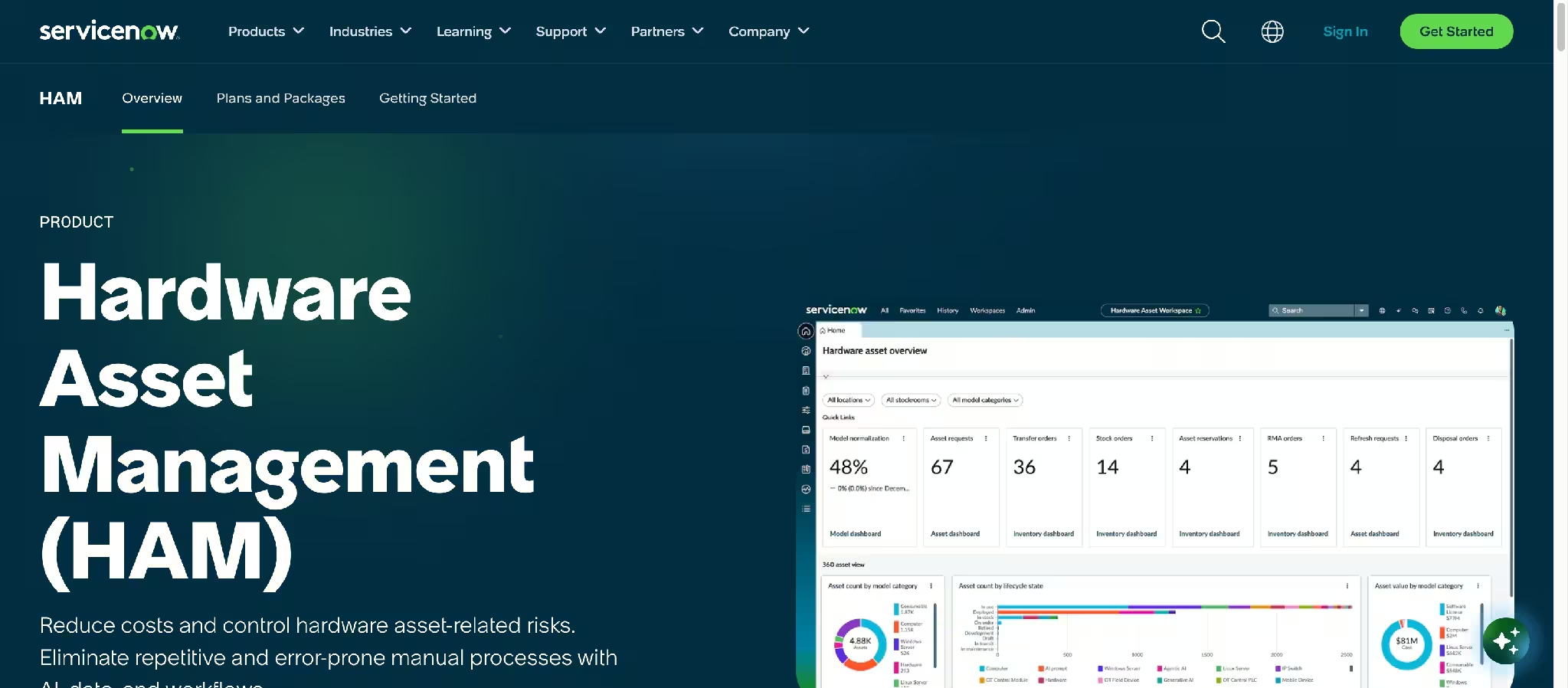
ServiceNow is usually already in the building, the mandated system of record for large enterprises. Hardware Asset Management Professional is a mature module rather than a box-tick.
Key Features
ServiceNow's HAM page describes the automated lifecycle flows HAM Pro adds to the asset tables: hardware asset orders with approval and purchase-order generation, bulk stock orders with auto-replenishment, onboarding and offboarding flows triggered from HR or ITSM, and six asset task types (Deploy, Swap, Retire, Refresh, Loaner, Leased Return). Alongside them sit a disposal flow with certificates, Advanced Shipment Notifications that pre-populate receiving records, and a mobile app for barcode stockroom audits.
Pricing
There is no public price list and no self-serve path. Licensing works by hardware resource category rather than by seat or device: the HAM licensing docs state that "Hardware Asset Management (HAM) licensing enables you to choose the Hardware Asset Management resource categories that you want to use."
Licensing basis per the ServiceNow HAM licensing docs, read August 2026.
Where ServiceNow HAM Pro Shines
- The asset record lives where every other process lives: an agent resolving a ticket, a change manager, a procurement approver and a finance controller read the same asset object.
- Lifecycle modelling well beyond a register: stockrooms, transfer orders, RMA, reclamation of idle hardware and refresh planning against end-of-support dates.
- Audit readiness at scale: a non-incentivized July 2018 Capterra review by an IT compliance manager reads: "I am able to, at a glance, see all of the IT assets in our company (more than 15,000) and see where they are and to whom they are assigned."
Where ServiceNow HAM Pro Falls Short
- Implementation dwarfs the licence: a practitioner in an August 2024 r/servicenow thread put numbers on it: "It's the SIs that gouge asking for 1.5x-3x license to PS hours cost. I.E. $50k licenses and a $150k implementation cost with a 45% margin baked in."
- Data quality becomes a permanent staffing commitment: a developer who rated the product 4.5 out of 5 in a June 2026 G2 review wrote that "The effectiveness of ServiceNow IT Asset Management heavily depends on data quality, governance, and proper setup", and a July 2025 r/servicenow comment summarised it as "garbage in - garbage out".
- Find out which product you have: Core Asset Management ships with every ITSM licence. A ServiceNow employee describes it on the vendor's own HAM blog as "a spreadsheet replacement with a database behind it" where "Every lifecycle transition ... requires a human to manually update records". Ask which one you have before concluding the automation is missing.
Reviews
The cleanest hardware-specific pool is also the smallest: Gartner Peer Insights 4.3 (34) in its Hardware Asset Management Tools market, read August 2026. Broader ITAM listings show G2 4.3 from 498 reviews and Capterra 4.3 from 32, where nearly every review is incentivized. G2's own aggregation counts 14 mentions of being too expensive for small companies.
Best For
- Large enterprises already on ServiceNow: putting the asset object elsewhere creates a reconciliation problem.
- Regulated, audit-driven estates: formal lifecycle trails, disposal certificates and compliance evidence.
- Facility-based fleets with stockrooms and field staff: barcode audits assume somebody walks the building.
A stockroom transfer in HAM Pro creates a database record and a task in somebody's queue. That person still packs the box and books the courier.
InvGate Asset Management: Best for SMB Discovery and a CMDB at a Flat Price
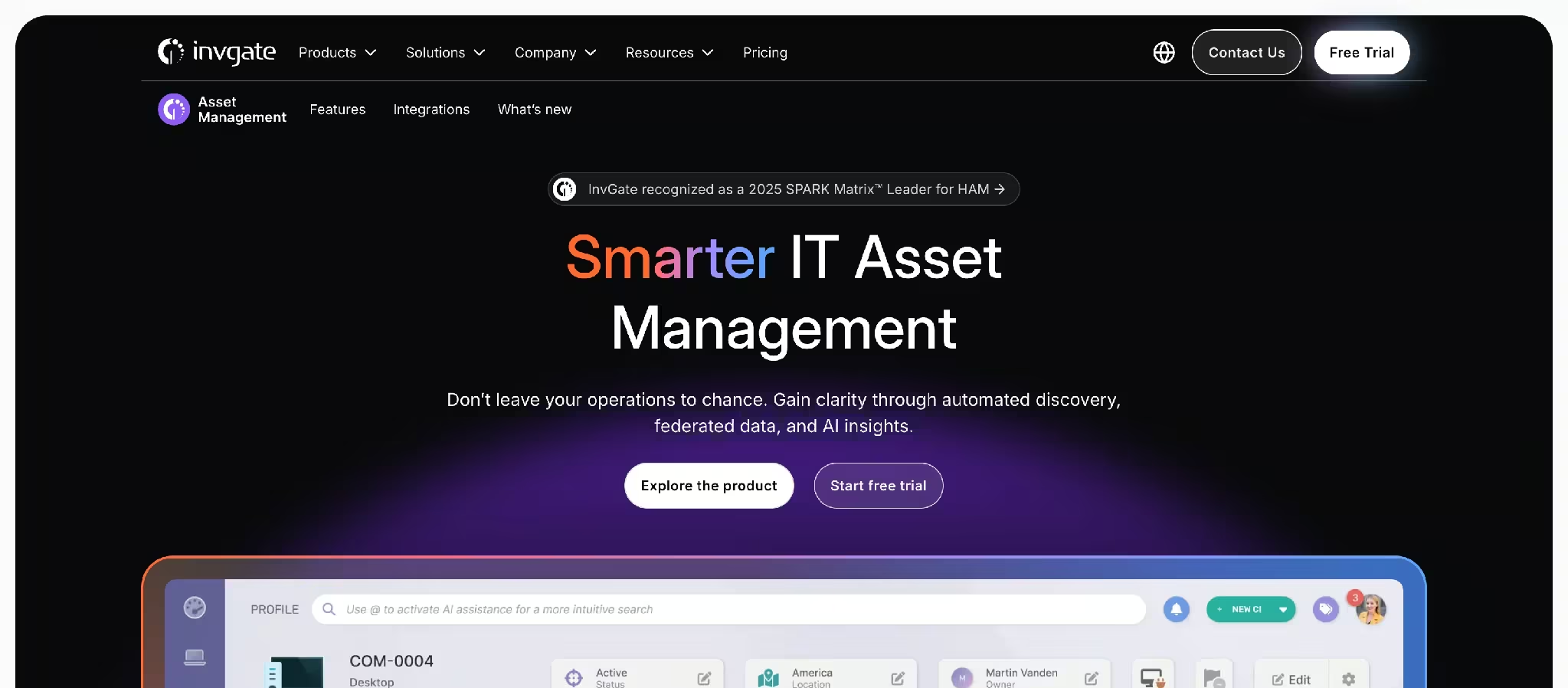
InvGate is an Argentine software company that raised a $35M growth round led by Riverwood Capital in July 2023 and lists 268 employees. Its asset product targets SMB teams wanting discovery plus a CMDB without per-technician pricing.
Resolve the naming trap first. InvGate sells InvGate Asset Management (the ITAM tool, previously InvGate Insight) and InvGate Service Management (the ITSM tool), and the two sit on separate review profiles. The service-desk product is better reviewed at roughly eight times the volume: 4.6 from 108 on Capterra against 4.4 from 14 for the asset tool. Capterra still uses the legacy `InvGate-Insight` slug, and the "Customers' Choice 2025" badge on the asset pages was awarded for ITSM platforms.
Key Features
Its feature table puts discovery agentless over IP ranges, using 11 or more protocols. An agent covers Windows, macOS, Linux and Android, and agentless coverage extends to AWS, Azure, Google Cloud and VMware. Above the inventory sit a CMDB with automatic relationship discovery, Health Status Rules, contract and warranty tracking, software metering with remote uninstall, and purchase orders. Billing counts IP devices, and each one allows two non-IP items such as monitors.
Pricing
Tiers from the InvGate pricing page, read August 2026. Starter excludes SSO, the open API, custom dashboards, automatic CMDB mapping, software metering and purchase orders, so read the flat tier as discovery plus a basic register.
Where InvGate Shines
- A published flat price with no per-technician fee: the number is on the page, and it does not move with the size of your IT team.
- Compliance on paper most rivals lack: SOC 2 Type II, ISO 27001:2022, ISO 9001 and GDPR, with certificates and penetration test reports in its own trust center.
- Ease of use is the one thing every review pool agrees on: a government reviewer in a June 2026 Gartner entry noted "there's less resistance from the team in using it".
Where InvGate Falls Short
- Agent reliability is the newest criticism: a July 2026 Gartner reviewer titled their three-star review "Asset discovery and inventory features hampered by inconsistent agent reliability", and a listed dislike on the same Gartner profile reads "Performance can be inconsistent for example agent was not working properly in China."
- A 500-device floor prices out small shops: an SMB buyer with about 160 users reported in a 2026 r/sysadmin thread that "Invgate requires a minimum of 5 agents and 500 assets (Pro tier)."
- Reporting customization was the long-standing complaint: a solutions analyst in an August 2023 Capterra review noted "It does not have customizable dashboards". Custom dashboards are now a Pro-tier feature, so date the criticism when you use it.
Reviews
The real pool is Gartner's, login-gated at 4.7 from 107 ratings as of August 2026. The public pools are thin: G2 4.7 from 11 reviews, nine from Latin America and mostly vendor-invited, and Capterra 4.4 from 14, of which 8 are vendor-touched. Treat the scores as promising rather than proven.
Best For
- SMB and mid-market teams: 500 to 5,000 networked devices at a predictable published price.
- Anyone already buying InvGate Service Management: the two-product integration is the strongest reason to choose it.
- Procurement gated on SOC 2 Type II today: InvGate holds it, and offers an on-premises option at Enterprise.
InvGate will tell you when a device stops checking in. Working out whether it sits in a former employee's kitchen drawer in Lisbon, and getting it out of there, still costs your team an afternoon.
Reftab: Best for Cheap Self-Serve Custody Tracking
Reftab is the small, founder-led entry, started in New York in 2013. Its own about page names the 2020 TinySeed batch as its only backing, and LinkedIn still lists it in the 11 to 50 employee band.
Key Features
Asset records with unlimited custom fields, custom QR labels, check-in and check-out to a person or a place, overdue-loan alerts, reservations with a booking portal, kits, signature capture, and maintenance, depreciation and audit logs on the top tier. Software asset management is native, via browser extensions that surface shadow IT.
Reftab ships no hardware discovery agent of its own. Hardware enters by manual entry, spreadsheet import, or a sync from a system that already has an agent. Its own integrations page makes the point using a rival's agent: "Lansweeper's network discovery tool automatically adds assets to Reftab, providing essential device info like antivirus and firmware details to keep you compliant with IT security policies."
Pricing
Prices from the Reftab pricing page, read August 2026. Accessories, licences and archived assets do not count toward the billable quota, and Reftab asks for no contract. Neither does Tequipy.
Where Reftab Shines
- Support is the standout: a 4.8 Customer Service sub-score on Capterra, and reviewers who reach a founder directly. One wrote in a May 2022 Capterra review: "I have been in contact with Mike, who I believe to be one of the founders of the software."
- Price and speed to first value: free at 50 assets, $31.25 a month after that, and you sign up and pay by card without a sales call.
- Purpose-built for shared equipment: reservations, kits, loan limits and overdue alerts solve the "who has the camera on Thursday" problem.
Where Reftab Falls Short
- Manual entry fills every gap the syncs miss: an IT director wrote in an October 2025 Capterra review that "The platform still feels quite manual when it comes to data input. Integration with Intune is helpful, but not all fields map correctly. Details like RAM and processor often don't come through."
- The working price is four times the sticker price: every MDM, vendor and identity integration, plus audit logs, sits at the $125 Business tier. A Starter buyer who wants the Intune sync and an audit trail pays four times the $31.25 sticker.
- Retrieval is somebody else's product: the Retriever integration quoted earlier draws the boundary in Reftab's own words. It runs on a separate Hello Retriever account with self-serve US, Canada and UK shipping.
Reviews
Reftab's reputation rests on one pool: Capterra 4.7 from 138 reviews as of August 2026, with ease of use at 4.7 and customer service at 4.8. GetApp and Software Advice repeat that figure. G2 4.3 from 4 reviews, also August 2026, is not a usable sample, and no Trustpilot profile exists. Seven reviews cluster in early October 2025, so read the individual negatives before the average.
Best For
- Small IT teams, schools and non-profits: cheap self-serve tracking with no procurement cycle.
- Shared-equipment operations: AV departments, media production, labs and job sites.
- Teams that will not deploy another agent: they accept manual entry instead of another endpoint install.
The check-out record is only as current as the last person who typed in it. The courier, the wipe and the resale sit outside the product, on somebody else's account.
Snipe-IT
Snipe-IT is the free, open-source option, created in 2013. It is now one of the best-known asset projects on GitHub, where its repository passes 14,000 stars. Self-host it under AGPL-3.0 and it costs nothing, with unlimited users and assets. Grokability's cloud hosting is priced from $399.99 a year up to $7,500 for a dedicated instance.
Reviewers rate it 4.6 from 27 on G2 and 4.4 from 23 on Capterra as of August 2026, where value for money scores 4.7 and customer service 3.7. The catch is the usual one for self-hosted software: you own the server, the backups and the upgrades, and there is no discovery automation. Nothing about self-hosting shortens the list of physical jobs either, so you also own the buying, the shipping and the chasing.
AssetTiger
AssetTiger is the cheapest credible register here, run by the MyAssetTag team at SmartSign, and it markets itself hard at K-12 school districts.
Check the current terms carefully, because they tightened. Its own pricing page now offers a 30-day free trial capped at 250 assets, 2 users and 5 custom fields. A trial that is not upgraded drops to view-only instead of continuing free. Paid tiers run from $220 a year for 500 assets to $3,025 for 250,000, with unlimited users and REST API access on every paid plan.
It scores 4.6 from 271 reviews on Capterra as of August 2026, though a large share are incentivized. The complaint that follows the change is the free-to-paid cliff: "the leap is just absurd from FREE, to $240 a year ... I need to pay $20 a month JUST to have more custom fields that I had for YEARS???" wrote a reviewer in a July 2025 Capterra review.
A barcode scan proves somebody walked past the asset with a phone in their hand. That is no help at all for a laptop two continents away.
How to Choose Hardware Asset Management Software
Feature matrices in this category all look alike, because every vendor lists the same nouns. One question separates them: who updates the record when a device physically moves? Work through it in four steps.
1. Trace Your Actual Data Entry Path
For every source of hardware truth, write down what triggers a record change. If a credentialed scan finds it, ask what share of your fleet is reachable on a network you control. If the MDM syncs it, the register inherits your MDM's blind spots, and a device enrolled nowhere stays invisible until somebody types it in. If somebody types it in, you have chosen a manual process and should budget for it.
2. Count Which Physical Steps Anyone Covers
List the lifecycle steps where a human touches hardware: sourcing in-country, configuration, delivery, repair, collection from a leaver, storage, redeployment, wiping, disposal. Mark which tool covers each. The list comes back empty for all eight, which is normal rather than a defect. Then put an owner's name and an hours-per-month estimate against every unmarked step. Those are the hours the r/sysadmin commenter quoted earlier was describing, and somebody on your team is already spending them.
3. Price the Whole Thing, Including the Parts That Are Not Software
Ask every vendor for the total first-year cost at your device count, itemised four ways: licence at the tier that contains the features you named, implementation or professional services, the integrations you need and which tier they sit in, and internal time to keep the data clean. That last line surprises people. One ServiceNow practitioner, in a July 2025 r/servicenow thread, told a peer to "ask for a new headcount if you can and get a CMDB admin/engineer to help you through it".
4. Decide Whether You Need One Tool or Two
If the failing layer is knowledge, buy software. If the failing layer is physical work, software will not touch it and a lifecycle service will. Plenty of teams run both, and that is usually the right answer rather than a compromise. The register governs and reports; the service performs the work and writes back what happened. IT procurement software and services divide along exactly that line, and most estates end up buying one of each.
Pro tip: before shortlisting anything, run a ten-asset proof. Export your register, pick ten serial numbers at random, and for each one get evidence that the machine is where the record says and with the person named: a photo of the serial on the chassis, a fresh MDM check-in under that user's account, or a courier signature. Allow five working days and count anything unproven as a miss.
Seven out of ten means your record is 70% accurate. Take that number into every vendor conversation instead of the dashboard figure. Then sort the misses into two piles. A miss a better scanner would have caught is a software purchase. A miss that needs a person to physically locate a laptop abroad is a service decision.
{{cta-primary}}
CONCLUSION
What's Next
Pick your layer before you pick your vendor. If you cannot prove what you own, a discovery-first tool from this list earns its money quickly, and a cheap custody register will do at small scale. If you already know what you own and the week still disappears into couriers, chasing ex-employees for laptops and answering customs questions, the physical layer is what is failing. That layer needs a service.
Tequipy runs it for globally distributed teams. Hardware comes at retail price, the platform fee is $99 a month whatever the fleet size, and every service works on devices you bought elsewhere. Start with one hire in whichever country has caused the most trouble, or talk to the Tequipy team about how the record feeds back into whatever register you keep.
FAQ
What is the difference between hardware asset management and IT asset management?
Hardware asset management is the subset of IT asset management dealing with physical devices: laptops, servers, network gear and peripherals. IT asset management covers those plus software licences, cloud subscriptions and contracts. Most tools sold as hardware asset management software also carry some software tracking.
Is a hardware asset management tool enough on its own?
It is enough when your problem is knowledge. If you cannot say what you own, where it is or when the warranty runs out, a register with discovery behind it fixes that inside a quarter. It stops being enough when your problem is work, because no tool in this category performs a physical step: sourcing hardware where you have no entity, configuring a machine before somebody's first morning, collecting a laptop from the home of a person who left in March, wiping it to a certificate, reselling it.
Reftab says as much in its own documentation by handing device returns to a courier company, and a practitioner in an r/servicenow thread put the boundary plainly: "No SW solution is going to do ITAM for you."
A register documents that work after somebody performs it, so teams in that position run a register alongside a lifecycle service such as Tequipy's global procurement and retrieval, and running both is usually correct rather than a compromise. Neither replaces the other.
Do you still need hardware asset management software if you already run an MDM?
Usually yes. An MDM manages configuration and security for machines it has enrolled. It does not hold purchase cost, warranty, contract, custody history or disposal records, and it cannot see hardware that was never enrolled. Most registers here read from your MDM and sit alongside it.
What is hardware and software asset management?
Together they are the practice of tracking every IT asset a company owns across its whole life, physical and licensed, from purchase to disposal. Hardware asset management answers what exists and who has it. Software asset management answers what is licensed, what is used, and what is being paid for twice.
What is the best asset management software?
It depends on which half of the problem is failing. For finding hardware on a network you control, Lansweeper is the strongest tool in this comparison. For governance and audit evidence at enterprise scale, ServiceNow HAM Pro. For a custody register at the lowest possible cost, Reftab or Snipe-IT. None of the eight moves a device, so teams whose hardware sits in employees' homes across several countries usually pair a register with a lifecycle service rather than picking one winner.
Does Tequipy work for large fleets?
Yes, and the pricing is what makes it work: $99 a month flat for unlimited devices, so a 2,000-device fleet pays the same platform fee as a 200-device one, with no seat minimum and no tier to move up into. The public evidence points the same way. Two of the three reviews on Tequipy's G2 profile come from enterprises above 1,000 employees, and Booksy has 800+ assets managed by Tequipy, with 99% of them delivered before the employee's start date.
Is Lansweeper changing owners, and should that affect a buying decision?
Yes, a change is agreed. A press release dated 27 July 2026 confirms Bridgepoint has agreed to acquire a majority stake in Lansweeper, with Insight Partners and Imker Group exiting and the deal expected to close by the end of 2026 subject to customary approvals. It has not closed, so allow for pricing uncertainty at renewal.

Keep your current setup.
Just test us on one order.
AUTHOR
Before Tequipy, Tomek ran IT at Revolut, scaling from 100 employees in 2 offices to 5,000 across 17. He built the system that kept every laptop accounted for, then founded Tequipy – a platform that handles IT equipment logistics for distributed teams across 180+ countries.
As CEO, he runs operations and covers the founder layer: strategy, product, and the company-building that comes with both.
15 minutes. Your countries, your devices, your setup. No pitch.