KEY TAKEAWAYS
- The international procurement process runs in five steps: define the requirement, qualify suppliers per market, price the landed cost rather than the unit cost, execute with customs and tax handled, then measure delivery and keep the record.
- Landed cost is the concept that separates a working process from a surprising one. The unit price is one line in a total that also includes duty, VAT treatment, freight, currency movement and internal time.
- The most reliable way to avoid customs delay on IT hardware is to avoid the border. Buying inside the destination country removes import paperwork instead of managing it.
- Tequipy runs this model for IT hardware across 180+ countries through 600+ authorized resellers, at recommended retail price with delivery included and every rate published.
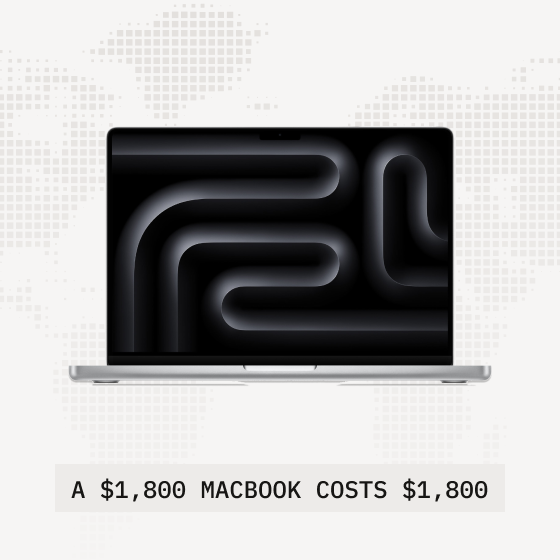
International procurement is the process of buying goods from suppliers outside your own country, and for IT hardware it is where most distributed companies discover their process was never a process. A laptop that costs $1,800 in one market arrives as a $2,300 problem in another once duty, freight and a customs hold are counted. This guide sets out the five steps, why the work has become harder, the benefits of standardising it, the five challenges that recur, and the tools that handle each part.
The International Procurement Process in 5 Steps
Step 1: Define the Requirement Before You Approach Anyone
Specify what you are buying in a way a supplier in another country can quote against: exact configuration, quantity, destination country, delivery window and any compliance requirement. For IT hardware this means model, RAM, storage, keyboard layout and warranty term, because each of those changes availability and lead time in a given market.
Standardising here pays for itself downstream. Two laptop builds across a fleet means comparable quotes, predictable spares and realistic resale value. Ten builds means every country becomes a bespoke negotiation.
Learn how to standardise equipment procurement across global teams.
Step 2: Qualify Suppliers per Market, Not Globally
A supplier that performs in one region is not a supplier that performs everywhere, which is the single most common false assumption in this process. Qualify against evidence rather than coverage claims: which countries have they actually delivered in this quarter, what is their SLA in your three hardest markets, and who pays when a delivery fails.
Connecteam learned the general lesson the specific way. Its previous global provider worked in most markets and broke in Australia, which its case study records. Ask for recent performance in your markets, not a map.
Step 3: Price the Landed Cost, Not the Unit Cost
Landed cost is the unit price plus duty, import VAT treatment, freight, insurance, currency movement and the internal hours spent coordinating. A quote that excludes any of those is not comparable to one that includes them.
Two anchors from real evaluations. One team compared a large lifecycle vendor's quote against direct retail and found the margin worked out to 40 to 45% on the same configuration. A separate buyer reported a 30% hardware markup on top of a per-seat platform fee. Neither figure was visible in the headline price.
Ask every supplier for the all-in figure per device, in each destination country, including delivery and any configuration work. Then ask which currencies they invoice in and whether you can choose per order, because a supplier invoicing in one currency has moved its exchange risk onto you.
Step 4: Execute With Customs and Tax Already Decided
This is the step where timelines are won or lost. Cross-border shipments need a commercial invoice, an HS classification, a party responsible for duty and, in many markets, a local tax identity. Any gap in that chain becomes a hold, and holds are not appealable on a schedule.
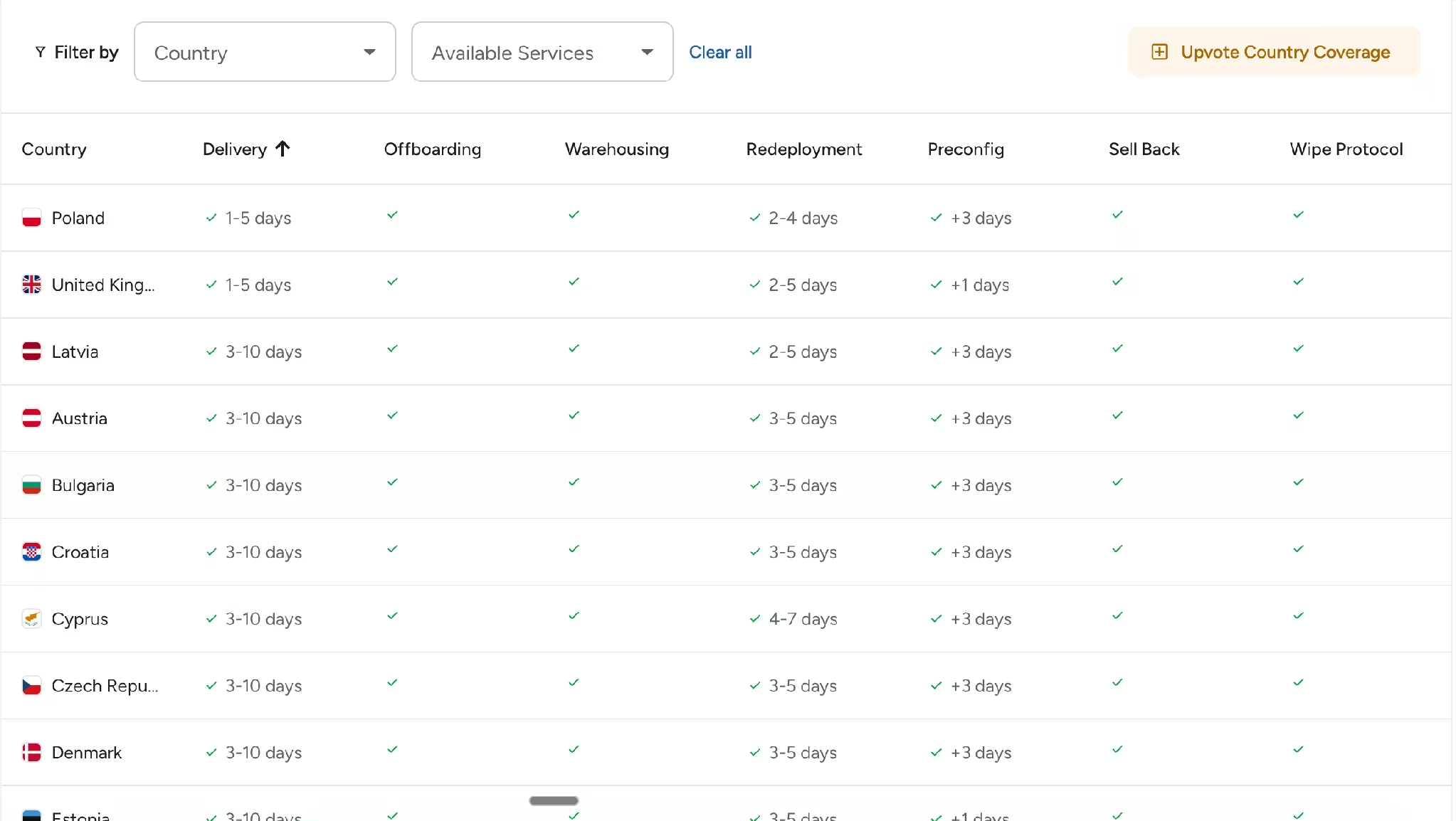
There is a structural alternative to managing all of it: buy inside the destination country so nothing crosses a border. Tequipy's global IT procurement fulfils each order through an authorized reseller in the employee's own country, at recommended retail price with delivery included. Delivery averages 3 business days worldwide with a 10-day maximum, and there is no customs step because there is no import. Within the European Economic Area, open borders make cross-border movement practical, which is the one exception worth knowing.
Coverage is not unlimited. Russia, Belarus and North Korea sit outside the footprint, and a small number of countries support procurement without local storage, so confirm both before you commit a hire to a market.
Step 5: Measure Delivery and Keep the Record
The metric that reflects reality is the share of devices arriving before the date they were needed, not the average transit time. Average time flatters a process that misses the dates that matter.
Record the order against the asset with country, price, serial number and recipient. That record is what makes warranty claims, redeployment and eventual resale possible, and it is the artefact an auditor asks for.
Rates and delivery timings above reflect Tequipy's published services.
Why International Procurement Has Become More Complex
Three forces have converged over the past few years.
Hiring outran the office. Companies now employ people in countries where they hold no legal entity, no vendor account and no tax registration. Procurement inherits the consequences of a hiring decision made elsewhere. One IT manager described the resulting patchwork to us: "We use Amazon for UAE, a local reseller in India, and a different one in the UK."
Compliance moved into the purchase. SOC 2 and ISO 27001 preparation forces documented custody and data destruction, which means the purchasing decision now has to account for what happens at the end of the device's life.
Finance wants total cost of ownership per unit. A lump procurement line no longer passes review, so buyers are asked what a device costs across its whole life, including collection and resale. That question rewards suppliers who publish rates and penalises those who quote.
Benefits of a Standardised International Procurement Process
Benefit 1: Predictable Delivery Against Hiring Dates
Standardisation turns delivery into a planning input. Booksy, with more than 500 employees and 800+ managed assets, sees 99% of equipment arrive before the employee's start date, having tested Latin America before expanding.
Benefit 2: Comparable Costs Across Markets
One build, one quoting standard and one landed-cost format make markets comparable for the first time. TapTap Send consolidated three separate purchasing processes onto one platform and now saves $6,500 a month.
Benefit 3: Hours Returned to the Team
Coordination is the hidden cost of an unstandardised process. Gigs, hiring across roughly 20 countries with 100 employees, got back 100+ hours a month after consolidating, and avoided hiring a dedicated IT logistics person.
What Are the Common Challenges in International Procurement
Challenge 1: Customs Delay and Duty Exposure
An import is a queue you do not control. Duty rates, VAT treatment and paperwork requirements vary by country and by product classification, and a missing document turns a three-day delivery into an open question. Shipping a laptop internationally is manageable as an exception and expensive as a model.
Challenge 2: Quotes That Cannot Be Compared
Different currencies, different inclusions, different lead-time definitions. Without a landed-cost format and a fixing date for currency, comparing two international quotes is guesswork dressed as analysis.
Challenge 3: Supplier Fragmentation
Five to ten vendor relationships per company is typical among distributed teams. Each carries its own pricing, warranty process and support path, and none shares a record with the others, so the asset register becomes a manual reconciliation job.
Challenge 4: Availability and Configuration Limits
Local keyboards are easy. A US layout in Mexico or a QWERTY board in France is a custom order that can take 3 to 4 weeks. High-specification machines for engineers or data scientists can take 2 to 3 weeks as custom builds. A requirement raised days before a start date cannot be met at any price.
Challenge 5: The End of Life Nobody Priced
Procurement is judged on the purchase and lives with the disposal. In Capterra's 2022 offboarding survey, "71% say at least one employee didn't return company-owned equipment, like a laptop or smartphone", with an average loss of $1,963 of equipment per non-returning employee. A procurement process that ends at delivery has not finished.
Pro tip: run a landed-cost test before you sign anything. Pick one configuration and your five biggest hiring countries, then ask each supplier for the all-in per-device cost including delivery, enrollment and any platform fee, in the destination currency. Ask what happens to that figure at 20 units and at 200. Twenty minutes of email produces a comparison table no sales deck will give you, and the spread between suppliers in your hardest market is usually larger than the spread in your easiest.
Tools and Software for Managing International Procurement Successfully
Three categories of tool touch this process, and only one of them buys anything.
Procurement or P2P software manages requisitions, approvals and purchase orders. It is the right tool for governance and the wrong one for logistics, because it does not source hardware or clear customs.
ITAM registers record what you own once it arrives. They reconcile scans, agent data and MDM feeds into one asset record, and they perform no physical step.
Lifecycle platforms buy, configure, deliver, collect, store, redeploy and resell, then update the record as each step happens.
Tequipy: Best for Managing International IT Procurement at Scale
Tequipy removes the border from IT procurement rather than managing it. Every order is fulfilled by one of 600+ authorized resellers in the employee's own country across 180+ countries, at recommended retail price with delivery included. Devices arrive enrolled in your MDM through Apple Business Manager or Windows Autopilot at no extra cost, which is the zero-touch deployment part of the same purchase.
Payment terms matter to a growing company as much as unit price. Card and bank transfer run through Stripe, invoicing is available in EUR, GBP and USD with the currency chosen per order, and a $5,000 credit line gives 7 calendar days to pay after delivery. That credit line is a payment mechanism rather than financing, and Tequipy does not lease or finance hardware in any market.
Three reviews sit on Tequipy's G2 profile in August 2026, averaging 4.8 out of 5, and the composition is the useful part: two reviewers work at enterprises above 1,000 employees and one at a mid-market company. An IT lead at an enterprise over 1,000 employees writes that "it really stands out that I don't need to have a local IT department in every country we operate in", naming Colombia and the Philippines (July 2026).
Two limits before you shortlist. Devices stay in the country where they were purchased or collected, with the EEA treated as one region, so cross-border redeployment is not available and resale is the answer for a market you are leaving. And SOC 2 is still in progress: ISO 27001 certification and penetration test reports are available today, so ask the team where that certification currently stands if a report is a procurement gate.
{{cta-primary}}
International Procurement Examples and Case Studies for Global IT Teams
Booksy: Qualify in the Hardest Market First
Booksy runs 800+ assets across more than 500 employees and chose Latin America as the pilot rather than an easy market. Marcin Szydłowski, Director of Enterprise Technology and Security, explains the reasoning in the case study: "We initially tested them in Latin America, a region where we faced logistical challenges." Delivery before start date now runs at 99%, and the relationship expanded from that test.
The transferable practice is the sequence. A pilot in your easiest country proves only that easy countries are easy.
RemoFirst: One Supplier Across 30 Countries
RemoFirst, a company of about 250 people, uses a single provider for deliveries, repairs and retrievals across 30 countries including Kazakhstan, Colombia and Ukraine. Its case study records every company-issued device recovered and roughly $2,000 per employee protected. People Operations Specialist Lera Lykholiet describes the arrangement in the same case study: "It's seamless, and it's exactly what we need while hiring globally."
{{cta-primary}}
CONCLUSION
Connect Procurement, Logistics, and Deployment With Tequipy
International procurement stops being firefighting when buying, configuring, delivering and collecting run as one process with one record. The fastest way to test that is not a vendor evaluation. Pick the country that has caused you the most trouble this year, run one hire through it end to finish, and compare the landed cost against your current route.
Talk to the Tequipy team about that first order, or price it yourself on the pricing page, which carries the full rate card and a calculator that works out your own numbers in about 30 seconds.
FAQ
What are the four main types of procurement?
Direct procurement of goods for production, indirect procurement of goods and services for internal operations, goods procurement, and services procurement. Company IT hardware is indirect goods procurement, which is why it often sits outside the formal purchasing process even in mature companies.
What are the six main methods of procurement?
Open tendering, restricted tendering, request for proposals, two-stage tendering, request for quotations, and single-source or direct procurement. For IT hardware in a single market, a request for quotations is typical; for global hardware, direct procurement through one partner usually beats tendering per country.
What software helps manage international procurement?
Three categories, each doing a different job: procurement or P2P software for requisitions and approvals, ITAM registers for tracking assets after arrival, and lifecycle platforms that actually buy, ship, collect and resell hardware. Only the last category performs the physical work.
How do you avoid customs delays when buying IT hardware abroad?
Buy inside the destination country so no border is crossed. Where a cross-border shipment is unavoidable, agree in advance who is the importer of record, who pays duty and VAT, and which HS classification applies, then keep the commercial invoice with the order.
How long should international hardware delivery take?
Three business days is a reasonable average when devices are sourced locally, with ten days as a worst case for remote locations. Custom configurations and non-standard keyboard layouts add 2 to 4 weeks, and any cross-border shipment adds an unpredictable customs step.
Keep your current setup.
Just test us on one order.
AUTHOR
Before Tequipy, Tomek ran IT at Revolut, scaling from 100 employees in 2 offices to 5,000 across 17. He built the system that kept every laptop accounted for, then founded Tequipy – a platform that handles IT equipment logistics for distributed teams across 180+ countries.
As CEO, he runs operations and covers the founder layer: strategy, product, and the company-building that comes with both.
15 minutes. Your countries, your devices, your setup. No pitch.