Device Lifecycle Management Software That Runs Every Stage
Every device in a spreadsheet. Updated by hand. Out of date already.
Tequipy is device lifecycle management software that also does the physical work. One record per device in 180+ countries. Every stage from order to sellback runs as a real service the moment you click: couriers booked, devices wiped, laptops resold and the money paid out. The record stays current because the platform runs the stages.



Here's what changes when device lifecycle management software does the work too
A record that updates itself, not a spreadsheet you update after the fact
Your tracker is only as good as the last person who updated it. The device came back but the row still says assigned; the repair happened but nothing logged it. By the time an audit asks who holds what, the answer is a week of chasing people.
Every status change is written by the service that caused it. The courier pickup, the wipe, the redeployment: each one logs itself the moment it happens. When an auditor asks who holds what, the answer is current, and it takes seconds.
Offboarding is a click that sends a courier, not a row you mark "returned"
An asset tracker records the offboarding your team still runs by hand: emailing the leaver, finding a box, booking the courier, checking the wipe. The tool watches while your people do every step, and when nobody has time, the laptop simply stays with the ex-employee.
Click offboard and Tequipy contacts the employee, ships packaging, books the pickup, wipes the device, and stores it, for $70-150 with everything included. Your team's only job is the click, and the same click works in 180+ countries.
Free under 100 devices, not $12-20 per employee per month
Lifecycle tools mostly bill per employee: $12-20 each per month, which is $40,000-70,000 a year for a 300-person company. The fee covers every seat, including the hundreds of people who never open the tool, and it's due even in months when nothing happens.
The platform is free under 100 devices and $99 a month flat above that, with no per-seat charge at any headcount. Services bill per use: an offboarding when someone leaves, storage while a device waits. A quiet month costs nothing.
Resold or redeployed at end of life, not written off in a drawer
Across the market, roughly 29% of devices never come back from leavers, at $1,500-2,500 each. The ones that do come back often sit in a drawer losing value. Either way, the device ends up written off instead of turned back into money.
Recovery, resale, and redeployment are stages in the same system. Devices come back (customers see 100% recovery against a 71% market standard), then redeploy for $70-150 or sell back for 20-70% of their value. One customer prevented about $2,000 per employee in losses.
What makes device lifecycle management software work on one platform

One live record for each device
Owner, MDM status, warranty, condition, serial number, and the full service history of every device in one registry, with unlimited admin seats for IT, HR, and Ops. The record updates as each stage runs.
Every stage runs from the software
Order, configure, repair, offboard, store, redeploy, sell back: each is an action in the platform, executed by Tequipy's network of 600+ local resellers, couriers, and warehouses in 180+ countries. Devices are sourced in-country and arrive in 3 business days on average.


Your HR system triggers the lifecycle
HR systems first: HiBob, BambooHR, and Workday sync natively (a $199/month add-on) so hires and leavers trigger lifecycle actions. Devices enroll via ABM and Autopilot, login runs on Google, Microsoft, or Okta SSO, and a REST API covers the rest.
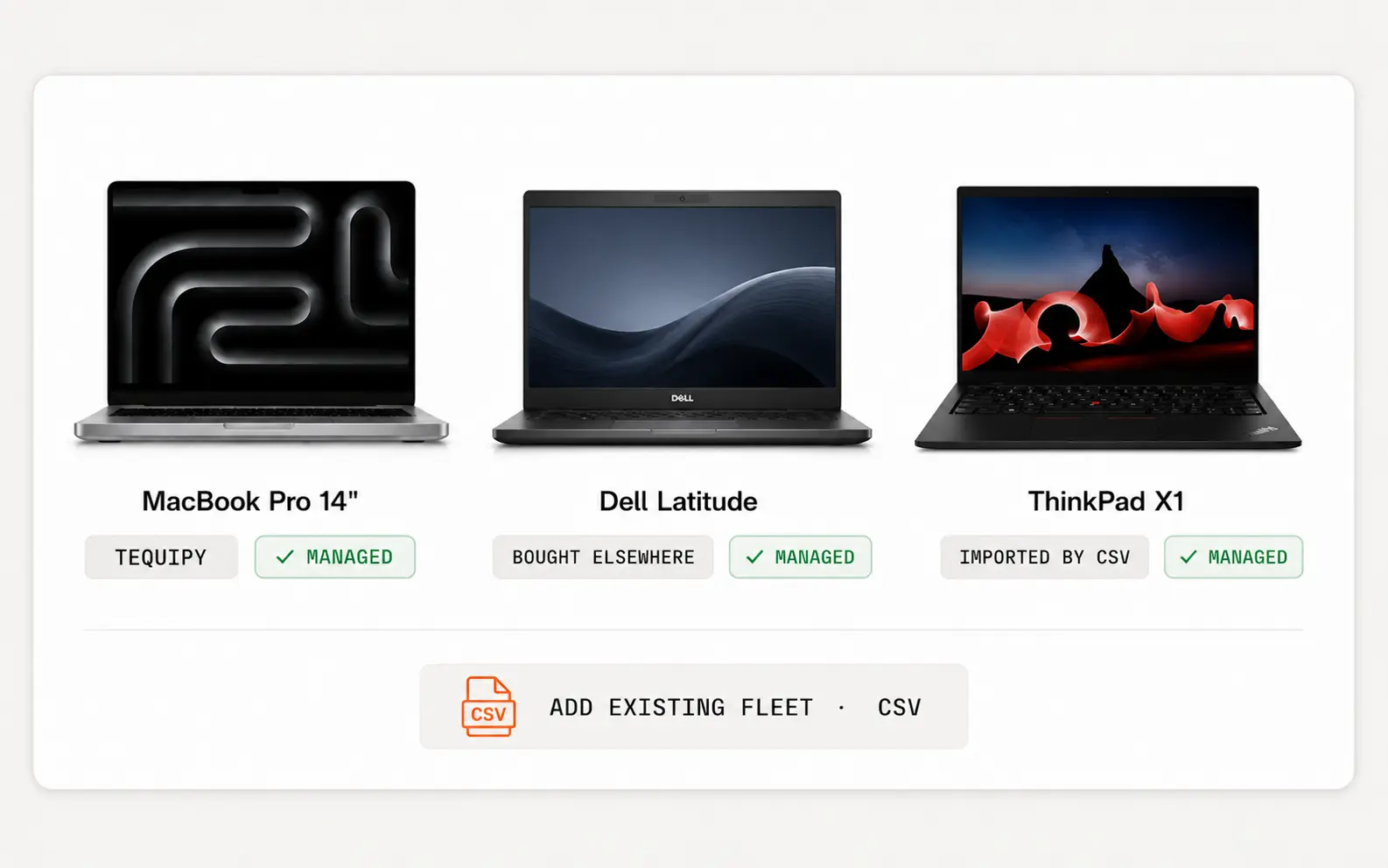
Covers the devices you bought somewhere else
Your current fleet comes in by CSV upload. Repair, offboarding, storage, redeployment, and sellback then apply to all of it, whoever sold you the hardware.
Free under 100 devices, then $99 flat
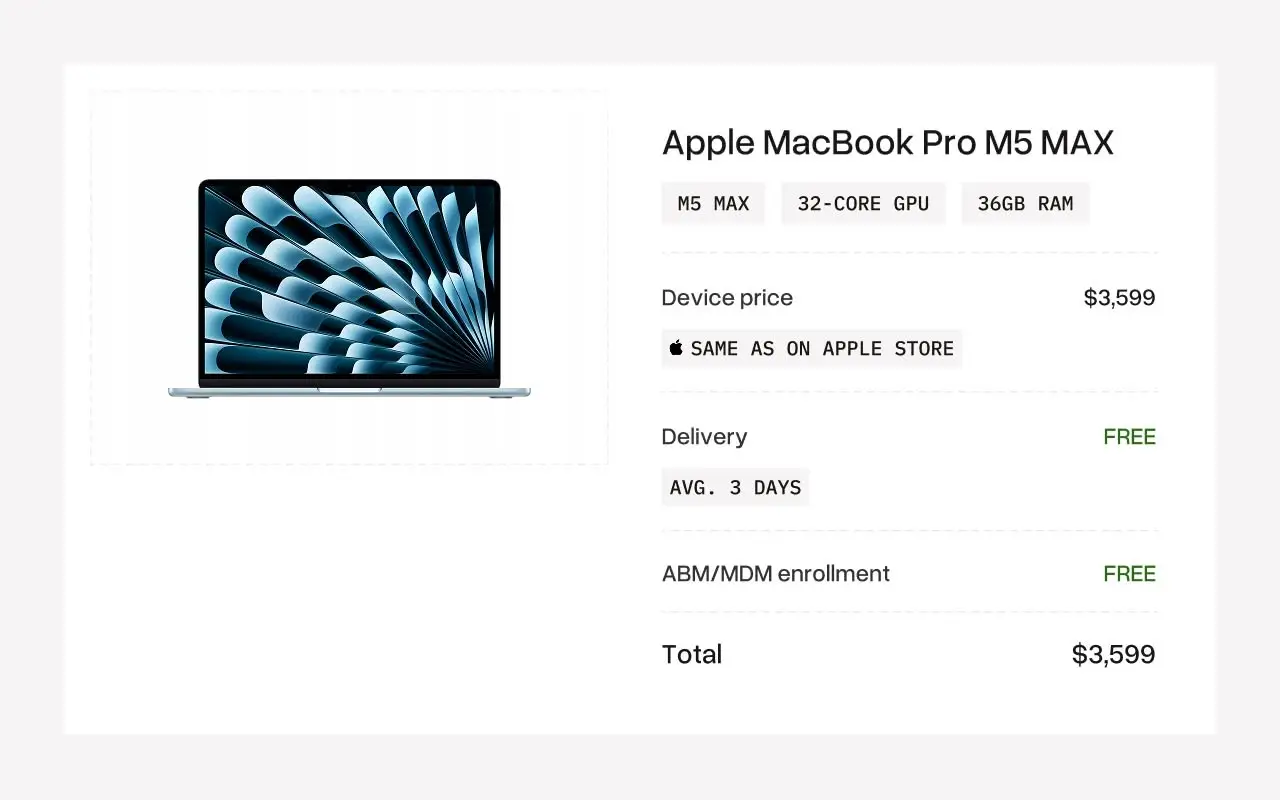
No per-seat or per-employee fee at any size. Hardware sells at recommended retail price, and each service bills only when used: offboarding $70-150, storage $12 a month per device. > "The dashboard is clean, intuitive, and gives us everything we need, from device tracking to offboarding flows." > Khachik Yenigbaryan, IT Operations Engineer, Tabby
How TapTap Send runs onboarding, offboarding, and servicing from one dashboard
TapTap Send, a 250-plus-person payments company, tracked hardware across three purchasing processes, with no automated offboarding and laptops that rarely got a second life. Devices were bought, used, and lost from view.
Every device now lives in one dashboard where the lifecycle actually runs: onboarding and offboarding take three clicks, Apple devices enroll in Jamf automatically, and each action logs itself. TapTap Send saves 40+ hours and $6,500 every month, with 99% of deliveries arriving before the start date.
Time saved
Money saved
SLA Performance
Device recovery rate


You're not taking on another system to keep updated. This one updates itself.
The honest answer to the first question every IT team asks: who keeps this record accurate? The services do. Every pickup, wipe, repair, and resale writes its own entry, so the record is a by-product of the work instead of a chore after it.
Day 1, Bring the fleet in
Day 5, Run one device's cycle
Day 30, The record keeps itself
See what global IT procurement looks like for your team
15 minutes. Your countries, your devices, your setup. No pitch.
Have more questions about device lifecycle management software?
What does device lifecycle management software cost with Tequipy?
The platform is free under 100 devices and $99 a month flat above that, with no per-seat fee. Hardware is at local retail price, and lifecycle services bill per use: offboarding $70-150, storage $12 per device per month, redeployment $70-150.
Can the software manage devices we bought somewhere else?
Yes. A CSV upload brings any device into the registry, and the lifecycle services, repair through sellback, run on it regardless of where it was bought.
How does the record stay up to date?
Each service writes its own status. When Tequipy collects, wipes, stores, or redeploys a device, the registry entry updates at that moment, so the record reflects what actually happened rather than what someone remembered to type.
What happens to devices at end of life?
Three options from the same screen. Redeploy to a new hire for $70-150. Sell back to Tequipy for 20-70% of the device's value, depending on age and condition. Or destroy it with a certificate where compliance requires it.
Does it integrate with our HR system and MDM?
HiBob, BambooHR, and Workday sync natively as a $199/month add-on, so a hire or leaver in the HR system can trigger an order or a collection. MDM enrollment runs through ABM and Autopilot, and a REST API covers other tools.
Is there an audit trail?
Yes. Every device carries its history: owners, repairs, MDM status, chain of custody on collections, and wipe certificates. Tequipy is ISO 27001 certified, penetration tested, and hosts in Europe.
What is device lifecycle management software?
Device lifecycle management software tracks and manages a company's devices through every stage of their working life in one system of record. The stages run from purchase and deployment through servicing and offboarding to redeployment, resale, or disposal.
What does device lifecycle management software do?
Device lifecycle management software keeps a live registry of every device with its owner, status, and history, and automates stage transitions such as onboarding and offboarding. Tequipy's version also carries out the physical work of each stage rather than only recording it.
How is device lifecycle management software different from asset tracking software?
Asset tracking software records where devices are and who holds them. Device lifecycle management software also manages what happens to them: deployment, repair, recovery, redeployment, and resale. Tequipy closes the remaining gap by executing those stages, not just scheduling them.