KEY TAKEAWAYS
- A free fixed asset register template in Excel for IT equipment: one row per device, a monthly depreciation schedule, inventory and ledger checks, and a refresh and returns dashboard.
- Its columns cover identification, ownership, cost, depreciation, disposal and verification; distributed teams add entity, invoice currency and FX rate.
- Set a threshold and useful lives first, and start depreciating when a laptop is available for use.
- Straight-line depreciation is cost minus residual value, divided by useful life in months. On a sale, the gain or loss is net proceeds minus net book value.
- Reconcile with the IT inventory by serial number every month.
Month end comes, and nobody can say which laptops are still on the books or what the one still with a leaver is worth.
A fixed asset register template gives finance one row per asset: what it cost, when it went into use, how much has been charged as depreciation and what it is still worth. For a laptop, depreciation usually spreads the cost evenly: a $1,800 laptop kept for 36 months costs the books $50 a month. This template is built for laptops in employees' homes, often owned by an entity in another country.
Below: how to use it, what each column group is for, six setup steps, one laptop worked to buyback, and four habits that keep the register true.
Download the free fixed asset register template Excel file
How to Use the Fixed Asset Register Template
Set your policy once on Settings, add one row per device, then act on what each tab tells you. The file's own How to use tab explains colours and formulas.
- Register. An amber in-service date means a capitalised laptop has not started depreciating: ask IT for its delivery date. An amber Pending return still carries book value: start a laptop return that week.
- Depreciation schedule. Add up the column for the month you are closing, entity by entity: that is the month's journal. In the example, October is 38.30 USD for Example Inc. and 147.54 EUR for Example GmbH; Charge to period end is the year so far.
- Reconciliation. Each mismatch is a correction to make before the month closes.
- Dashboard. Devices fully depreciated within six months are next half-year's refresh budget; those still in use after that are your oldest. Pending return book value is what a slow returns chase puts at risk.
Asset ID and Serial number match the IT inventory template, so one paste reconciles the two. The disposal columns record a device sold back, recycled or written off through IT asset disposition.
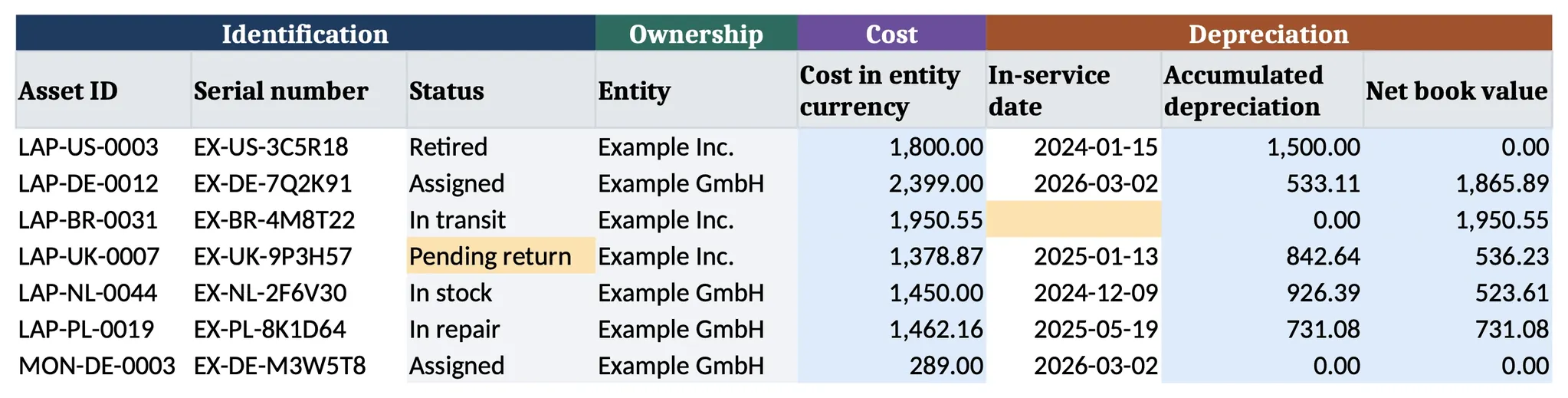
Two of the seven fictional rows show amber: a laptop not yet delivered, and a leaver's laptop not yet back.
Pro tip: record each invoice in the owning entity's currency once, at the invoice-date rate, and never revalue it. IAS 21 keeps "the exchange rate at the date of the transaction" for historical-cost assets. Never add two entities' currencies together: a group total belongs in consolidation.
Does Every Company Need a Fixed Asset Register?
Yes, if it capitalises anything:
- Depreciation. The monthly charge sets reported profit; net book value is a laptop's worth at each stage of laptop lifecycle management.
- Audits. An auditor picks a ledger line and asks for the device and invoice behind it.
- Tax. Relief follows its own rules but is claimed from the same purchase records.
- Insurance. A claim needs the cost and serial number of what was lost.
- Devices that do not come back. A 2022 Capterra survey asked 287 HR staff about the past year: 71% of those who had offboarded someone had a leaver who did not return company equipment. HR staff estimated $1,963 of equipment per employee who kept it. The register shows what that device is still worth on the books: the amount written off if it never returns.
What to Include in a Fixed Asset Register
This is the fixed assets register format in Excel the template uses: 32 columns in seven groups.
- Identification: without one row per physical device, you cannot prove to an auditor that an asset exists.
- Ownership: the entity decides whose accounts carry the cost; the country decides who can collect or repair laptops given to employees at home.
- Cost: what the entity paid, in its own currency, is the base for every later figure.
- Depreciation: how much cost has reached the profit and loss account, and what is left.
- Disposal: turns a device's exit into a recorded gain or loss instead of a missing line.
- Verification: tells you which rows were confirmed recently and which are guesses.
- Calculation: the helper figures behind the totals.
Entity, invoice currency and FX rate are the extra fields a distributed company needs. The cost fields come from the invoice, whether you buy from a local reseller or through IT procurement services.
| Group | Column | What to enter |
|---|---|---|
| Identification | Asset ID | The ID the IT inventory uses, for example LAP-DE-0012 |
| Identification | Serial number | The maker's serial, as in the IT inventory. It never repeats: a duplicate turns red |
| Identification | Description | Make and model |
| Identification | Asset class | Dropdown (Lists) |
| Identification | Status | Dropdown: In stock, Assigned, In transit, In repair, Pending return, Retired |
| Ownership | Entity | Dropdown: the company that owns the device and holds the invoice |
| Ownership | Country | Dropdown: where the device is now |
| Cost | Purchase date | Invoice date (yyyy-mm-dd) |
| Cost | Invoice or PO number | As on the invoice |
| Cost | Cost (invoice currency) | Price paid, plus duties and non-recoverable taxes, minus discounts |
| Cost | Invoice currency | Dropdown: ISO code |
| Cost | FX rate to entity currency | Invoice-date rate into the owning entity's currency; 1 if the same. Never update it |
| Cost | Cost in entity currency | Formula: cost times FX rate |
| Cost | Capitalise? | Formula: Yes, Expense (below threshold), After period end, or Check class and entity |
| Depreciation | In-service date | Date the device was available for use, for example delivered to the employee |
| Depreciation | Useful life override (months) | Optional. Blank uses the class default |
| Depreciation | Useful life (months) | Formula: the override, or the class default |
| Depreciation | Residual value | Formula: cost times the class residual % |
| Depreciation | Accumulated depreciation | Formula: straight-line, by full months, to the period end |
| Depreciation | Net book value | Formula: cost minus accumulated depreciation; 0 once disposed or expensed |
| Disposal | Disposal date | The date the device left the books |
| Disposal | Disposal type | Dropdown (Lists) |
| Disposal | Proceeds (entity currency) | At the disposal-date rate. 0 if none |
| Disposal | Disposal costs (entity currency) | Incremental costs, such as a collection fee. 0 if none |
| Disposal | Carrying amount at disposal | Formula: cost minus accumulated depreciation at disposal |
| Disposal | Gain or loss on disposal | Formula: proceeds minus disposal costs minus carrying amount |
| Disposal | Evidence | Buyer's invoice, wipe or recycling certificate, or police report |
| Verification | Last verified | Last date someone confirmed the device exists |
| Verification | Notes | Free text |
| Calculation | Monthly depreciation | Formula, for reading: (cost minus residual) divided by useful life |
| Calculation | Months depreciated | Formula: full months from in-service to the period end or the month before disposal |
| Calculation | Fully depreciated on | Formula: the month end when depreciation completes |
How to Set Up a Fixed Asset Register in 6 Steps
Thresholds, useful lives and allowances below are general information, not tax or accounting advice: agree them with your accountant or auditor.
Set a Capitalisation Threshold and Asset Classes
IAS 16, paragraph 9 sets no threshold and leaves it to "judgement". A workable rule: capitalise an item that lasts more than a year and costs enough to be worth tracking; expense everything below the line, so it carries no book value and lives in the IT inventory. The example file uses 1,000 per entity, in its own currency; on Reddit, an accountant noted some companies "expense computers under 1k".
A tax allowance does not set your book threshold. The US de minimis safe harbor lets you deduct up to $2,500 per invoice or item, or $5,000 with an applicable financial statement, but only "to the extent such amounts are deducted by you for financial accounting purposes". The UK annual investment allowance lets a business "deduct the full value" of most plant and machinery, up to £1 million, whatever the books do.
In the template: each entity's threshold on Settings; Capitalise? reads Yes or Expense.
Choose Useful Lives and a Method
IAS 16 asks for "the method that most closely reflects the expected pattern of consumption". A laptop gives about the same service every month, so straight-line fits it. On Reddit, one auditor recalled a client that "depreciated them over a 3 year period for GAAP". Review lives each year end against your hardware refresh cycle.
For US tax, IRS Publication 946 puts computers in a 5-year class under MACRS methods such as 200% declining balance: a separate tax schedule.
In the template: the class table on Settings.
Gather Invoices per Entity
A company that buys laptops locally in each country ends up with invoices in reais, pounds and złoty for the same model. IAS 21 records each one in the owning entity's currency by applying "the spot exchange rate" on the transaction date.
In the template: the Cost group, with the FX rate typed once per row.
Tag Every Asset With an ID and Its Serial Number
A sticker falls off a laptop at home; the serial stays on the device and in device management. Use the same Asset ID in both files.
In the template: the first two columns; a repeated serial turns red.
Record Each Asset From the Day It Is Available for Use
IAS 16 paragraph 55 starts depreciation "when it is available for use". For a laptop shipped to a home, the template suggests the day of laptop deployment, a policy reading to agree with your auditor. For US tax, IRS Publication 946 counts property as placed in service when it is "ready and available for a specific use".
In the template: the In-service date column; a capitalised row without one turns amber.
Set a Review Cadence
Monthly: move the period end, post the closing month's column and clear the reconciliation. Yearly: review each class's useful life and residual value.
In the template: the period end on Settings, then the schedule and Reconciliation tabs.
Fixed Asset Depreciation Methods Explained
IAS 16 paragraph 62 names three methods:
| Method | How it works | Best for | Example asset |
|---|---|---|---|
| Straight-line | "A constant charge over the useful life" | Assets used about evenly every month | A laptop |
| Diminishing balance | "A decreasing charge over the useful life" | Assets that lose most of their value early | Equipment whose value drops fastest in year one |
| Units of production | "A charge based on the expected use or output" | Assets worn by use rather than time | A production machine, by hours run |
The template uses straight-line, the first of the IAS 16 methods.
One Laptop From Purchase to Buyback
This fixed asset register example follows one laptop; every number is an example. Cost $1,800, US entity, in use from January 2024, 36 months, no residual value: $50 a month.
| Date | Months depreciated | Accumulated depreciation | Net book value |
|---|---|---|---|
| 2024-12-31 | 12 | $600 | $1,200 |
| 2025-12-31 | 24 | $1,200 | $600 |
| 2026-07-20, sold back | 30 (to June 2026) | $1,500 | $300 carrying amount at disposal |
IAS 16 paragraph 71 sets the gain or loss as "the difference between the net disposal proceeds, if any, and the carrying amount". Net proceeds here are the price less an example $100 fee for collecting it from a leaver.
- Sold back at 30% of the purchase price: $540 minus $100 minus $300 is a gain of $140, the row in the example file.
- Sold back at 20%: $360 minus $100 minus $300 is a loss of $40.
Tequipy's own published device buyback range starts at about 20% of value for old or damaged machines, so an older or worn laptop sits near the bottom. On double declining balance over 3 years, with the final year taking what remains, the same laptop is charged $1,200, then $400, then $200.

The Depreciation schedule tab is a fixed asset depreciation schedule template, also called a fixed asset schedule template. In the example, this year's charge, January to October 2026, is 683.02 USD for the US entity and 1,342.05 EUR for the German entity.
Best Practices for Keeping a Fixed Asset Register Accurate
Verify Devices on a Schedule
Confirm every device at least once a quarter and set Last verified to that day.
Tip: take the serial from the device management record, not from a form the employee fills in. A mismatch can mean two colleagues swapped laptops.
Reconcile Every Month With the IT Inventory and the Ledger
Who fixes each kind of gap:
- In the IT inventory only: check the threshold first. Below it, the item belongs there alone. Above it, it is a purchase nobody capitalised; finance adds the row from the invoice.
- In the register only: a device IT lost track of, or an item IT never listed; IT finds it or confirms it gone, and finance records any disposal.
- A ledger difference: whoever posted the journal corrects it.

In the example, one serial fails to match: a monitor kept in the register as Expense that the IT inventory never listed. It carries no book value, so IT simply adds it.
Record Disposals in the Month They Happen
Enter the date, type, proceeds, disposal costs and an evidence reference, such as the buyer's invoice. A disposal left for year end keeps depreciating on paper.
Track Devices Held by Remote Employees in Other Countries
Remote equipment management puts devices where finance never sees them. In the same survey, Capterra found that staff working hybrid or remote were 17% more likely not to return company-owned equipment than people based on site. Buyers describe it to Tequipy's sales team this way: "We have laptops sitting with ex-employees in three countries".
Tequipy's laptop retrieval service collects devices from homes in the 180+ countries it covers and updates its record at each step. A sold-back device is paid in cash against an invoice: the register's Proceeds and Evidence in one document.
In the RemoFirst case study, Lera Lykholiet said: "They assist us with laptop deliveries, repairs, MDM, and retrievals across 30 countries where our team members are located."
Free templates for the rest of the device's life
- To track each device: the IT inventory template (Excel), or the IT asset inventory Excel template (Excel), which adds a returns tab for leavers.
- When someone gives notice: the employee offboarding checklist (PDF or Word), 30 steps with an owner and a deadline each.
- After the last working day: the return of company property letter (Word), six letters that ask for the devices back.
- When a device will not be reused: the asset disposal form (PDF, Word or Excel), the signed record that it was wiped and left the business.
- For the whole process: the IT asset management checklist (PDF), 40 tasks from purchase to disposal.
{{cta-primary}}
CONCLUSION
Keep Every Company Device Accounted For With Tequipy
Before Tequipy, its co-founder was Head of IT at Revolut, where headcount rose from 100 to 5,000 and offices from 2 to 17, about 300 people rotated every week, and no laptop went missing. Tequipy serves globally distributed teams, including first hires abroad.
- One record per device, updated as Tequipy handles it; devices bought elsewhere arrive by CSV. Finance keeps the register.
- The register's evidence: invoices, warranty details and certified wipe certificates (if purchased); invoices split by legal entity in EUR, GBP or USD.
- Buyback at 20 to 70% of the initial device value.
Tequipy charges a flat $99 a month for the platform from 100 devices up, nothing below that, and $199 a month for the optional HR sync.
Start with the free template and run your first reconciliation. If it shows leavers' devices you cannot reach, send Tequipy their countries for a collection price.
FAQ
What Is a Fixed Asset Register?
A list of long-term assets with each one's cost, useful life, accumulated depreciation and net book value (the IAS 16 carrying amount).
How to Write a Fixed Asset Register?
Agree the threshold, classes and lives, then add one row per asset from its invoice and update monthly.
Is a Fixed Asset Register the Same as an IT Asset Inventory?
No. The register is finance's record of cost and value; the IT inventory records who holds each device and where. The serial number links them.
How Do You Record a Laptop That Is Lost or Never Returned?
Remove it when no future benefit is expected, per IAS 16 paragraph 67: proceeds 0, carrying amount as a loss. A laptop retrieval service like Tequipy's may recover it first.
How Long Should You Keep Fixed Asset Records?
Longer than the asset: the IRS says until the limitation period ends for the disposal year; UK companies, 6 years. General information, not tax advice.

Keep your current setup.
Just test us on one order.
AUTHOR
Before Tequipy, Tomek ran IT at Revolut, scaling from 100 employees in 2 offices to 5,000 across 17. He built the system that kept every laptop accounted for, then founded Tequipy – a platform that handles IT equipment logistics for distributed teams across 180+ countries.
As CEO, he runs operations and covers the founder layer: strategy, product, and the company-building that comes with both.
15 minutes. Your countries, your devices, your setup. No pitch.