KEY TAKEAWAYS
- AssetTiger pricing follows asset count, not users. Paid plans run from $20 a month for up to 500 assets (Basic) to $275 a month for up to 250,000 (Enterprise), with the same features and unlimited users on each.
- The AssetTiger free plan is gone. New accounts get a 30-day trial for up to 250 assets and 2 users, then turn view-only unless upgraded.
- The price is fair for labels, scanning and check-out. Small teams tracking shared equipment in one or two offices get a lot for $220 a year. With no named HR or MDM connector, data comes in by hand, by CSV or through an API job your team writes.
- Staff laptops spread over several countries change the sums. Once a team is globally distributed, the larger bill is moving each laptop out to a new hire and home from a leaver. Tequipy buys, delivers and collects those laptops in 180+ countries and keeps one page for each laptop with its holder, dated history, files and repairs; its platform is $99 a month flat at 100 devices or more (unlimited devices), with no fee below 100.
Until 2026, AssetTiger offered a free plan. That plan is gone. So the questions now are whether a paid plan still makes sense, and whether a register is even your real problem.
The second question matters more than it looks. A 2022 Capterra survey of 287 HR staff found that 71% had dealt with a leaver who never returned company equipment. No register price covers that gap. This guide lists every AssetTiger plan as read on AssetTiger's pricing page on 18 November 2026, works out the cost per asset at each tier, and covers the costs the plan price leaves out.
How Much Does AssetTiger Cost?

AssetTiger sells five public plans, each sized by the number of assets you track. The price is a flat fee per month or per year for that asset limit. Users are unlimited on every paid plan, so adding staff to the account costs nothing.
| Plan | Asset limit | Monthly billing | Yearly billing | Yearly cost per 100 assets at the limit |
|---|---|---|---|---|
| Free trial | Up to 250, 2 users, 30 days | $0 | Not offered | n/a |
| Basic | Up to 500 | $20 a month | $220 a year | $44 |
| Core | Up to 2,500 | $40 a month | $440 a year | $17.60 |
| Advanced | Up to 10,000 | $75 a month | $825 a year | $8.25 |
| Pro | Up to 50,000 | $140 a month | $1,540 a year | $3.08 |
| Enterprise | Up to 250,000 | $275 a month | $3,025 a year | $1.21 |
Prices read on AssetTiger's pricing page on 18 November 2026, in US dollars. AssetTiger's plan table also lists asset limits up to 500,000, with no public price for that size.
The pricing page states "Every paid plan. Same features." So moving up a tier buys room for more assets and nothing else. One exception sits on the API page: inventory, contract and insurance endpoints carry feature flags tied to the subscription tier.
For labels, mobile scanning and check-in/check-out in one office, a plan that starts at $20 a month is hard to beat. Tequipy's register has none of these features. The wider field of hardware asset management software has deeper tools, but few start this low.
Tequipy: An Alternative for Teams With Laptops in Several Countries
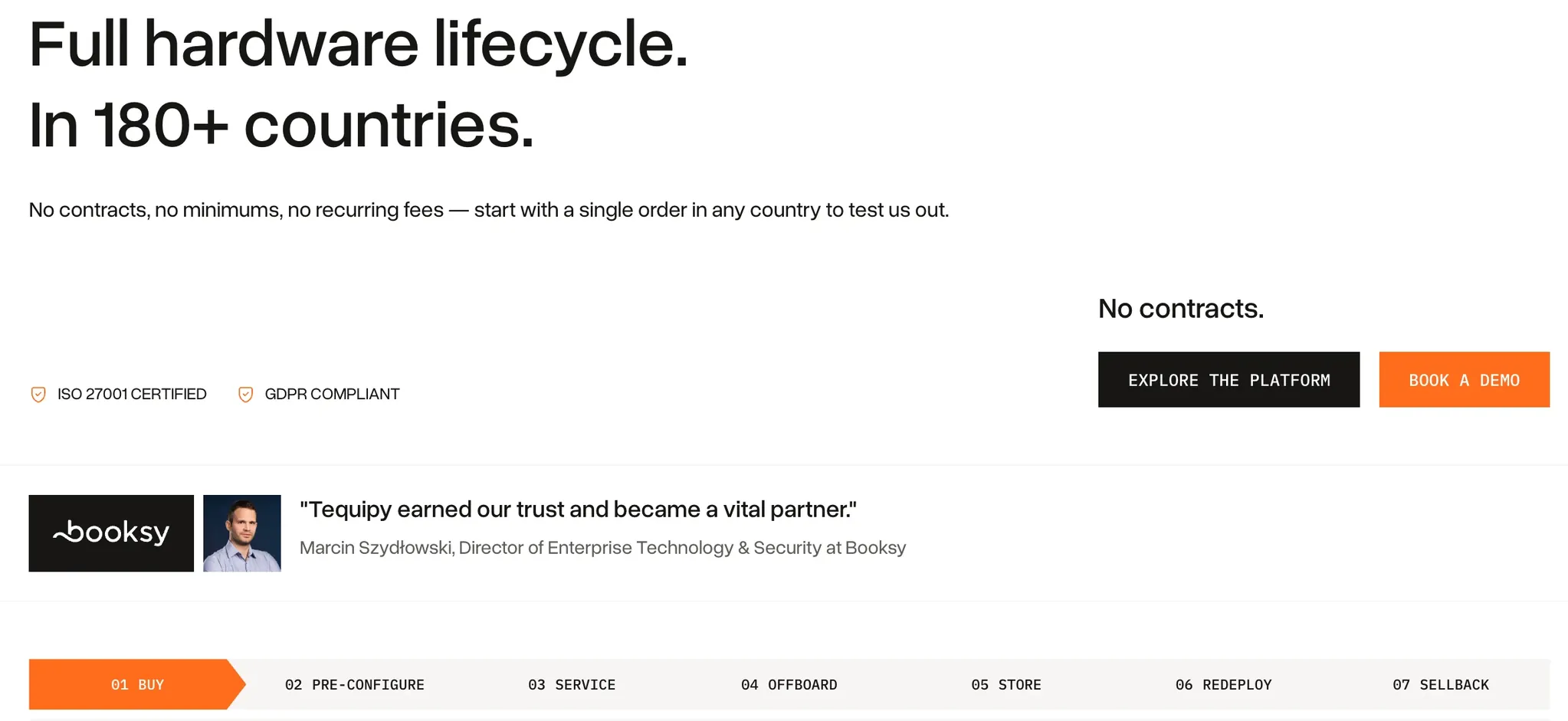
AssetTiger charges by asset count for a record your team keeps up to date. Tequipy keeps a simpler record, with one page per device, and does the physical work on each laptop: it buys, ships, collects, wipes and stores devices in 180+ countries.
- Retail-price laptops, bought locally: each device comes from a local hardware partner in the employee's own country, with MDM enrollment before dispatch.
- Collection when someone leaves: Tequipy's team arranges the box, the courier, the wipe and the storage.
- A platform fee that ignores headcount: one flat $99 a month at 100 devices or more, for unlimited devices, and nothing below that.
| Item | Price |
|---|---|
| Platform | $99 a month flat for 100 devices or more, unlimited devices; free under 100 devices |
| Offboarding | $70 to $150 per device, by country |
| Storage | $12 a month per device |
| Redeployment | $70 to $150 per device |
| HRIS integration | $199 a month, optional |
The Tequipy pricing page lists each standard service rate by country. The platform itself is shown on the device lifecycle management software page.
{{cta-primary}}
AssetTiger Pricing Plans: A Breakdown
The five plans split into two groups. Basic and Core are sized for small businesses and schools with up to 2,500 items. Advanced, Pro and Enterprise exist for organizations with thousands of tagged items, such as a district tracking every projector and chair.
Basic and Core Plans: For Small Fleets
| Plan | Asset limit | Price |
|---|---|---|
| Basic | 500 | $20 a month, or $220 a year |
| Core | 2,500 | $40 a month, or $440 a year |
Basic suits a team that tracks a few hundred items: laptops, monitors, phones and some shared kit. A 100-person company with one laptop and one monitor per person uses 200 of its 500 slots. At $220 a year that is $1.10 per tracked item.
Core is the plan AssetTiger marks "Most Popular". It costs twice as much as Basic for five times the room. The step from Basic to Core comes at asset 501, so a team at 480 assets pays double the moment it adds the next batch of monitors.
Pro tip: before you pick Basic or Core, count your assets as they will be in 12 months. Add planned hires, the docking stations and headsets they get, and any loaner pool. If that number lands between 450 and 550, budget for Core from the start. A tier change mid-year costs little at this level. Still, nobody wants that surprise in a budget review. A free IT asset inventory Excel template gives you a quick count before you commit.
Advanced, Pro and Enterprise Plans: When Your Asset Count Grows
| Plan | Asset limit | Price |
|---|---|---|
| Advanced | 10,000 | $75 a month, or $825 a year |
| Pro | 50,000 | $140 a month, or $1,540 a year |
| Enterprise | 250,000 | $275 a month, or $3,025 a year |
The higher tiers grow the asset limit far faster than the price. Enterprise holds 500 times as many assets as Basic for less than 14 times the yearly price. At full use, Enterprise works out at $1.21 per 100 assets a year, against $44 on Basic.
The features do not change between these tiers. A school district with 40,000 items on Pro gets the same scanning, depreciation and reports as a 300-item office on Basic.
The Inventory Add-On for Stock and Consumables
Assets are items you track one by one. Stock is what you count in bulk: toner, cables, spare mice. AssetTiger handles stock through a separate inventory add-on that works on any plan.
| Inventory add-on | Price |
|---|---|
| Up to 2 stock items | Free |
| Unlimited stock items | $15 a month, or $165 a year |
The add-on is a flat fee with no per-item charge. A team on Basic that adds it pays $385 a year in total instead of $220.
The 30-Day Free Trial and the End of the Free Plan
The AssetTiger free plan has been replaced by a trial. It needs no credit card and lasts 30 days. Its limits, from the pricing page:
- up to 250 assets and 2 users
- 5 custom fields, 100 persons and 1,000 locations
- 500 documents and 500 photos
- no REST API, which AssetTiger reserves for paid plans
The pricing table lists alert emails as "Up to 25/day" during the trial, while the FAQ on the same page says 100 a day. The vendor's own pages disagree, so check before you rely on either figure.
When the 30 days end, AssetTiger's Terms say an account that has not been upgraded moves to "view-only status". You can still see your data, but you cannot add, edit or delete it.
AssetTiger's FAQ also states that under the current pricing model, active organizations get no permanently free tier. A rival asset-tracking vendor, UNIO24, reported in a blog post that the change came in August 2026. A team that decides not to pay can export its records to CSV and keep them in a spreadsheet instead.
Billing terms are simple. Monthly plans can be cancelled at any time, with access running to the end of the period paid. Yearly billing costs 11 months at the monthly rate, so it saves one month: $20 on Basic, $275 on Enterprise.
AssetTiger Hidden Costs
The plan price covers the software. These costs sit around it.
- Moving up a tier: the price doubles at asset 501 and rises again at 2,501. Count chargers, monitors and phones before you count only laptops.
- The inventory add-on: stock items beyond the first 2 cost $15 a month or $165 a year.
- Labels: AssetTiger prints label templates, but tags themselves come from its sister company, MyAssetTag. A linked MyAssetTag order earns "a free month of service for qualifying purchases", says AssetTiger's FAQ. Scanning runs on a phone through the mobile app included in every plan.
- Data entry: AssetTiger names no native HR or MDM connector. Its own IT page says Jamf or Intune data comes in "by CSV or Excel import" or through the API. A new hire and a new laptop reach the register through someone on your team, or through a script your team writes against the paid-plan REST API.
- The physical work: AssetTiger records that a laptop is assigned, overdue or disposed of. It does not buy, ship, collect or wipe one. For a leaver in another country, that work falls to your team, using a process like this employee offboarding checklist.
The last two are the costs that grow with headcount, and neither appears on a pricing page. They are labour, and they cost staff time.
Pro tip: put a price on the hours as well as the licence. For one month, log the time your team spends ordering, shipping and collecting laptops. Price a year of that time at your own pay rates. Set that figure next to the AssetTiger plan before you decide what a register really costs you.
AssetTiger Pros and Cons
Everything below holds on every paid plan, since AssetTiger does not gate features by tier. The question is whether what you get matches the work you need done.
What You Get for the Price: Labels, Scanning and Check-In/Check-Out
- A low entry price: $20 a month for 500 assets, with unlimited users.
- Labels and scanning: built-in label templates for Code 128, Code 39 and QR codes, and an iOS and Android app with offline scanning.
- Check-in/check-out: due dates, overdue alerts, an optional signature on issue, and GPS coordinates recorded when an item is checked in or out, according to AssetTiger's features page.
- Records that go deep: unlimited custom fields on paid plans, four depreciation methods, warranty alerts 30, 60 or 90 days before expiry, and 80+ report types.
What the Price Doesn't Cover: Connectors and the Physical Work
- No free plan: the old free plan is gone, and an expired trial turns view-only.
- No named connectors: HR, MDM and helpdesk data come in by CSV or through an API job your team builds and maintains.
- Steps in the price: the bill doubles from Basic to Core, then rises again at each limit.
- Nothing physical: the register shows that a laptop sits with a leaver in another country. Getting it back is your job.
Who Is AssetTiger Best For?
AssetTiger is priced for teams whose question is "who has what?". A team asking "how do we get it to them?" has a different problem. These three cases show where the price fits and where it does not.
Small Businesses Tracking Mixed Equipment
A small business with a few hundred items across one or two sites gets a full register for $220 a year. Laptops, tools, furniture and AV gear all fit in one database, with custom fields for anything the accountant needs. For a team leaving a spreadsheet behind, it adds depreciation, audits and alerts for about $4 a week on Basic.
Teams That Lend Out Shared Equipment
Schools, labs and media teams that lend cameras, laptops or projectors can run each loan through check-in/check-out. Due dates, overdue emails and a signature on issue keep loans on track with little manual work. A school can tag every item, hand students a scanner app and stay on Basic or Core.
Not a Fit: Laptops Held by Staff in Several Countries
An asset tool with an agent or an MDM sync can see a remote laptop, and AssetTiger can record one too. The harder part is moving the laptop in and out of a country. A buyer put it to Tequipy plainly: "We just opened a Colombia office and shipping from the US was a disaster." A register entry does not change that.
Pro tip: almost no asset tool sends anyone to collect a laptop. Before you renew any register, ask who will pick up the next leaver's device in a country where you have no office. If the answer is "nobody", your gap is remote asset management, and Tequipy collects devices in 180+ countries.
AssetTiger Customer Reviews
On review sites, AssetTiger holds 4.6 out of 5 from 272 reviews on Capterra and 4.5 out of 5 from 16 reviews on G2, as of November 2026. Before you trust any AssetTiger review there, note that Capterra marks many of them as written for a nominal incentive.
What Small Teams Like: Simple Setup and Low Cost
Two 2022 Capterra reviews from schools praise how quickly it worked. A charter school teacher named "The ease of completing a school wide inventory" as a main reason to use it, in a July 2022 Capterra review. A network administrator who runs a student help desk said it is "easy to incorporate and teach students to use", in a May 2022 Capterra review. Both reviews are marked as incentivized.
Across the reviews and comments we checked, the price earns praise about 15 times and the quick setup about 10.
What Reviewers Complain About: Missing Integrations and the Free Plan
Price changes draw the most complaints, at least 6 on Capterra and Reddit. After AssetTiger tightened its free tier in 2025, one school IT admin wrote on Reddit that they were "also shocked at the price jump, haven't found anything cheaper though", in a December 2025 r/k12sysadmin comment. The second change, the end of the free plan in 2026, had no reviews on Capterra or G2 yet as of early November 2026.
The mobile app draws about 4 complaints and setup effort about 3. A communications director gave it 3 out of 5 and wrote "there are too many details to input for each item, making the setup tedious", in an April 2025 Capterra review. A project manager wrote "My biggest gripe lies with the mobile app", in a July 2022 Capterra review. Older complaints about "no API" no longer hold: AssetTiger now documents a REST API on every paid plan. What remains is the lack of named connectors.
Alternative to AssetTiger: Tequipy
Before Tequipy, its co-founder ran IT at Revolut as the company grew from 100 employees to 5,000 in 17 offices. Tequipy now does that kind of IT work for globally distributed teams, whether they hire in three countries, fifteen, or more. Its register is simpler than AssetTiger's, built on the device pages described below. Tequipy also does the part AssetTiger leaves to you: local hardware partners buy and deliver the laptops, and a courier collects them when someone leaves.
Buying, Shipping and Collecting Laptops in 180+ Countries
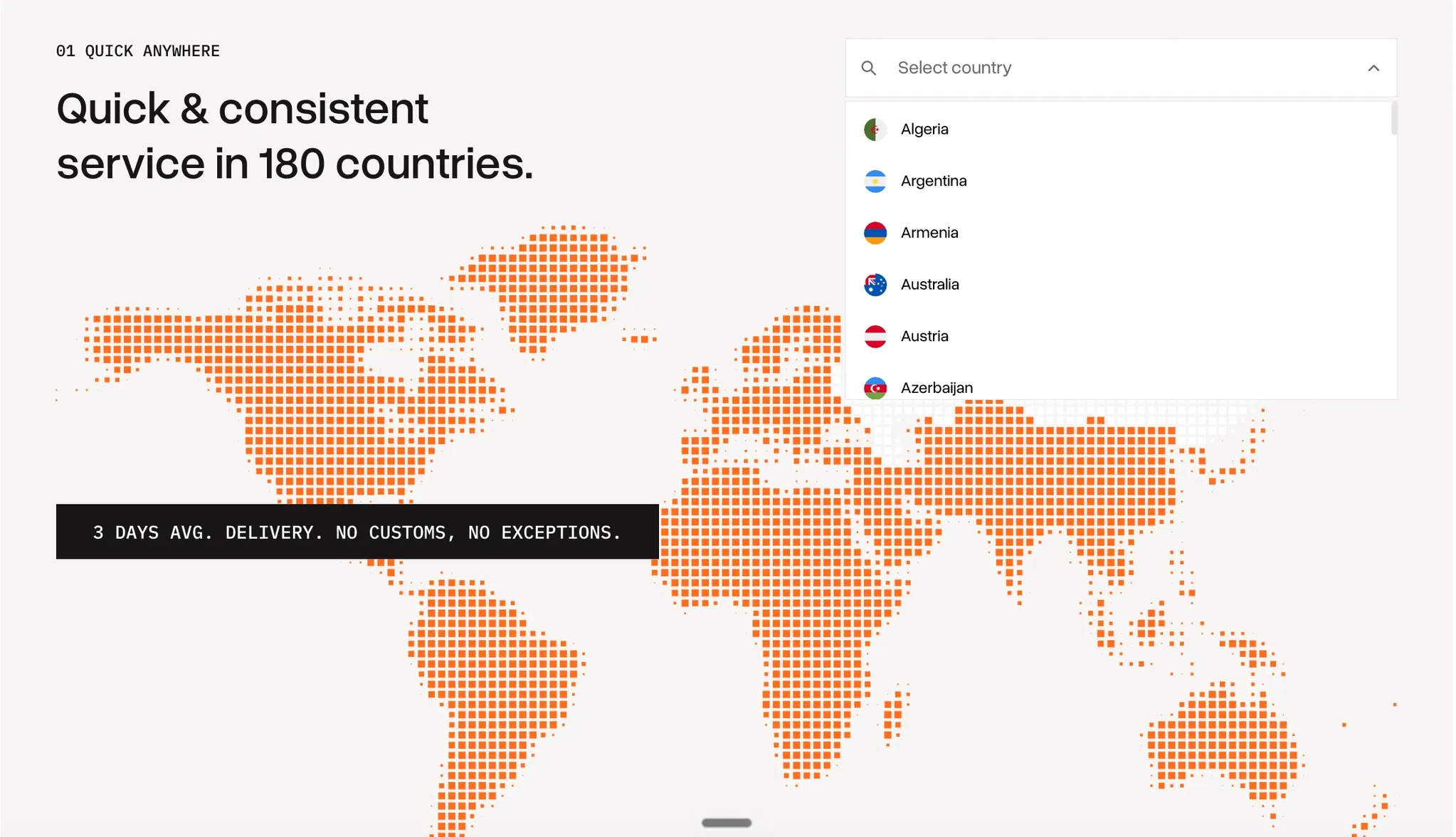
AssetTiger can show who holds a laptop. When that person leaves, nobody comes to collect it. Tequipy sells laptops at retail price through local hardware partners, with MDM enrollment before dispatch. For a leaver, Tequipy's laptop retrieval service handles the whole return. It reaches the person, sends a box and books a courier. Then it wipes the device and either stores it or passes it to the next hire.
A Device Record That Tequipy's Team and Carriers Keep Up to Date
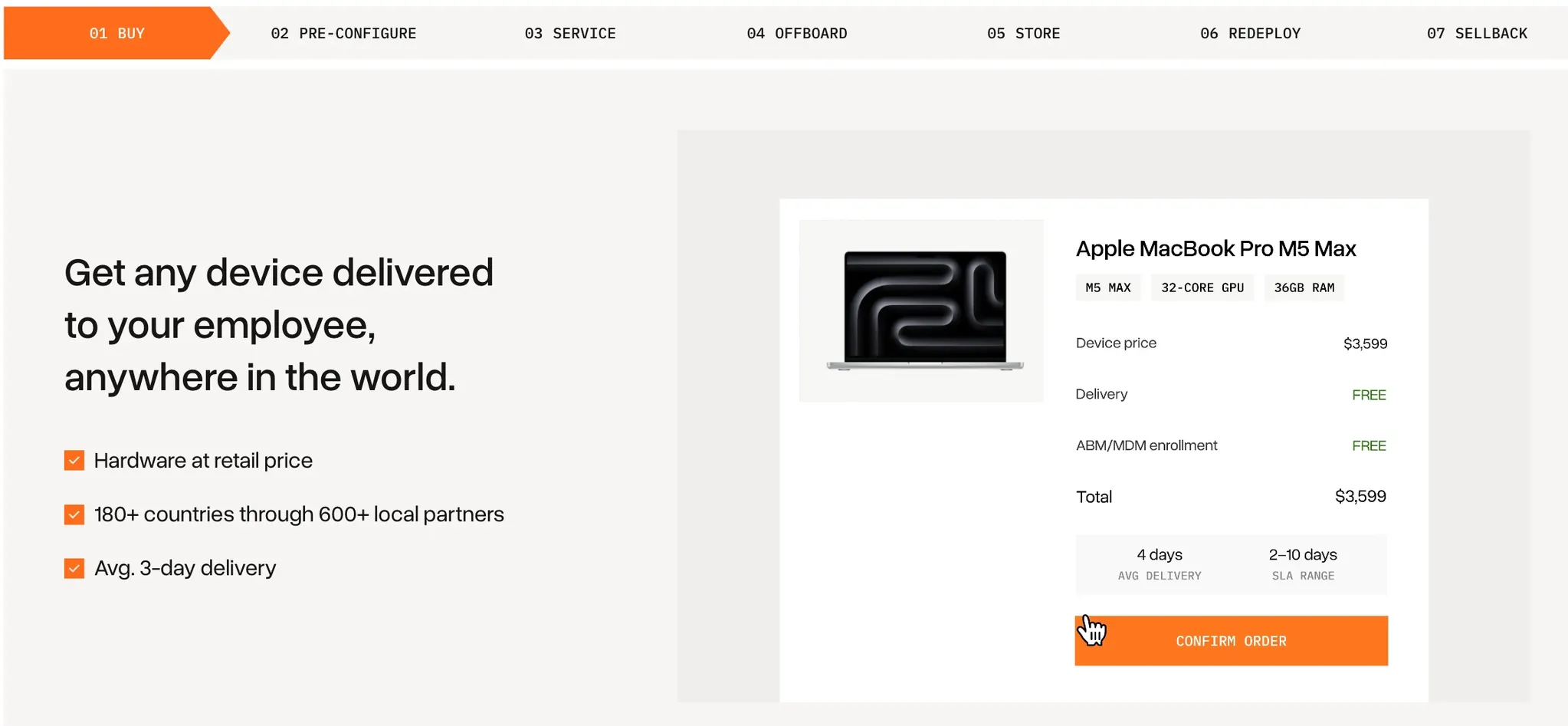
Each device in Tequipy has a page with four tabs. Details shows status, serial number, holder, specification, estimated value and any protection plan such as AppleCare+; History lists dated assignments with admin notes; Files keeps invoices, warranty documents and manuals; Repairs holds past and open requests. Tags group devices and people, and an archived device keeps all of that instead of being deleted.
Admins also set equipment groups, so staff order from a pre-approved list and an admin approves each order. Views split assigned devices, your own storage, Tequipy's warehouse and the archive, and assigned devices, orders and requests export to CSV.
When a courier delivers a laptop, its page shows the new status from the tracking scan; collections show the same way, though that tracking is still being improved. When Tequipy's team moves a laptop into storage or checks its condition, the team records it on the page. Nobody on your side has to type these changes. Laptops you bought somewhere else go in by hand, through a CSV that Tequipy's team loads for you, or by the REST API.
Teams can use Tequipy in one of three ways. It can run alone as the only register.
A team can also keep AssetTiger for labels, scanning and loans, and use Tequipy to source, deliver and pick up the laptops. To link the two, that team's own staff build a scheduled job: it reads devices, orders and collections from Tequipy's REST API and writes them into AssetTiger through AssetTiger's API or a CSV import. The data moves on that schedule because Tequipy does not send changes to other tools by itself, and BlueTally is the one tool with a ready-made sync.
A third option suits a team that no longer uses an asset tool's deeper features, such as custom fields, barcode labels, check-out or depreciation. Tequipy's register can then hold the laptop record: who holds each laptop, its details and estimated value, its dated history, files and repairs, plus the orders and collections Tequipy handles for you. Tequipy's team imports your existing records from a CSV file. Under 100 devices nothing is charged; from 100 up the fee holds at $99 a month flat for unlimited devices, whereas a per-asset plan grows with each device you add.
An optional HR add-on, $199 a month, brings people data one way from HiBob, BambooHR, Workday or Rippling. Joiners then show up in Tequipy by themselves; on Rippling, a leaver can also open an offboarding.
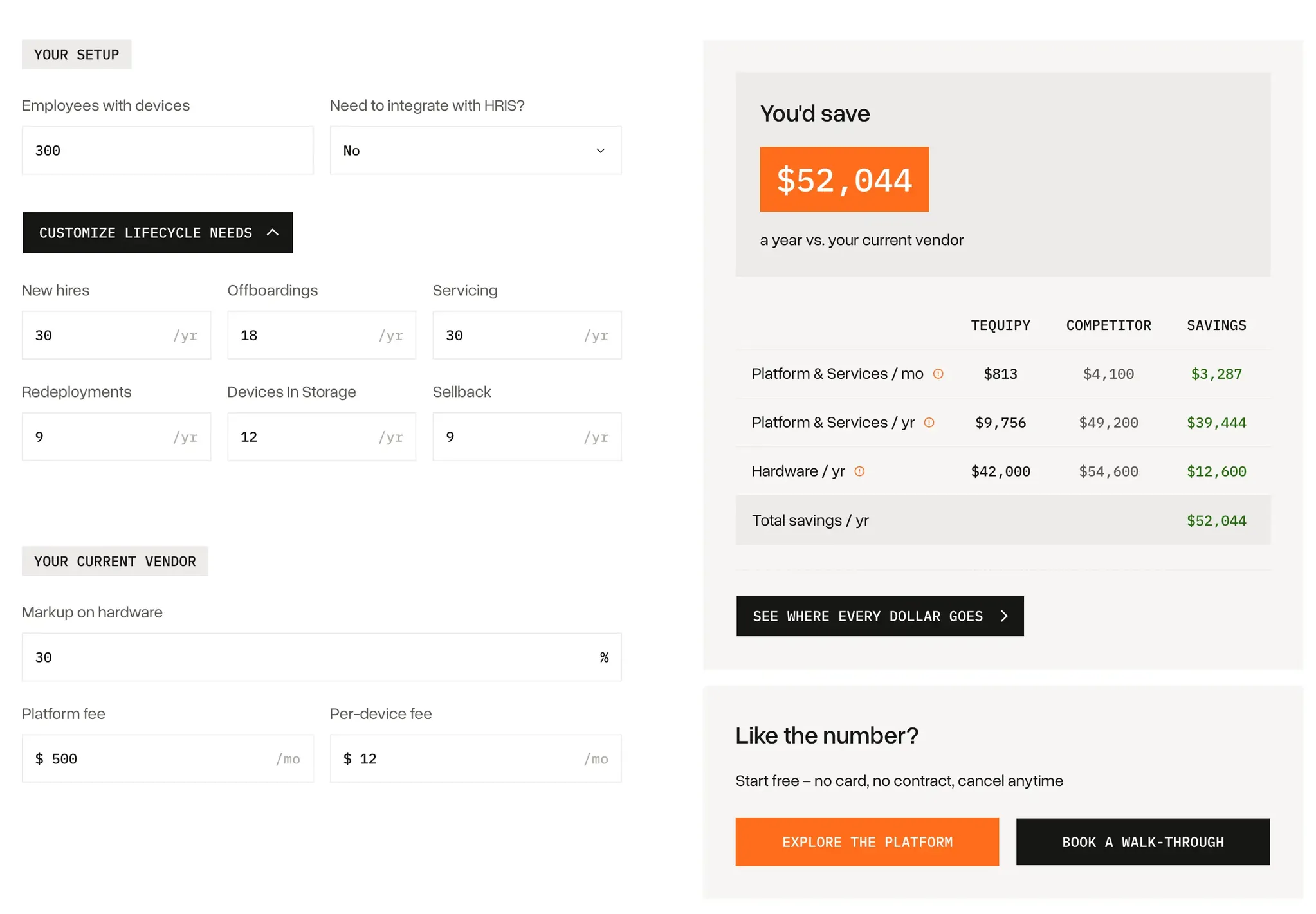
A 100-person team with 100 laptops pays AssetTiger $220 a year on Basic, before services, and Tequipy $2,856, a gap of $2,636. Tequipy's figure covers collections, storage and redeployments, not hardware. AssetTiger sells no services, so your team does those jobs. US computer user support specialists earn a median of about $30 an hour (US Bureau of Labor Statistics, May 2025). At that rate, the gap closes at about 7 hours of those jobs a month. Gigs, a 100-person Tequipy customer, saves 100+ hours a month on IT management, worth about $35,700 a year at that rate. Your team also pays the couriers. The HRIS add-on is $199 a month. Enter your team size, hires and leavers in the calculator.
The customers who use it describe the result in their own words. Gigs, which hires across 20 countries, said: "Delivery times, pricing, and service quality remain reliable no matter where we're hiring." TapTap Send's Director of IT and InfoSec named "the transparency of their pricing and process" in the TapTap Send case study.
Where Tequipy Falls Short
- No loan desk: Tequipy's register keeps each laptop's holder, history, files and repairs. It has no QR or barcode labels, no mobile app and no check-in/check-out for shared equipment.
- Fewer register fields: custom fields, depreciation, warranty end dates, warranty alerts and in-app asset reports are all missing; tags stand in for fields. Tequipy's team pulls data for a customer on request.
- No IT discovery: network scans, software licence tracking and a CMDB (a map of how IT systems connect) are outside what Tequipy does.
Who Tequipy Is Best For
- Teams hiring in countries without an office: Tequipy buys each laptop locally at retail price with delivery included, so a first hire abroad needs no new supplier.
- Teams whose leavers keep their laptops: Tequipy collects devices in 180+ countries, works on laptops bought anywhere and logs who held each one and when, so you can start with one collection.
- Teams that do not want a contract: there is no contract and no minimum, so you can test one order before you change anything else.
- Not for: single-office teams that track shared equipment. Tequipy has nothing for labels or loans.
{{cta-primary}}
CONCLUSION
Does AssetTiger Pricing Fit Your Budget?
If you need labels, scanning and check-in/check-out in one office, AssetTiger's price is fair, and staying on Basic or Core may be the right call. At $220 a year for 500 assets, few registers come cheaper.
If your laptops sit with staff in several countries, the register is the small part of the bill. The bigger part is buying each device where the employee lives and collecting it when they leave. That is where Tequipy fits, through global laptop procurement and collection in 180+ countries. Talk to Tequipy's team about one order in your hardest country first.
FAQ
Can I cancel AssetTiger at any time?
Yes. Paid plans renew automatically and can be cancelled at any time. Access runs to the end of the period you paid for, monthly or yearly.
What happens if I go over my AssetTiger asset limit?
AssetTiger publishes no overage fee. Plans are sized by asset count, so more assets means the next plan, for example Basic ($20 a month) to Core ($40).
Can I export my data if I leave AssetTiger?
Yes. AssetTiger's FAQ says assets, history and reports can all be exported to CSV. Export before you cancel: its Terms say content leaves backups within 30 days.
Is the AssetTiger mobile app included in every plan?
Yes. The iOS and Android app, with barcode and QR scanning and offline mode, is part of every paid plan and the 30-day trial. AssetTiger does not gate features by plan.
How does Tequipy's price compare with AssetTiger's?
Tequipy's platform is $99 a month ($1,188 a year) flat for 100 devices or more, unlimited devices, free under 100. AssetTiger Basic is $220 a year for up to 500 assets. Tequipy also sells collection, storage and redeployment, which AssetTiger does not offer, priced on the Tequipy pricing page.

Keep your current setup.
Just test us on one order.
AUTHOR
Before Tequipy, Tomek ran IT at Revolut, scaling from 100 employees in 2 offices to 5,000 across 17. He built the system that kept every laptop accounted for, then founded Tequipy – a platform that handles IT equipment logistics for distributed teams across 180+ countries.
As CEO, he runs operations and covers the founder layer: strategy, product, and the company-building that comes with both.
15 minutes. Your countries, your devices, your setup. No pitch.