KEY TAKEAWAYS
- Remote asset management is the practice of knowing where every company device is, who holds it, and what state it is in, when none of those devices ever passes through an office.
- The record is the easy half. The hard half is the physical work behind each record: buying hardware where the employee lives, getting it there configured, collecting it when they leave, and proving the data was destroyed.
- Non-return is the most expensive failure. In Capterra's 2022 offboarding survey, "71% say at least one employee didn't return company-owned equipment, like a laptop or smartphone", at an average loss of $1,963 per non-returning employee.
- Tequipy performs the physical layer in 180+ countries and updates the record as each step happens, with services priced per use and the platform at $99 a month flat at any fleet size, free under 100 devices.
Remote asset management starts to matter the moment your hardware stops coming back to a building. A spreadsheet can tell you a MacBook was issued to a developer in Bogotá in March. It cannot tell you whether she still has it, whether it was wiped when she left, or who is going to collect it. This guide covers the lifecycle stage by stage, the challenges that break it, the practices that hold at scale, and how the tool categories divide the work.
Remote Asset Management Lifecycle
Stage 1: Acquire
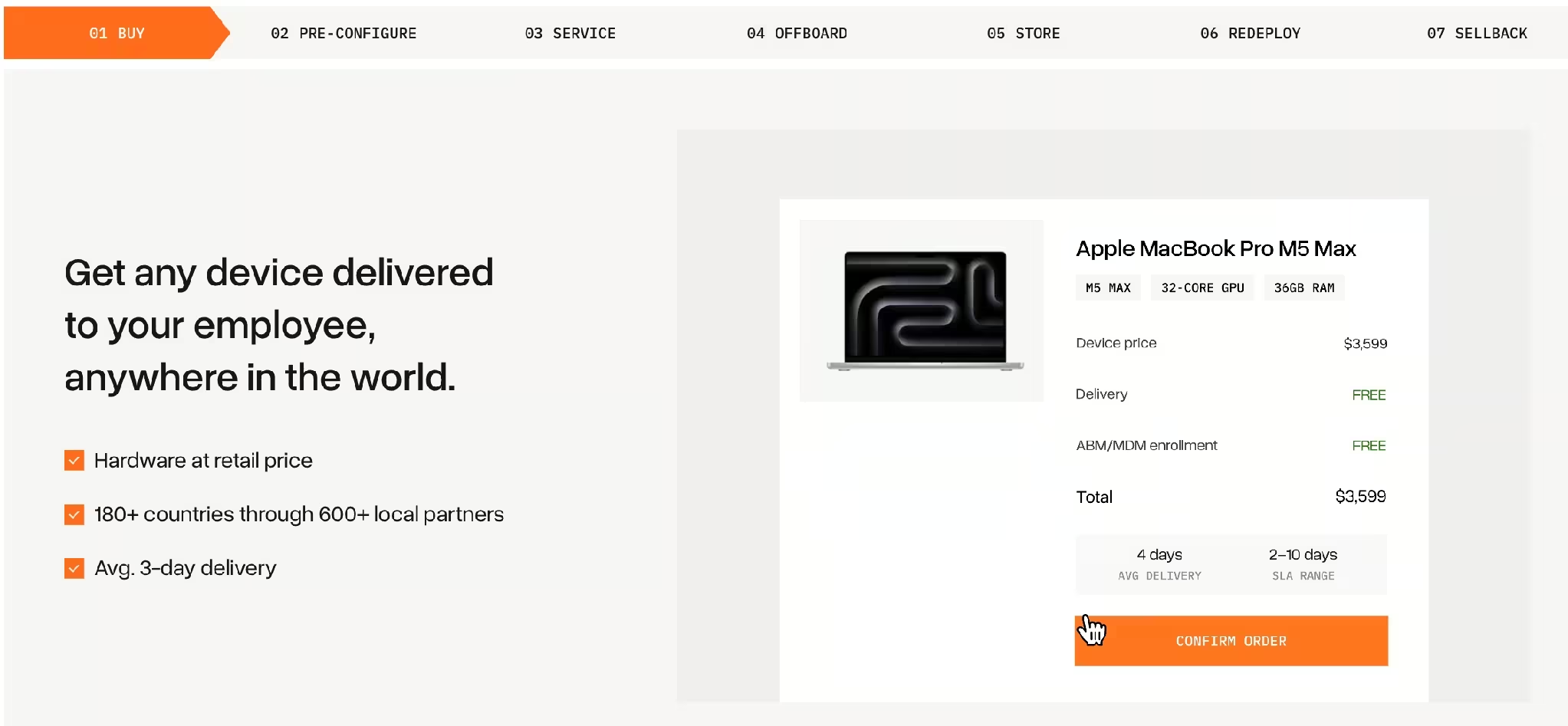
The lifecycle starts with a purchase decision that is also a logistics decision. Buying centrally and shipping outward puts a border between the stock and most of your employees. Buying in the employee's own country removes customs from the process entirely.
Tequipy's global IT procurement fulfils each order through one of 600+ authorized resellers in the country where the person lives, at recommended retail price with delivery included, averaging 3 business days and capped at 10.
Stage 2: Deploy
A device should arrive under management. Registering each machine in Apple Business Manager or Windows Autopilot before dispatch means it auto-enrolls into your existing MDM on first boot, so zero-touch deployment works with Jamf, Intune, Kandji, Mosyle, Hexnode or JumpCloud without a direct MDM integration.
This stage is where the asset record is created, and where it is either accurate from the start or wrong forever.
Stage 3: Maintain
Devices break, and remote devices break out of reach. Average repair turnaround from pickup to a working laptop is around 14 business days even when the process runs well, which is why the practical answer is a replacement machine in front of the person while the repair happens, drawn from stored inventory or bought new. Dead-on-arrival units follow a separate path: a new device out next day, the faulty one collected afterwards.
Warranty status decides the cost. Repair work is covered where warranty applies, with pickup and delivery charged at the standard service rate, and anything out of warranty is quoted before work starts.
Stage 4: Recover
The exit is where remote asset management earns its keep. A courier collects from the employee's address, the device is condition-checked, cleaned and wiped, and the record updates. Laptop retrieval costs $70 to $150 per device including courier, packaging, pickup and basic wipe.
Wipe options matter for compliance rather than convenience: a basic wipe for redeployment, a Blancco certified wipe for resale, a certificate of destruction for regulated environments, or no wipe at all where a legal hold applies and the data must be preserved.
Stage 5: Redeploy or Retire
A recovered device goes back into service, into storage, or out through resale. Storage runs $12 per device per month, laptops and monitors only, with accessories stored free. Redeployment costs $70 to $150, and devices stay in the country where they were collected, with the EEA treated as one region.
The arithmetic decides the policy. Offboarding, three months of storage and a redeployment together cost $180 to $240, against $1,500 to $2,500 for a replacement. Where you will not hire again in that country, device buyback returns 20 to 70% of initial value depending on age and condition.
Service rates above are published on Tequipy's pricing page.
Why Remote Asset Management Matters More Than Ever
Reason 1: The Fleet Is Permanently Outside the Building
Asset management was designed for hardware that returned to a desk. Once devices live in homes across a dozen countries, physical verification stops being possible and the register becomes the only view you have, which makes its accuracy the whole game.
Reason 2: Compliance Now Asks Where Every Device Is
Teams tell Tequipy that SOC 2 and ISO 27001 preparation forces three questions: where every device is, who can access it, and how data is destroyed at disposal. Each one needs evidence rather than an assurance, and the evidence is produced during the physical steps.
Reason 3: Unrecovered Hardware Carries Data With It
The hardware value is the visible loss. The data on an unwiped machine is the one that scales: IBM's Cost of a Data Breach reporting puts the 2025 global average breach at $4.4 million, and a device outside your control is exactly the kind of loose endpoint an auditor asks about first.
Reason 4: Finance Wants Cost per Device, Not a Procurement Line
A lump hardware budget no longer survives scrutiny. The question is what a device costs across its whole life, including collection and resale value, and answering it requires the lifecycle to be recorded rather than estimated.
Remote Asset Management Challenges
Five problems recur in almost every evaluation conversation.
The register drifts. Every asset record is accurate the day somebody types it and decays at the speed of your device movements. A sysadmin put the effort in proportion in a June 2026 r/sysadmin thread: "Inventory is one thing, but onboarding, offboarding, returns, repairs, redeployments, and disposal are where we found we were spending most of our time."
Discovery misses what it cannot reach. Network scanners find devices on networks you control. A laptop in someone's flat behind a home router is invisible to that approach, and an MDM only sees machines that were enrolled in the first place.
Nobody owns retrieval. Delivery has an owner because somebody is waiting for the device. Retrieval has none, which is why it slips until the asset is written off.
Cross-border moves are impractical. Shipping a used laptop from Brazil to Germany turns an internal transfer into an import, with duties and unpredictable timelines. In practice, devices should stay in region and resale should cover the rest.
Vendor coverage claims outrun performance. Connecteam's previous provider worked in most markets and broke in Australia, which its case study records. Ask which countries a vendor has delivered in this quarter rather than which appear on a coverage map.
Best Practices for Managing Remote Assets at Scale
Practice 1: Make the Work Update the Record
The most reliable register is one that nobody maintains by hand. Where the party buying, shipping and collecting the device also writes the record, each movement updates it as it happens. Manual entry is what produces the drift in the first place.
Practice 2: Trigger Everything From the HRIS
The hire and the exit already exist as events in your HR system. Tequipy syncs natively with HiBob, BambooHR and Workday as a $199 a month add-on, so an activation can create the onboarding order and a departure can create the collection request without a ticket. Everything else connects through the REST API.
Practice 3: Audit Ten Assets Every Quarter
Pro tip: run a ten-asset proof rather than a full inventory. Export the register, pick ten serial numbers at random, and for each one get evidence that the device is where the record says and with the person named: a photo of the serial on the chassis, a fresh MDM check-in under that user's account, or a courier signature. Allow five working days and count anything unproven as a miss. Seven out of ten means your register is 70% accurate, and that number belongs in every vendor conversation and every audit prep.
Practice 4: Decide the Destination at Collection
A recovered device with no decision attached becomes a device in a drawer, depreciating. Decide on arrival whether it is going back into service, into storage or to resale, and record the decision with the asset.
Practice 5: Keep Storage and Redeployment in Region
Devices stay in the country where they were collected, with the EEA treated as a single region for redeployment. Where you will not hire again in that market, sell the device rather than shipping it.
Practice 6: Separate the Two Failure Piles
When something goes missing, sort the cause. A miss a better scanner would have caught is a software problem. A miss that needs a person to physically locate a laptop abroad is a service problem. Buying the wrong one of those two is the most common mistake in this category.
Benefits of an Effective Remote Asset Management Strategy
- Devices arrive before day one. Booksy, with more than 500 employees and 800+ managed assets, runs at 99% of equipment delivered before the employee's start date.
- Recovery becomes measurable rather than hopeful. RemoFirst, a company of about 250 people hiring in 30 countries, recovered every company-issued device and protected roughly $2,000 per employee.
- IT hours return to IT work. Gigs, at 100 employees across roughly 20 countries, got back 100+ hours a month after consolidating the lifecycle with one provider.
- Consolidation shows up in the invoice. TapTap Send merged three purchasing processes onto one platform and now saves $6,500 a month.
- Audit preparation stops being a project. Wipe certificates, chain of custody and assignment history exist as a by-product of the work rather than as a reconstruction exercise.
Remote Asset Management Platforms and Software
Tool 1: A Lifecycle Platform That Performs the Physical Work
Tequipy buys, configures, delivers, repairs, collects, stores, redeploys and resells, and updates the asset record at each step. The register holds serial numbers, assignment, warranty dates, condition reports, storage location and a full audit trail, with unlimited admin accounts so IT, HR and People Ops can all work in it.
The platform costs $99 a month flat at any fleet size and nothing under 100 devices. Services bill per use, so a team using only offboarding pays only for offboarding. Every rate sits on the pricing page beside a calculator that prices your own countries and volumes in about 30 seconds.
Tool 2: An ITAM Register or CMDB
A dedicated ITAM product is the right choice when your problem is knowledge rather than movement: licence positions, discovery across on-network hardware, relationship mapping, audit-grade reporting. Tools in this category record what exists and reconcile it from scans, agents and MDM feeds.
What none of them do is perform a physical step. Where both problems exist, running a register alongside a lifecycle service is the normal answer rather than a compromise, and our comparison of IT procurement software and services covers the overlap.
Tool 3: An MDM
Your MDM owns the software state of every enrolled machine: policies, encryption, apps, remote lock and wipe. It is the fastest way to answer "is this device compliant right now" and the wrong tool for "who has the laptop we bought in Manila in March", because a device that was never enrolled does not exist to it.
Examples of Successful Remote Asset Management
RemoFirst: Recovery as a Number
RemoFirst hires across 30 countries with about 250 people, and treats recovery as a metric rather than an aspiration. Its case study records every company-issued device returned, roughly $2,000 per employee protected, and delivery into markets including Kazakhstan, Colombia and Ukraine. People Operations Specialist Lera Lykholiet describes the arrangement in the same case study: "We've been partnering with Tequipy for over two years, and their support has been invaluable."
Booksy: A Register That Survives Growth
Booksy manages 800+ assets across more than 500 employees, and tested Latin America before expanding elsewhere. Marcin Szydłowski, Director of Enterprise Technology and Security, explains the choice in the case study: "We initially tested them in Latin America, a region where we faced logistical challenges." Delivery before start date runs at 99%.
{{cta-primary}}
CONCLUSION
Manage the Entire IT Device Lifecycle With Tequipy
Remote asset management works when the record and the work are the same process. Tequipy buys devices in the employee's own country across 180+ countries, enrolls them before dispatch, collects them from the door at offboarding, wipes them to a certificate, and stores, redeploys or resells them, updating the register at every step.
Three reviews sit on Tequipy's G2 profile in August 2026, averaging 4.8 out of 5. Two come from enterprises above 1,000 employees and one from a mid-market company. A reviewer in financial services at enterprise scale describes buying, provisioning, repairs, offboarding, storage, redeployment, and laptop buyback "in a single platform, instead of forcing IT teams to coordinate across multiple vendors" (posted July 2026 through a G2 invite).
Two limits to weigh before you shortlist. Tequipy tracks the fleet it manages rather than scanning networks, so where discovery across on-network hardware is the requirement, pair it with a register. And SOC 2 is still in progress: ISO 27001 certification and penetration test reports are available today, so ask the team where that certification currently stands if a report is a procurement gate.
Start with the country that has caused the most trouble this year, with one hire or one exit. Talk to the Tequipy team, or read how remote equipment management works in practice when no device passes through an office.
FAQ
What are the five pillars of asset management?
Most frameworks describe planning, acquisition, deployment, maintenance and disposal. Applied to remote hardware, each pillar carries a physical step as well as a record: buying in the right country, configuring before dispatch, servicing in-country, collecting from a home address, and destroying data to a documented standard.
What is remote asset management?
Remote asset management is the practice of tracking and managing company devices that never pass through a company location. It combines an accurate register with the logistics needed to deliver, repair, collect and dispose of hardware wherever the employee lives.
Can you manage devices you did not buy through the platform?
Yes. Existing devices can be uploaded by CSV and then offboarded, serviced, stored and redeployed like any other asset, so switching providers does not require repurchasing hardware.
How do you prove a device was wiped?
With a certificate against the asset record. A basic wipe covers redeployment inside your own fleet, a Blancco certified wipe is used for resale, and a certificate of destruction covers regulated environments where the device must be destroyed.
What happens to devices in a country where we stop hiring?
Sell them rather than ship them. Cross-border transfers turn an internal move into an import, so resale at 20 to 70% of initial value is usually the better economics, with the EEA treated as one region for redeployment.
Keep your current setup.
Just test us on one order.
AUTHOR
Before Tequipy, Tomek ran IT at Revolut, scaling from 100 employees in 2 offices to 5,000 across 17. He built the system that kept every laptop accounted for, then founded Tequipy – a platform that handles IT equipment logistics for distributed teams across 180+ countries.
As CEO, he runs operations and covers the founder layer: strategy, product, and the company-building that comes with both.
15 minutes. Your countries, your devices, your setup. No pitch.