
KEY TAKEAWAYS
- The platform is free and stays free. Nothing per month, nothing per seat, with the account manager, the public API and the HRIS connections all on that one plan.
- Devices are quoted, never listed. A guest tool prices any model in 155 countries with no login and no sales call, at the local market price with delivery on top.
- Storage is the only published service rate. It starts at $35 per device a month on used fleet. Retrieval, buyback and repair are answered on a call.
- Tequipy publishes every service rate instead, which is the practical difference for globally distributed teams: $70 to $150 to collect a device, $12 a month to store it, and a platform fee of $99 a month flat at any fleet size, free under 100 devices.
Quipteams pricing is more open than almost anything else in this category, and it still will not let you total a year. Platform access carries a real number, zero. So does storage. The other three service lines resolve to a conversation.
So a buyer reads the page, understands the model perfectly well, and still cannot answer the question finance asked. This guide puts every published rate in one place, names the three that are missing, and sets the whole thing out like for like, so a zero cannot do the arguing.
How Much Does Quipteams Cost?
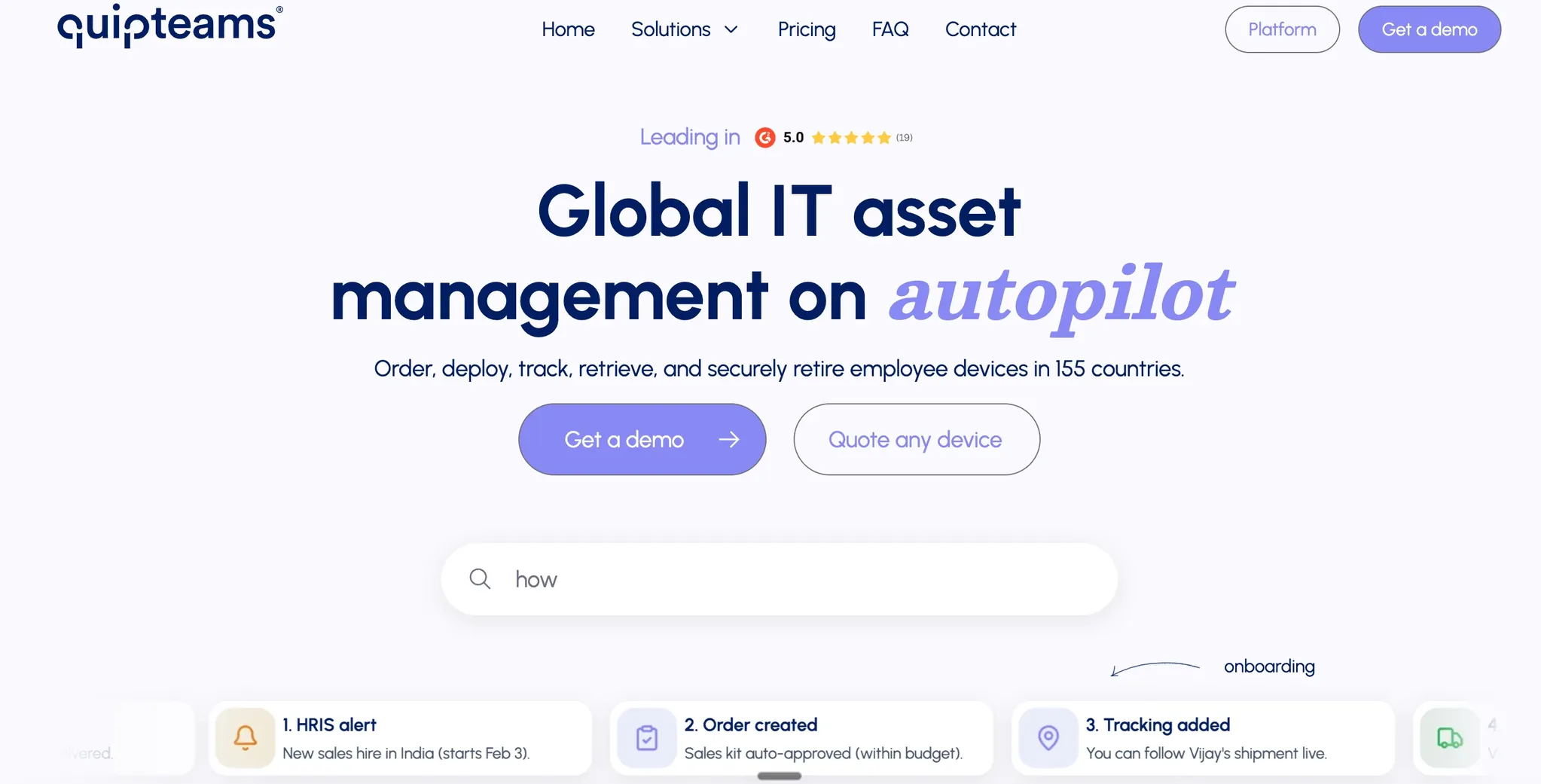
There is one plan and it has no price. Everything the software does sits behind a $0 fee, and every physical service is quoted per device. So the honest answer splits into what carries a number and what does not. The rows below come from the vendor's own pricing page and FAQ, read on 22 September 2026, and where a row says not published, that is their page talking rather than us.
| Item | What Quipteams publishes |
|---|---|
| Platform access | $0 a month, on every plan, with no per-seat charge |
| Setup and onboarding | $0. Account creation, integration setup and training are included |
| Device | Local market price in the employee's country, plus delivery, quoted in the guest tool |
| Retrieval and offboarding | Not published. Per device, varies by country or region |
| Storage | $35 per device a month on used fleet. Free on unassigned new devices bought from them |
| Buyback and refresh | Not published. Quoted per device on model, age and condition |
| Minimum order | None |
| Contract | None, and no exclusivity or early-termination fee |
Tequipy: An Alternative
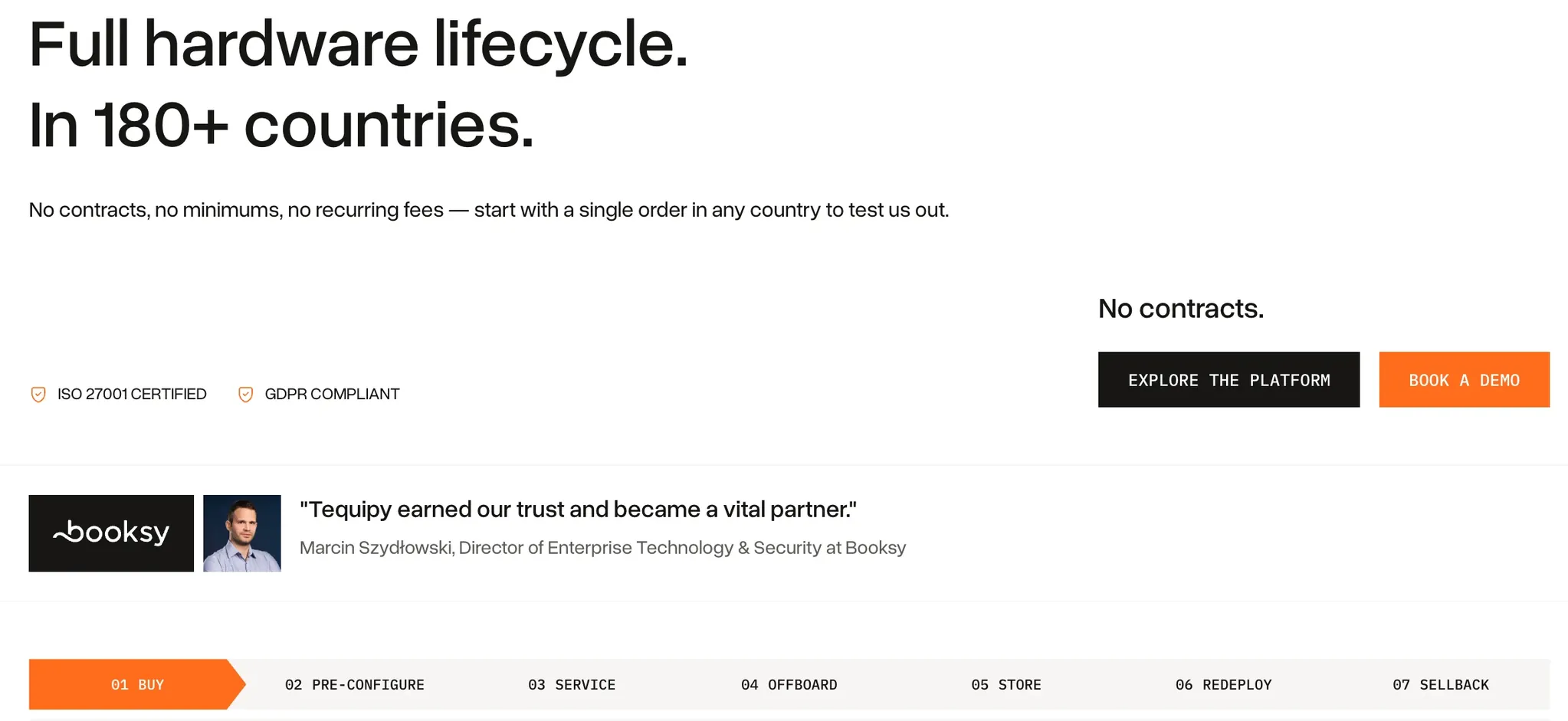
Declare the interest first: this one is ours. Read what follows as a supplier setting out its own prices, and open the links rather than taking the sentences on trust. One of our founders ran IT at Revolut while it climbed from 100 people in two offices to 5,000 across seventeen, rotating about 300 employees a week without losing a laptop.
What that became:
- Devices at recommended retail price, delivery included. An $1,800 MacBook is invoiced at $1,800.
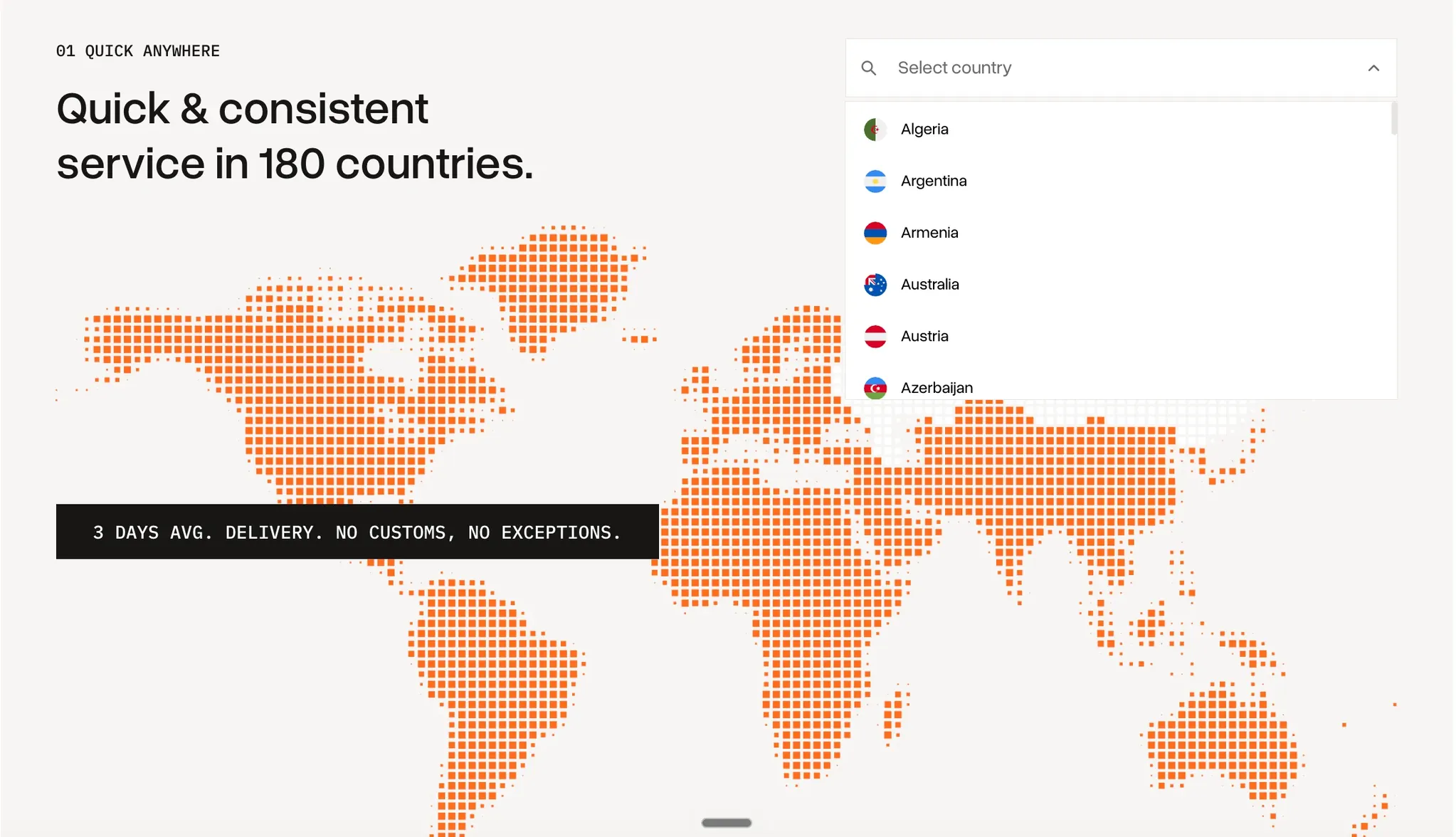
- 180+ countries through 600+ authorized local resellers, so the order is filled where the employee already lives. That is global device procurement in 180 countries rather than a warehouse and a long courier run.
- Three business days on average, ten at the outside, anywhere we operate.
- 99% of devices arrive before the start date, the headline figure in the Booksy case study.
- ISO 27001 certified, with penetration test reports on request.
Every rate below is published on the Tequipy pricing page, alongside a calculator.
| Item | Quipteams | Tequipy |
|---|---|---|
| Service price, device | Local market price plus delivery, quoted in the guest tool | Recommended retail price, delivery included |
| Service price, retrieval | Not published | $70 to $150 per device, by country |
| Service price, storage | From $35 per device a month, used fleet only | $12 per device a month |
| Service price, redeployment | Not published separately | $70 to $150 per device |
| Service price, sellback | Quoted per device, returned as account credit | No fee, and it returns 20% to 70% of the original value as cash |
| Platform fee | $0 on every plan | $99 a month flat at any fleet size, free under 100 devices, optional HRIS sync $199 a month |
| Minimum to start | None | None |
Keeping the platform row separate is the whole point. One vendor charges nothing for access and quotes the work. The other charges a small flat fee for access and publishes the work. Set a $35 storage rate against a $99 subscription and you have compared a service with a login.
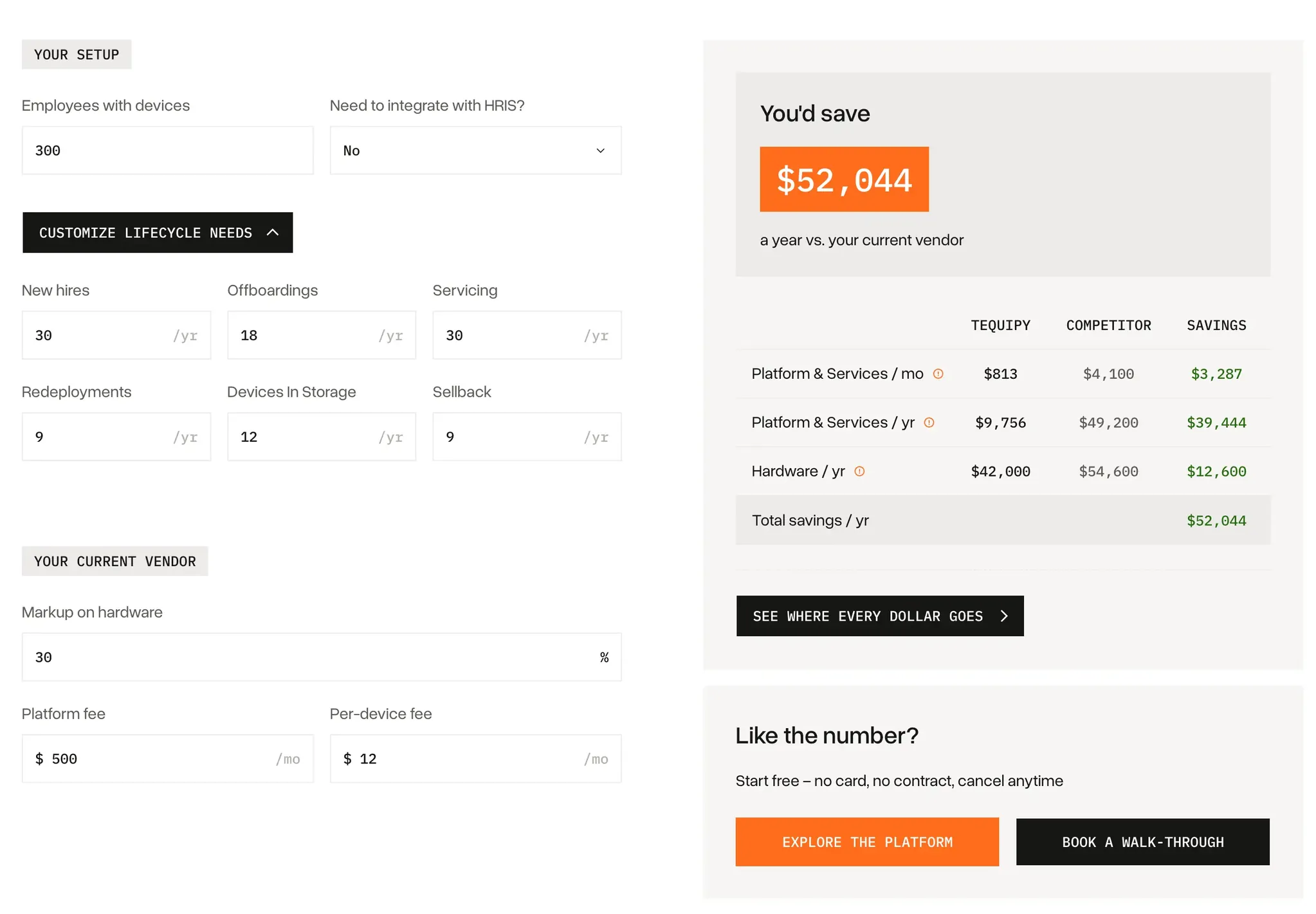
Total your own year rather than trusting ours. Open the calculator on our pricing page and it starts with the number of employees who hold a device and an HRIS yes or no, then the annual volumes: new hires, offboardings, servicing jobs, redeployments, machines in storage and sellbacks.
The last block belongs to whoever supplies you today: their hardware markup as a percentage, their monthly platform fee, their monthly per-device fee. What comes back is a year, which is the only figure worth setting beside a rival's.
{{cta-primary}}
Quipteams Pricing Plans: A Breakdown
There are no tiers here, so there is nothing to compare across a feature grid. The breakdown runs by service instead. Four things can reach a Quipteams invoice: the device, the retrieval, the storage and the buyback credit. Repair sits behind all of them, free under warranty and quoted otherwise. Each one prices on a different basis, and only one of the four carries a public number.
Device Procurement
One all-in figure per device per country. No unit price list exists anywhere on the site, because the price lives in the quoting tool, which anyone can open without an account. Choose a country, choose a model, and the quote comes back with the hardware, the delivery and the local taxes itemised on separate lines. The positioning behind it is that nothing ships internationally, so there is no customs charge and no intermediary margin to pass on.
The vendor's own pages disagree on how fast the tool answers: the pricing page promises a quote in under a minute, the FAQ says under 30 seconds. Small, and the kind of small that tells you how closely a pricing page was proofread. The useful point is that an itemised quote can be checked, so price the same configuration at a local retailer and compare totals instead of claims.
Retrieval and Offboarding
Priced per device by pickup country, and that is the entire published answer. The service covers contacting the employee, booking the courier, the certified data wipe, and routing the machine to a warehouse, a new hire or resale. Most pickups take five to ten business days according to the FAQ, against a faster four to seven quoted on the company blog.
What it actually costs depends on your country mix and your volume, and you learn it on a call. That is ordinary in this category, and it is still the hardest line to plan around, because leaver volume is the one thing a growing company cannot forecast. Tequipy publishes laptop retrieval for departing employees at $70 to $150 per device by country, so that line can be modelled before anyone picks up the phone.
Storage
Two situations sit under one word here, and no page in the search results separates them.
New devices bought through Quipteams that have not yet been assigned are warehoused free, with no stated time limit. Buy ten laptops in January for hires you expect in March and the shelf costs nothing, which genuinely helps a company that batches its purchasing.
Used fleet is charged. A machine retrieved from a leaver, or waiting to be reassigned, carries a flat monthly fee per device that starts at $35 and improves at volume. That is the only service rate the company publishes, and also the one its customers notice.
The gap shows up at ordinary churn rather than at scale. Tequipy charges $12 a device a month for the same warehousing. Twenty machines sitting between users for a quarter is $2,100 on one rate card and $720 on the other.
Buyback and Refresh
Quoted per device on model, age and condition, with no minimum quantity attached. Machines are resold in the local market, and the recovered value comes back as credit against future orders, settled in cash when an account closes. No figure is published, which is defensible: resale value moves with the model and the market, so a fixed percentage would be marketing rather than a quote.
Tequipy charges nothing to run device buyback to recover value and does state the range it returns, 20% to 70% of the original value by age and condition, paid as cash. Both approaches are reasonable. The difference only bites at the exit, where credit against a supplier you are leaving is worth far less than its face value.
Zero-touch deployment before shipping is free from both companies on devices bought through them, and the same breakdown for Workwize shows this exercise run against a vendor that publishes nothing at all.
Quipteams Hidden Costs & Additional Fees
Start with what the evidence does not show. Nobody in the public record describes a surprise invoice from Quipteams, and no complaint anywhere alleges a concealed charge. Three of the four service lines are simply unpublished, so a buyer cannot model them without booking a call. An absent number and a hidden number are different things.
- Three of four services carry no number. Retrieval, buyback and repair all come down to your country mix and your volume. Budget them from your own leaver history rather than from anything on the site.
- Storage on offboarded devices surprises people. It is the single rate they do publish and still the complaint that recurs. Jorge C., an IT engineer writing in a July 2025 G2 review, names it as his one reservation: "our only concern about them is the fact that they charge for keeping the equipment of offboarded users".
- The device price is the whole bill, so check it. Quipteams positions on local market price with no markup, and most of its G2 reviewers volunteer that the pricing is fair. Set against that, a buyer who ran a trial and then left described about $1,000 of fees attached to one 16-inch laptop. Treat it as a single evaluation rather than a rate card. It points where the public praise points: read the lines on the quote.
- Local-currency billing covers the major markets, not all of them. The FAQ names six currencies, US dollars, euros, Brazilian reais, Mexican pesos, Colombian pesos and Indian rupees, on net 30 terms with one consolidated invoice. Outside those six, the conversion is yours.
Pro tip: price one identical machine in your hardest country on both platforms before you speak to either sales team. Same configuration, same country, same week.
Then write down four numbers: the device total including delivery and tax, the monthly storage rate for a machine sitting between users, the quoted retrieval fee in that country, and the platform charge at your real fleet size. Three of those four are already published on one side and quoted on the other, so the exercise also measures how long each company takes to answer a simple question.
Quipteams Pros & Cons
Price is one axis of a decision and rarely the deciding one. Here is what the money buys and what it does not, limited to what the published record actually supports.
Pros
- A price without a sales call. Any device, in any of 155 countries, no login and no account needed. Almost nobody else in this category will do that, and it deserves credit it seldom gets.
- The platform costs nothing and gates nothing. With no tiers to climb, the named account manager, the public API, the HRIS connections and single sign-on all arrive on day one at $0.
- The commercial terms ask for nothing up front. No minimum order, no minimum spend, no contract, no exclusivity, no early-termination fee. An IT manager choosing them for Latin America put it plainly in a comment on r/ITManagers: "no minimum nor subscription fees. No bs platforms or trying to pull off a SaaS." Tequipy sells on exactly those terms too, so read this as the going rate at the pay-per-use end of the category rather than as a point of difference.
- Four business days on average worldwide, with about 80% of orders arriving inside two to four.
Cons
- Most of the price list is not a list. One service in four has a number on it. Everything else is a conversation, which is a poor fit for anyone who has to forecast a budget before they can buy.
- No published ISO 27001 and no SOC 2. Where a security team gates vendor selection, that ends the evaluation at the first question. To be even-handed about it: Tequipy holds ISO 27001 and its SOC 2 work is still in progress, so neither company clears a SOC 2 requirement today.
- The coverage evidence sits in one region. The claim is 155 countries. Of the fifteen most-read G2 reviewers, eight bought for Latin America specifically, and the largest published customer story, CookUnity, runs 600+ devices across eight Latin American markets. None of that proves a failure elsewhere. It does mean hires landing in Nairobi, Tbilisi or Manila are covered by a country list and nothing more.
- Integrations are the most-named dislike on G2. An IT manager writes in an August 2025 G2 review that "They need to add several integrations and they will be on the right path", and G2's own integration tag confirms Slack alone against roughly fifteen listed on the marketing site.
Certification and integration depth are requirement questions rather than price questions, and both get easier once the whole device loop is written down. We set that loop out in how remote equipment management works, service by service under IT asset lifecycle management.
Who Is Quipteams Best For?
Headcount is the wrong axis, because nothing in this pricing scales with it. What decides fit is the shape of your spend: where the devices land, how predictable the volume is, and whether anyone inside your company is going to ask for a certificate.
Persona #1: Hiring That Is Mostly Latin American
This is where the evidence lives. Reviewers name Argentina, Brazil, Mexico, Chile, Colombia, Peru and Uruguay between them, and the biggest published deployment covers eight Latin American markets. A reader whose hiring map looks like that is buying a track record rather than a promise, so the sensible advice is to stay put unless something else on this page has changed their mind.
Persona #2: Hiring That Is Unpredictable or Seasonal
A per-seat subscription punishes a quiet quarter, because the bill arrives whether anyone joined or not. Pay-per-use tracks the year you actually had, which suits a company that hires twelve people in one month and nobody for the next four. Tequipy bills on the same principle, so the choice between the two comes down to the device and service prices rather than the model. Planning for a spiky year is its own problem, and we work through it in providing laptops to employees.
Persona #3: Nobody Has Asked for a Certificate Yet
Plenty of good companies have never had a security questionnaire land on the procurement of a laptop, and for them the missing ISO 27001 and SOC 2 documentation costs nothing today. The thing to watch is that it changes suddenly rather than gradually. A new CISO, an enterprise customer's vendor review or a compliance programme starting will each turn a non-issue into a blocker within a week, and no amount of delivery speed answers it.
Quipteams Customer Reviews
Twenty-two public reviews in total, which is thin for a company claiming several hundred customers. Quipteams holds 5.0 from 19 reviews on G2 and 3.8 from 3 on Trustpilot, both read on 1 July 2026. There is no Capterra, TrustRadius or GetApp profile, so those two pages are the entire independent record.
Positives
On price specifically, the reviews are consistent. Maddie C., working in people and talent, pairs it with delivery speed in an October 2025 G2 review: "in addition to the speed of delivery, their pricing is fantastic, too." Santiago L. is shorter about it in a September 2025 G2 review: "Their prices are super competitive."
At least five reviewers volunteer that the prices are fair or competitive when nobody asked them about cost. That is the loudest public signal this vendor has, and it is why the $1,000 figure earlier sits in a footnote rather than a headline. Nineteen reviews is a small base, so treat it as a consistent direction of travel rather than a measurement.
Complaints
The storage charge is the only recurring cost complaint, and it comes from a customer who otherwise rates the company five stars. Put a number on it before deciding how much it matters: twenty machines cycling through storage for a quarter costs $2,100 at the published rate, and a company with almost no churn pays close to nothing. The charge scales with departures, at the moment nobody is budgeting for departures.
The other public negative has nothing to do with money. Earl McDonald, writing from Jamaica on Trustpilot in February 2026, reports "I booked two meetings on two different days" and that nobody appeared for either. That is a pre-sales failure, and it sits against account-manager praise in eleven of the fifteen G2 reviews. Keep the counts in view: three Trustpilot reviews exist in total, so nothing on that page is big enough to be a pattern.
Alternative to Quipteams: Tequipy
The commercial terms on both sides are close enough that arguing about them wastes everyone's time. No contract either way, no minimum either way, per-use billing either way. What separates the two is how much a buyer can find out before talking to anybody, and where the proof of delivery comes from.
Every service rate is published. The device price, the collection fee, the storage charge, the redeployment fee and the sellback terms all sit on one public page with a calculator beside them. A finance lead can total a year on a Tuesday afternoon without booking anything.
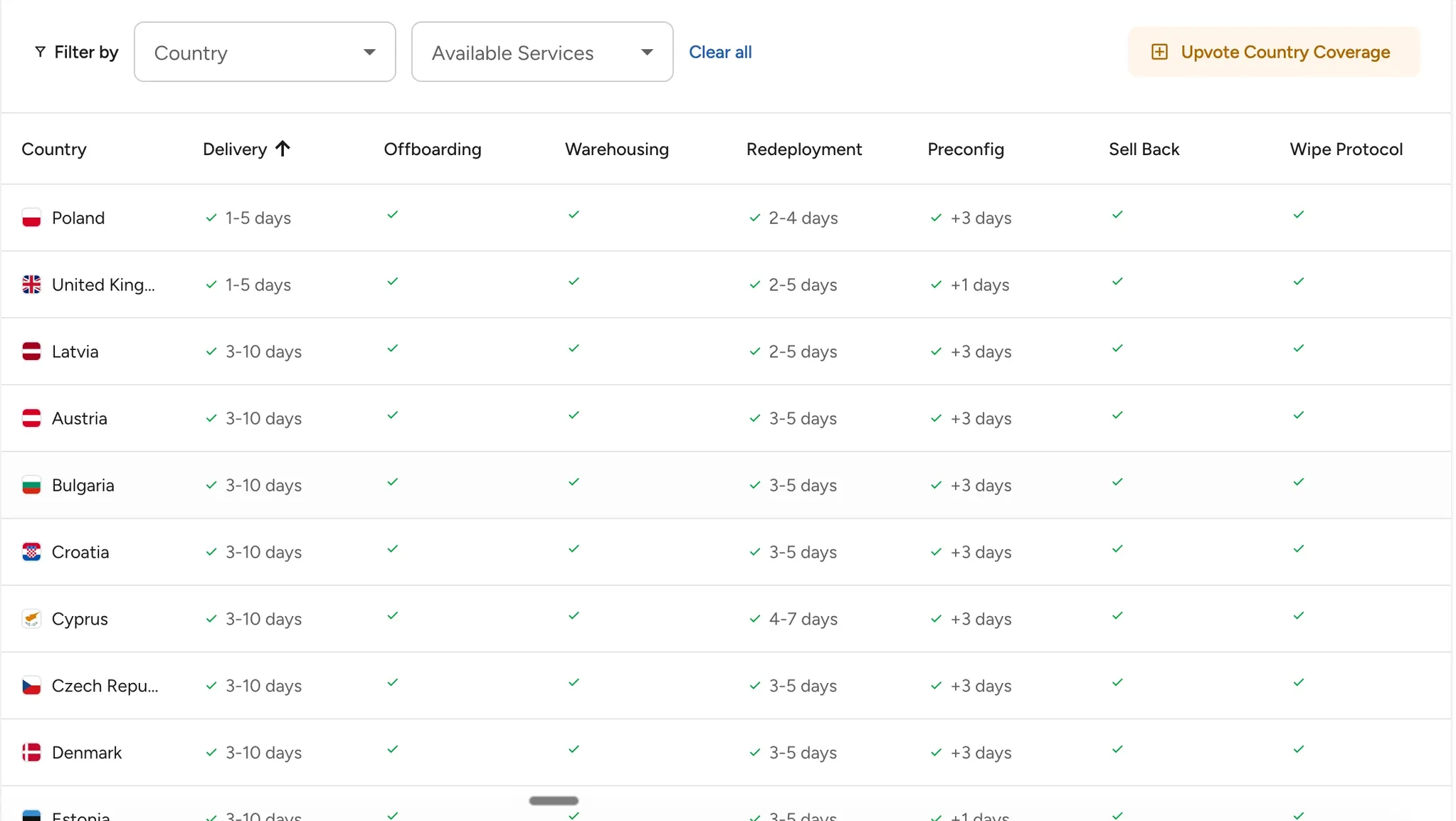
Named coverage proof outside Latin America. RemoFirst has us collecting devices in Kazakhstan, Armenia and Georgia. Booksy had to equip people in the Philippines and in Colombia with very little warning. Ukraine has been served through wartime. Country lists are cheap. Named customers in named markets are not.
| Item | Quipteams | Tequipy |
|---|---|---|
| Service prices | Storage from $35 per device a month. Device, retrieval, buyback and repair each quoted per case | Devices at recommended retail price, retrieval $70 to $150, storage $12 a month, redeployment $70 to $150, sellback free |
| Platform fee | $0 on every plan | $99 a month flat at any fleet size, free under 100 devices |
| Minimum to start | None | None |
The outcomes behind those rates carry names. RemoFirst collected devices across 30 countries and recovered roughly $2,000 per employee in assets that used to walk out of the door. TapTap Send saved $6,500 monthly after folding three purchasing processes into one. Across the case studies, 99% of devices land before the employee's first day and every company device has come back after offboarding. For the category baseline, start with what IT procurement services cover.
Two honest caveats. Our SOC 2 is in progress rather than finished. And our public review base is smaller than Quipteams', so the evidence here is named case studies rather than a star rating.
{{cta-primary}}
CONCLUSION
Does Quipteams Pricing Fit Your Budget?
It fits if your hiring is concentrated in Latin America, your volume is spiky enough that a subscription would waste money, and nobody in your company gates suppliers on certification. On that profile the reviews are consistent, the terms are clean, and staying put is the right call.
It fits less well if you have to forecast retrieval and buyback before the year starts, or if your next hires land in markets where no reviewer has been yet. Price the same machine in the same country on both platforms, then run a full year through the calculator. Tequipy, hardware for global teams, every published Tequipy rate and the Tequipy team are each one click away, with nothing attached.
FAQ
Is Quipteams Really Free?
The platform is. Account creation, platform access, the public API, single sign-on and a named account manager all cost $0, with no per-seat charge. Hardware and physical services are billed per order.
How Much Does Quipteams Storage Cost?
$35 per device a month for used or retrieved machines, improving at volume. New devices bought through Quipteams and not yet assigned are stored free, with no stated time limit.
Does Quipteams Require a Minimum Order or a Contract?
No, on every count: no minimum order, no minimum spend, no contract and no exit fee. Tequipy sells on the same terms, so compare the device and service prices instead.
Does Quipteams Publish the Price of Retrieval?
No. Retrieval is quoted per device and varies by country or region, so the number arrives on a call. Tequipy publishes $70 to $150 per device, by country, on its pricing page.

Keep your current setup.
Just test us on one order.
AUTHOR
Before Tequipy, Tomek ran IT at Revolut, scaling from 100 employees in 2 offices to 5,000 across 17. He built the system that kept every laptop accounted for, then founded Tequipy – a platform that handles IT equipment logistics for distributed teams across 180+ countries.
As CEO, he runs operations and covers the founder layer: strategy, product, and the company-building that comes with both.
15 minutes. Your countries, your devices, your setup. No pitch.