KEY TAKEAWAYS
- Outsourcing IT procurement hands a supplier work your procurement function used to run. With employee devices that work is physical: buying, configuring, shipping, collecting, reselling.
- Four conditions decide it. More than one hiring country, hiring you cannot forecast, one IT person carrying the fleet, and devices that never come back from leavers.
- Keep it in house if you buy in one country with steady headcount and a reseller that performs. In Deloitte's 2024 survey, 70% of executives had pulled outsourced work back in house.
- A device partner holds employee home addresses and phone numbers, so GDPR Article 28 makes it a processor. A written contract, an audit right and data return are legal duties.
Outsourcing IT procurement pays off when hiring crosses borders faster than your IT function can reach them. It wastes money when a single-country team with steady headcount and one reliable reseller signs a contract it never needed. Deloitte's survey of more than 500 executives found 70% had brought outsourced work back in house over five years, while 80% still planned to hold or raise third-party spend.
What Does Outsourcing IT Procurement Mean?
Outsourcing IT procurement means giving a supplier work your own procurement function used to do. CIPS, the Chartered Institute of Procurement and Supply, defines outsourcing as "taking an operation, process or function that the procurement function has previously undertaken itself and using a supplier to deliver this instead" (CIPS). With employee hardware, what leaves your team is physical work.
CIPS splits the practice by geography: on-shore, off-shore somewhere usually cheaper, and near-shore in a nearby country with similar language and skills. Devices bend that model, because a laptop has to finish in the same room as its user. Purchasing can sit anywhere. Delivery cannot.
A typical engagement flows one way. You keep the standard build, the budget and the approval rule. The partner quotes per country, buys through a local supplier, enrols the machine in your MDM, ships it to the employee's home, then collects, wipes, stores or resells it at exit. Some providers stop at the purchase order, so ask where a shortlisted provider's IT procurement services stop.
What You Can Outsource (and What to Keep In House)
The scope runs from the first quote to the final certified wipe, and no partner takes all of it. Read the third column of the table first, because handing over the execution of a purchase differs from handing over the judgement behind it.
Security duties travel with every handover above. ISO/IEC 27036-1:2021 was written for this exact relationship, covering information security in supplier relationships (ISO).
Sourcing and Purchasing
Almost every provider takes this piece, so treat it as table stakes. It covers supplier search per market, quotes, volume pricing, purchase orders and invoices. APQC's benchmarking data puts the cost of processing one purchase order at "anywhere from about $14 to more than $54" (APQC).
Geography makes hardware different. A cheap laptop bought in a low-cost country still crosses a border, and the border adds duty, tax and a clearance time nobody will quote. Ask whether the provider buys locally or ships from a central warehouse, which is the fork set out in IT hardware procurement.
Deployment and Configuration
Providers separate here. Imaging, enrolment in Apple Business Manager or Windows Autopilot, tagging and shipping to a home address are distinct capabilities, and a provider can do the buying without any of them. The test is short: does the machine arrive already managed, or does the new starter get a 40-minute setup call on day one? The first is zero-touch deployment. The second is a courier with a login.
Enrolment carries a consequence scoping calls miss. A partner enrolling your devices needs standing MDM access, so settle who holds admin rights, at what level, and for how long.
Storage, Retrieval and Offboarding
The back end is what teams outsource last and need most: warehousing spares, collecting devices from leavers, wiping them to a documented standard, and returning them to service. Laptop retrieval fails more often than any other stage, because it depends on somebody who no longer works for you.
Everybody recognises the failure. A developer resigns abroad, the laptop is promised in the post, and eleven weeks later the register still shows it open. One IT lead described the resulting policy in a vendor evaluation call: "We just write off devices when someone leaves abroad, it's not worth the hassle." Ask for the collection window in days, the chase attempts, and the fallback when a leaver goes quiet, which is the practical detail in getting equipment back from a leaver.
What Most Teams Keep In House
Security policy, approval thresholds, budget ownership and the final say on what gets bought stay with you in almost every arrangement. Outsourcing procurement does not outsource the decision. A partner can tell you what the same laptop costs in Portugal and what it costs in Brazil. Whether the role justifies that machine is still your call, and so is remote equipment management, whoever moves the boxes.
The law reinforces the split. The supplier processes employee personal data on your instructions, so it is a processor and you stay the controller. GDPR Article 28(3) requires the contract to state the subject matter and duration of the processing, its nature and purpose, the type of personal data and the categories of data subject (Article 28, ICO).
Benefits of Outsourcing IT Procurement
The upside concentrates in three places for a growing company: comparable prices, team capacity, and the end of the device's life.
Prices Become Comparable Across Countries
A supplier per market produces a price logic per market. Two lines recur in vendor evaluation calls. On sourcing: "We're approaching local vendors in each country, it's extremely time consuming." On quotes: "Prices are all over the place, hard to compare quotes across vendors."
One partner, one quote format and one currency choice per order turn that spread into a comparison. Deloitte found 80% of executives planning to hold or raise third-party investment. The gain is administrative before it is financial, since a comparable price is what makes a negotiation possible.
The IT Team Stops Being the Bottleneck
One person cannot cover a hiring plan spread across six countries. One IT manager put the constraint in a single line during an evaluation call: "I'm the only IT person, if I'm on holiday, we can't hire." No spreadsheet answers that sentence.
The hours go into the admin behind each hire: a quote, an order, a courier booking, a customs form, then the chase when nothing arrives. At the APQC range above, paperwork alone on 200 orders a year runs from about $2,800 to $10,800.
The End of the Device's Life Gets Handled
In-house processes tend to be strong at arrival and weak at departure. A partner that collects, wipes, stores and redeploys turns a write-off into residual value, and produces what an auditor asks for: a wipe record per serial number and a chain of custody.
The data side is a duty. GDPR Article 28(3)(g) makes the processor delete or return all personal data when the contract ends, at your choice. The ICO accepts that backups may not be deletable the same day, provided the data is "put immediately beyond use" and removed on the next deletion cycle (ICO guidance).
Drawbacks and Risks to Weigh
CIPS names three disadvantages: loss of control, security of confidential information, and employee morale. On the first it is blunt: "Outsourcing means you are giving control to another organisation, so there are risks when it comes to standards of service and quality" (CIPS). Every risk below has a question that manages it.
You Lose Direct Control Over Timelines
A new hire starts Monday and the laptop sits with a third party you cannot walk over to. "It's Thursday and someone starts Monday, in the Maldives" is the version that keeps IT managers awake. Outsourcing changes who fixes that Thursday, never whether it arrives.
Manage it with a delivery SLA, then examine the SLA. Ask what percentage of last quarter's devices landed on or before the first day of work, country by country, judged against the date you asked for rather than the date the vendor promised. Averages hide the misses. Then ask what a missed SLA produces: a credit, an escalation path, or an apology.
Security and Data Handling Exposure
The exposure is measurable. Verizon's 2025 Data Breach Investigations Report puts third-party involvement at 30% of the breaches it analysed, double the roughly 15% of the year before, from more than 22,000 incidents and 12,195 confirmed breaches (Verizon). SecurityScorecard, on a separate sample of 1,000 breaches, puts third-party related breaches at 35.5% for 2024 and says the figure "is likely conservative due to underreporting and misclassification" (SecurityScorecard).
A device partner sits in that category by design, holding home addresses and phone numbers, often with enrolment rights in your MDM. Ask for documents rather than assurances: the ISO 27001 certificate with its scope statement, whether SOC 2 is held or in progress, the latest penetration test report, and who holds admin access and for how long. NIST SP 800-161 Rev. 1 and the NCSC supply chain principles are free, and both hand you a question list.
Vendor Lock In and Exit Costs
Once the asset register, the serials and the storage all live with a partner, leaving gets expensive in a way nobody prices at signature. Banking regulators wrote the checklist first. European Banking Authority guidelines bind banks and payment institutions rather than every company, so treat them as the standard a regulator considers reasonable.
They require a documented exit strategy per critical function, a business impact analysis of what an exit costs in people and time, and a contract that must "facilitate the transfer of the outsourced function to another service provider or its re-incorporation into the institution" (EBA).
Borrow it. Ask what data comes back, in what format, on what timetable, at what price, and ask for notice periods on both sides in writing. Treat reversal as ordinary too: peer-reviewed research calls backsourcing "a viable option for organizations facing outsourcing-related challenges, such as problematic vendor relationships, high costs, or the recognition of software development as a core competence" (Empirical Software Engineering). That study covered public-sector software teams, so borrow the posture rather than the finding.
Hidden Fees and Opaque Margins
The bill has more lines than the pitch: hardware markup over retail, shipping, per-device-per-month storage, collection fees, wipe fees, a platform or per-seat charge, a minimum term. No public dataset says what any of them should cost.
So build the comparison yourself. Ask each provider to price one hire and one leaver in your three hardest countries, every line included, in the destination currency. "It depends" means the price gets set after you commit. Ask about the hardware markup separately, because that line usually beats every service fee combined.
Coverage Gaps in Countries You Actually Hire In
Every provider says global. The narrower question is which countries it buys in locally and which it merely ships into. A shipped-in device brings a customs entry, an importer of record question and a clearance time nobody commits to, so shipping a laptop internationally suits one device and fails as a hiring plan.
Take your next four quarters of hiring countries, awkward ones included, and ask for delivery evidence in each from the last three months. No public dataset verifies a coverage claim, so recent performance in your markets is the only check you have.
When Outsourcing IT Procurement Makes Sense
The trigger is rarely headcount. It is the gap between where you hire and where your IT function can reach. Roughly half the people asking should keep the work in house, and almost nobody tells them so, so both halves sit below.
Signs You Have Outgrown In House Procurement
Five signals turn up together often enough to count as one:
- You hire in more than one country, and each one adds a supplier, a currency and a courier network.
- Your IT team is one person, or nobody, and that person is also the help desk.
- Ops or a founder couriers laptops personally, or carries them in hand luggage.
- Nobody can say where a third of the fleet is. One IT manager described the register in an evaluation call: "We don't even know how many devices are unaccounted for."
- Onboarding slips past day one often enough that hiring managers plan around it.
Worked example. A 140-person company hiring in Poland, Portugal, Brazil, the Philippines and the UK, with one IT manager. At the APQC range above, paperwork on 120 orders a year runs from about $1,700 to $6,500. The queue costs more: two weeks of leave stops hiring in five countries. No independent benchmark exists for IT hours per device order, and the figures in circulation come from vendors selling the fix, so measure your own for a month.
When to Keep It In House
Keep it in house if you buy in one country, headcount is predictable, and one reseller already delivers in days. A partner then adds a contract, an invoice, a handoff and a dependency, while removing a job that takes an afternoon a month. There is not much convenience left to buy.
Two findings support the caution. Deloitte found 70% of executives had selectively brought outsourced work back in house over five years, while 80% planned to hold or raise third-party investment, which reads as rebalancing rather than retreat. The same survey found 70% describing their own vendor management function as short of full maturity, and outsourcing creates a supplier to manage. Revisit the decision when the second country appears.
The Cost Comparison That Matters: A Fee or a Hire
Most evaluations weigh the partner's fee against last year's hardware invoices, which is the wrong pair. The in-house option has a salary inside it. Somebody owns quotes, orders, couriers, enrolment, collections and the register, and past a few hundred devices in several countries that somebody is a role.
Public figures put a floor under the comparison. US median annual wages for May 2024 were $139,510 for purchasing managers, $96,800 for systems administrators and $171,200 for IT managers. The UK government's careers service publishes ranges instead of medians: £24,000 to £36,000 for an IT support technician, £28,000 to £60,000 for a purchasing manager.
One published example makes it concrete. Gigs, a company of 100 people, saved 100+ hours a month on device logistics and skipped an IT logistics hire it costed at a $60,000 to $80,000 salary (Gigs case study). If the genuine alternative is a hire you were about to make, a fee below that salary wins on arithmetic. If it is 40 minutes a week from an office manager with the reseller on speed dial, the fee loses.
Ways to Outsource IT Procurement
Four models compete for this work, and each is genuinely right for somebody.
Procurement BPO
A business process outsourcer runs transactional purchasing at volume. Gartner's market definition for finance and accounting BPO describes "the use of third-party outsourcing service providers to execute transactional finance processes, including purchase-to-pay (P2P), order-to-cash (O2C)" (Gartner), and purchase-to-pay is the relevant part. Buying gets handled competently, while everything after the box arrives stays yours.
Managed IT Service Provider
An MSP gives broad IT support with procurement attached, which is efficient when you also need a help desk, patching and identity administration. The weakness is specific: hardware logistics and international shipping are a separate operational capability, and many MSPs are strong in one region and thin outside it.
Value Added Reseller
A VAR brings pricing, vendor relationships and product knowledge, and inside its home market it often beats a general marketplace on price and lead time. It stays a buying channel: no deployment, no collection, no storage, no resale.
Device Lifecycle Platform
The newest category runs procurement, pre-configuration, delivery, storage, retrieval, redeployment and resale against one asset record, usually buying locally in each country. Device lifecycle management names the category rather than a product. You are buying a logistics operation, so coverage evidence and exit terms matter more here than a feature list.
Tequipy sits in the fourth row. It buys through a local reseller where the employee lives, pre-configures the device, then runs collection, storage, redeployment and resale against one record, with every rate on its pricing page.
{{cta-primary}}
How to Choose an IT Procurement Partner
Five criteria separate a partner that removes work from one that only moves it. Put each as a question whose answer contains a number.
Coverage Where You Actually Hire
Hand over your hiring countries for the next four quarters and ask, per country, whether the provider buys locally or ships in, and what it delivered there last quarter. A homepage map is a marketing asset. A delivery record is evidence.
Published Prices Instead of Quotes
A provider with a public rate card has made a commitment you can hold it to. One that quotes case by case has kept the pricing decision until after your commitment. Ask for the markup over recommended retail price explicitly, in writing.
One Record Across the Whole Lifecycle
Ask whether buying, deployment, storage, retrieval and resale update the same asset record, or whether three systems get reconciled by hand each quarter. Ask also whether the services work on devices bought elsewhere, because your current fleet has to fit somewhere.
See what IT procurement software can automate.
Security You Can Verify
The right to audit makes everything else checkable. GDPR Article 28(3)(h) requires your processor to supply the information needed to demonstrate compliance and to "allow for and contribute to audits, including inspections, conducted by the controller or another auditor mandated by the controller" (GDPR Article 28). Banking regulators put it plainly: "The right to audit is key to providing the appropriate assurance that at least critical or important outsourced functions ... are provided as contractually agreed and in line with regulatory requirements" (EBA guidelines).
A Register and an Exit, Written Down First
Keep a supplier register recording, per arrangement, the start date, renewal date, end date, notice periods for both sides, and whether personal data is involved. That list comes from the same banking guidelines and costs nothing to copy. Then write the exit early: what data returns, in what format, over how long, and who pays.
Pro tip: run the trial in your worst country. Pick the market that broke this year, move one hire and one leaver through the partner there, and measure four things: arrival against the start date, all-in cost against your last local quote, days taken to collect, and the state of the register afterwards.
Booksy chose that sequence deliberately, and said so afterwards: "We initially tested them in Latin America, a region where we faced logistical challenges." That is Marcin Szydłowski, its Director of Enterprise Technology and Security, in the Booksy case study. Testing an easy market teaches you nothing you did not know, and the worst case here is one laptop.
Where Tequipy Fits for a Distributed Team
Tequipy is a device lifecycle platform for globally distributed teams. What that excludes matters here: no retainers, no managed IT support, no help desk. Hardware sells at recommended retail price or lower with no markup and delivery included, and each service carries a published price.
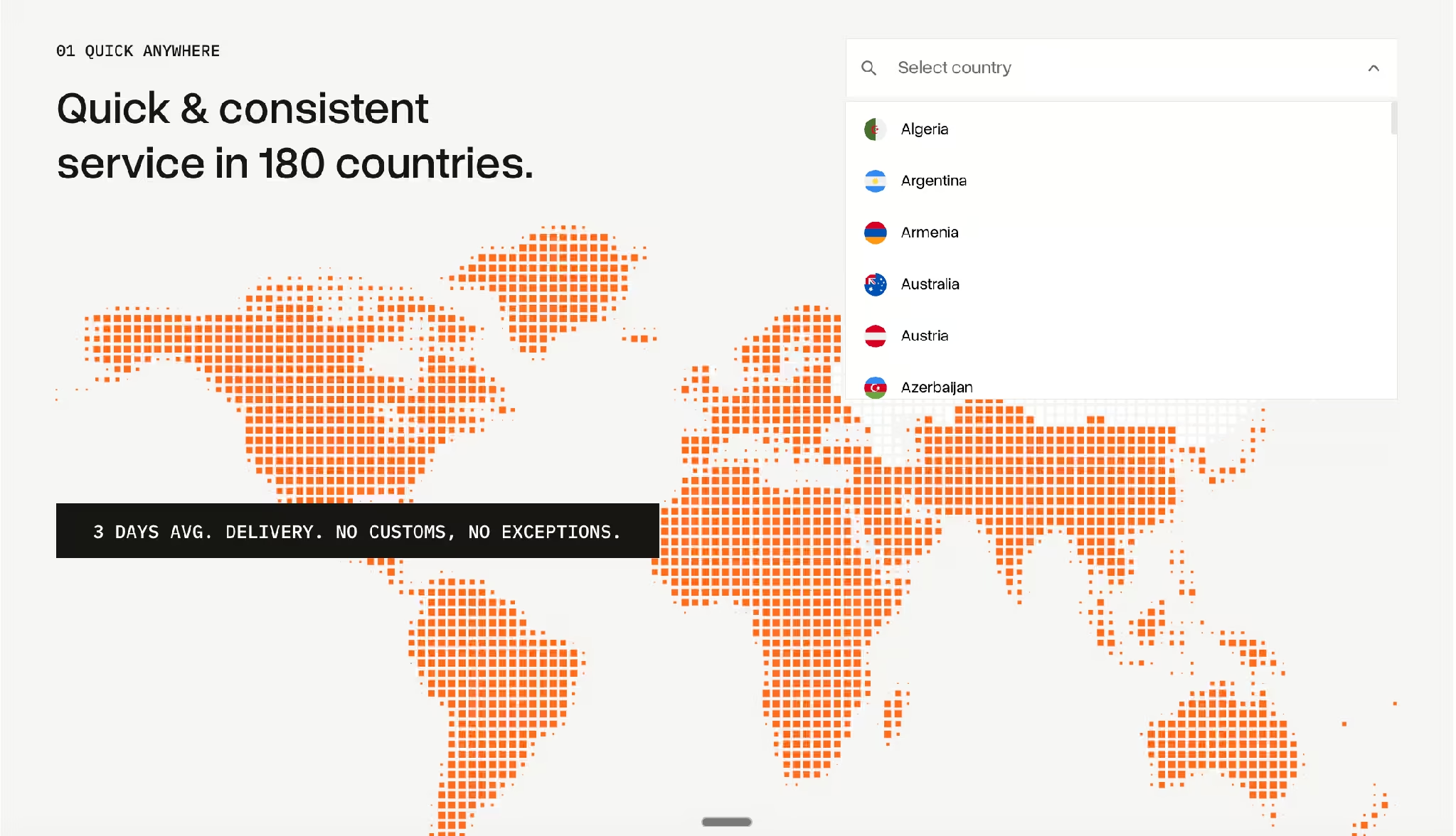
Each order goes through one of 600+ authorized local resellers in 180+ countries, which puts the purchase inside the employee's own country and removes the import step. Delivery averages 3 business days with a 10-day cap. Three countries sit outside the footprint: Russia, Belarus and North Korea.
Seven services run against one asset record: Buy, Pre-Configure, Service, Offboard, Store, Redeploy and Sellback. All of them work on hardware bought elsewhere too, and an existing fleet uploads by CSV.
Every rate above sits on the published rate card, alongside a $199 monthly HRIS integration. There is no contract, no minimum, no setup fee and no exit fee. Nothing is prepaid: invoices follow delivery, and a $5,000 credit line buys 7 calendar days to settle. Tequipy neither leases nor finances nor rents hardware in any market.
Cycling a returned laptop costs less than replacing it: collection, three months in storage and a redeployment come to roughly $180 to $240, where a new machine of the same class costs $1,500 to $2,500.
On security the position is ISO 27001 certification, European hosting under GDPR, penetration test reports on request, and a documented chain of custody per device. At offboarding you pick one of four data outcomes: the included basic wipe, a Blancco certified wipe, a destruction certificate, or nothing touched under legal hold. SOC 2 remains in progress, so ask for its current stage if your security review needs that report.
The customer figures here are Tequipy's own tracked numbers, published per case study. Booksy saved 3,200+ hours of IT administration across more than 500 employees, with 99% of devices arriving before the start date. TapTap Send saved 40+ hours a month and $6,500 a month on average, with 100% device recovery. RemoFirst covers 30 countries with every device returned. Lera Lykholiet, People Operations Specialist there, describes the result plainly: "now we don't have to worry about device logistics at all".
Three limits belong in a shortlist. Devices stay in the country they were collected in, with the EEA counted as one region, so exiting a market means a sellback. Tequipy is not an MDM, and integration runs through Apple Business Manager, DEP and Windows Autopilot rather than a direct Jamf or Intune connection. Approval workflows and budget controls are absent so far, and integration beyond HRIS is API only.
{{cta-primary}}
CONCLUSION
Should You Outsource Your IT Procurement?
Outsource IT procurement when the work has outgrown the person doing it and the map has outgrown your suppliers: more than one country, hiring you cannot forecast, one IT person as the single point of failure, devices that stay abroad when people leave. There the real comparison is a fee against a hire, and the fee usually wins.
Keep it in house when you buy in one country, hiring is steady, one reseller performs and somebody competent owns the register. Outsourcing then adds a contract to manage and a handoff to coordinate for a problem you have already solved.
In the first group, the cheapest way to find out is one order in your hardest market. Talk to the Tequipy team about that order, compare the seven lifecycle services, or read the companion guide to IT hardware procurement before shortlisting anybody.
FAQ
How Much Does It Cost to Outsource IT Procurement?
It depends on the model, and no headline number compares two providers honestly. Price one hire and one leaver in three countries with every line included: device, delivery, pre-configuration, platform fee, collection, wipe and storage. The hardware markup over retail is usually the biggest line.
What Is Procurement as a Service?
Procurement as a service is a marketing term rather than a defined standard. Providers use it for an arrangement where an external team runs some or all of your purchasing, on a subscription or per-transaction basis. No standards body defines it, so ask which activities it covers.
What Is the Difference Between Outsourcing IT Procurement and Managed IT Services?
Scope. Outsourcing IT procurement hands over buying, and often deployment and the rest of the device lifecycle. Managed IT services hand over IT operations: help desk, patching, monitoring and identity administration, with buying attached as a side service. Plenty of companies use both.
Can You Outsource Only Part of Your IT Procurement?
Yes, and most companies start there. The usual first steps are the countries you have no supplier in, or the offboarding and retrieval work that keeps failing. Keep specification, approval and budget in house, then hand over execution stage by stage.
How Does Tequipy Handle Outsourced IT Procurement for Distributed Teams?
Tequipy places each order with a local authorized reseller where the employee lives, in 180+ countries, charging recommended retail price with delivery included. It then pre-configures, collects, stores, redeploys or resells the machine against a single asset record. Platform access is $99 a month at any fleet size.

Keep your current setup.
Just test us on one order.
AUTHOR
Before Tequipy, Tomek ran IT at Revolut, scaling from 100 employees in 2 offices to 5,000 across 17. He built the system that kept every laptop accounted for, then founded Tequipy – a platform that handles IT equipment logistics for distributed teams across 180+ countries.
As CEO, he runs operations and covers the founder layer: strategy, product, and the company-building that comes with both.
15 minutes. Your countries, your devices, your setup. No pitch.