KEY TAKEAWAYS
- GroWrk publishes no prices at all. The pricing page names two tiers, A La Carte and Flex, ticks off the features in each, and puts a request form where the numbers belong.
- Outside estimates disagree. The Vendr listing reports a median buyer paying $11,280 a year inside a range from $8,760 to $41,040. SelectHub's GroWrk page says $12,000 a year to start, on the page where it also says specific pricing details are not readily available.
- The free tier is real and it is limited. A La Carte costs nothing and bills on each order. HRIS integrations, zero-touch MDM, buy-back, end of lifecycle services, the employee dashboard, multi subsidiary support and a dedicated account manager all sit inside paid Flex, which starts on a 12-month initial agreement.
- Tequipy prices the same work in public. For globally distributed teams the platform runs $99 a month flat at any fleet size and free under 100 devices, hardware sells at recommended retail price across 180+ countries, and every lifecycle service carries a listed rate.
GroWrk pricing is the one thing GroWrk's pricing page does not contain. The page names two tiers, lists what each one includes, and hands you a form. Everything a budget needs, the monthly fee, the device price, the offboarding charge, sits on the far side of a sales conversation.
So this guide rebuilds the bill from what can be checked: what GroWrk states about each tier, what two independent marketplaces report, what its own calculator says about itself, and which charges customers describe after they sign.
How Much Does GroWrk Cost?
There is no listed answer, and GroWrk does not pretend otherwise. Both tiers end at "Request your pricing". Everything the page does state fits in one table.
Two marketplaces try to fill the gap and land in different places. The Vendr listing reports a median GroWrk buyer paying $11,280 a year, inside a range running from $8,760 to $41,040. A spread of almost five times says the contracts vary more than any single figure suggests. SelectHub's estimate sets a starting price of $12,000 a year, on the same page where it says specific pricing details are not readily available.
A customer makes the practical point better than either marketplace. A reviewer in the design sector writes: "We are currently using the A La Carte model as their premium service is beyond our price-point", in a G2 review. For some paying customers the free tier is the destination, not a step towards Flex.
Tequipy: An Alternative
A bias note first. What follows describes our own company, so check each rate against the page it links to rather than taking our word for it. The company came out of Revolut, where one of our co-founders ran the IT function while headcount went from 100 people in two offices to 5,000 across 17 worldwide. A weekly rotation of about 300 staff cost the business no laptops at all.
Four things differ from a quote-only model, and all four show up on an invoice:
- Every rate sits on a public page. The platform fee, offboarding, storage, redeployment and sellback all carry printed numbers on the Tequipy pricing page, so a twelve-month total takes ten minutes to build.
- Hardware at recommended retail price. Orders are filled locally, by an authorised reseller where the employee lives, benchmarked against that country's own Apple Store price. There are 600+ such partners covering 180+ countries.
- Services run on devices bought anywhere. Retrieval, storage, redeployment and sellback all work on hardware bought through another vendor, GroWrk included, so a first order needs no migration.
- One flat platform fee. $99 a month at any fleet size, free under 100 devices, with no per-seat or per-workstation charge on top.
No part of this is a lease. Tequipy sells hardware outright in every market it operates in and arranges no financing of any kind. The single concession on timing is a $5,000 credit line, payable seven calendar days after delivery, which behaves like a purchase order.
{{cta-primary}}
GroWrk Pricing Plans: A Breakdown
Four things move a GroWrk bill: which tier you sit on, how many workstations you manage, what the hardware costs above buying direct, and the charges that fall outside the monthly fee. Each moves on its own, which is why one company's annual total tells you almost nothing about your own.
A La Carte: Free Platform Access, Charged Per Order
The entry tier is labelled free to use, and GroWrk describes it as a flexible, pay-as-you-go model without ongoing SaaS fees. There is no commitment and no published minimum device count. Tequipy bills order by order at any fleet size as well, so read those terms as common ground rather than as a difference.
Seven things are included, as the page listed them in September 2026: free platform access with individual charges for each order, global procurement, device retrievals, storage, global logistics, pre-configuration and remote wiping.
What the tier leaves out is the longer list. Eleven features sit on the paid side only: bundled logistics charges, 40+ integrations and the MCP connection, MDM zero-touch deployment, a customer success manager, end of lifecycle services, multi subsidiary support, HRIS integrations, the employee dashboard, a dedicated account manager, EOL and buy-back services, and 24/7 AI-powered support.
One r/sysadmin user describes how the two tiers meet inside a sales conversation: "I couldn't justify growrk's subscription model, told them they were too expensive then they pulled out the a la carte and my decision was made", in an r/sysadmin comment.
Flex: A Monthly Management Fee Per Workstation
Flex is the subscription tier, aimed at companies of more than 100 employees. Its billing unit is neither the employee nor the device. GroWrk's FAQ says the company "charges a monthly management fee per workstation managed", and defines a workstation as "a laptop plus peripherals". That fee covers imaging, MDM enrolment, shipping, 24/7 IT support, repairs, warranty management and storage.
Two things sit outside it. Offboarding is billed separately from the management fee, and the same FAQ states that "Initial agreements cover the first 12 months", with second-year and add-on agreements available afterwards. No figure is published for the fee itself, for a minimum device count, or for a setup charge.
Hardware: The Largest Line With No Rate Card
Devices move more money than any subscription on a growing team, and this is the part GroWrk keeps furthest from public view. No catalogue prices appear on the site, no markup figure is published anywhere, and the quoting tool asks for a login before it shows a number.
The public evidence points one way. A verified reviewer in hospital and health care writes that "Buying assets from them is substantially more expensive (often 2-3 times more) than buying it yourself and shipping it to their warehouse", in a G2 review. Corinne P. puts the same thing more mildly in an October 2025 G2 review: "The cost involved tends to be on the higher end, making it less cost-effective than I would like."
A current GroWrk customer gave us both figures for one machine and told us the arrangement "is not sustainable". Buying that device and shipping it out in-house came to $1,700 to $1,800. The GroWrk quote came back at $2,500 to $2,600.
What GroWrk's Own Calculator Says About GroWrk
The pricing page now carries an IT lifecycle cost calculator comparing GroWrk with two named rivals. Those competitor figures are GroWrk's own estimates of other companies' prices, so they are marketing rather than evidence, and this guide does not repeat them.
One number in it is worth reading, because it is GroWrk describing itself. In the sample scenario the platform component comes to $3,678 a year inside a total of $19,840, with hardware at $12,160 and deployment at $4,002. Negotiate only the subscription line and you are negotiating the smallest of the three.
GroWrk Hidden Costs and Additional Fees
These are the items that never reach the pricing page and do reach the invoice.
- Offboarding sits outside the Flex fee. GroWrk's FAQ places imaging, enrolment, shipping, support, repairs, warranty and storage inside the monthly management fee, then charges offboarding separately. On a team with ordinary churn that is a recurring line nobody quoted.
- Logistics is bundled only on the paid tier. A La Carte carries a charge on each order, while the pricing page lists logistics charges as a Flex inclusion. The per-order total is the number to ask for in writing.
- Speed you pay for and may not get. A verified reviewer in consumer services reports "Delays with shipment even if it's the device in hand. Overnight shipping doesn't exist even with overnight shipping charges", in a G2 review.
- A quote that grows. One r/sysadmin user writes that "Prices that we were initially quoted didn't include the total costs, which just felt very deceptive", in an r/sysadmin comment. Treat that as one anonymous account rather than a pattern, and as the sharpest version of a complaint several reviewers make more gently.
- The price at the other end. One four-year GroWrk customer told us the resale offers were "really pretty terrible", putting four-year-old MacBook Pros at $50 each. Buy-back is a Flex feature, so the tier you pay for also sets that number.
Pro tip: price the same twelve months twice, once on each tier, before anyone quotes you a subscription.
GroWrk sells two commercial models under one brand, so the real question is which side of the A La Carte line your last year would have landed on. Pull your own counts first: orders placed, devices retrieved, device-months in storage, leavers processed.
Then ask for five things by email rather than on a call. One, the per-order rate for every A La Carte service in your five most common countries. Two, the Flex fee per workstation, with GroWrk's own definition applied to your fleet, spares in a cupboard included. Three, the offboarding charge, which falls outside that fee. Four, a same-spec device quote beside the manufacturer's price for that country on the same day. Five, what the annual total becomes if headcount drops by a fifth.
Run last year through both columns. If A La Carte wins, the features that made Flex attractive are the ones you would not be buying, and that is the decision rather than a discount conversation.
GroWrk Pros and Cons
Price is one column of a decision. GroWrk has a documented record in places where several global vendors do not, and its complaints cluster in a few predictable spots. Everything below traces to a linked public review or to a buyer who told us directly.
Pros
- A documented Latin America record. One reviewer, three years into the platform and responsible for standards and compliance, says the service holds steady for staff in Chile, Colombia, Brazil, Argentina and Uruguay alike, per a September 2024 G2 review.
- Lifecycle breadth that reviewers can feel. An IT manager writes that GroWrk has "made it incredibly easy to ship and retrieve laptops across continents without any hiccups, consistently meeting our timelines, even in challenging locations", in a September 2024 G2 review.
- Starting costs nothing. A VP of operations values "The flexibility of being able to purchase equipment on a need-by-need basis, without having to sign up for a plan", in a G2 review. Tequipy bills order by order at any fleet size too, so that is shared ground rather than an advantage over the field.
- Buyers who need reach say the return works. An r/ITManagers user concedes the premium and defends it: "Pricing is a bit higher compared to some local-only vendors, but for global reach, the ROI made sense for us", in an r/ITManagers comment.
- SOC 2 Type 2. GroWrk carries a SOC 2 Type 2 badge on its security page. Where a security review treats that as pass or fail, it is a real advantage over vendors whose audit is still open.
Cons
- Nothing is published, so budgeting takes a sales cycle. Two marketplaces disagree by thousands of dollars a year, and neither number came from GroWrk.
- Hardware above direct purchase. This is the cost complaint buyers raise most. Even a satisfied r/sysadmin customer writes that "The pricing for international partnerships is lame" while defending the time his team saves, in an r/sysadmin comment.
- The lifecycle sits behind a twelve-month agreement. Buy-back, automated HRIS provisioning and zero-touch enrolment are the features that justify hiring a lifecycle vendor rather than a catalogue, and each one arrives only with paid Flex.
- Delivery outside the Americas. One reviewer wrote that "It's been more than month since I submitted my request, and they still can't deliver a laptop to a Central European country", in a December 2025 Trustpilot review.
- Buyers price it against rivals and walk. One prospect who ran the comparison told us GroWrk "was significantly more expensive" than the option they chose.
Who Is GroWrk Best For?
Three kinds of buyer get real value at prices nobody can see from outside. Everyone else should price the alternatives before the quote lands.
Teams Hiring Across Latin America and the United States
This is where the evidence is strongest and most consistent, and where several larger platforms are thinnest. The boundary comes from a three-star review written in Mexico. The customer found GroWrk "very helpful to buy on a need-by-need basis equipment for our remote team members in LATAM", then draws the limit in the next sentence: "as a full-service plan, there are other competitors in the market that offer a more complete service", per an October 2025 Trustpilot review.
Small Teams That Fit Inside A La Carte
If your device movement runs to a handful of orders a quarter, the free tier does the job and costs nothing until you place one. GroWrk aims it at organisations with immediate equipment needs, and its small-business page targets companies of 0 to 100 employees. Tequipy's platform is free under 100 devices and $99 a month flat at any fleet size above that, so the entry terms are close and the real gap opens on the hardware line.
Companies With Enough Device Movement to Absorb a Per-Workstation Fee
A monthly fee per workstation earns its keep when workstations actually move. A team that evaluated GroWrk and walked away told us it "seems they work more for a larger employee base where there's a lot of turnover. There's a lot of equipment being purchased and moved around, inventory stored." Where a fleet is stable, that fee pays for management that is not happening.
GroWrk Customer Reviews
GroWrk's public record sits mainly on G2, with smaller pools elsewhere. Its Trustpilot profile averages 3.8 from 15 reviews, read in September 2026, and its Gartner Peer Insights page averages 3.6 across five ratings as of September 2026. Capterra, GetApp and TrustRadius carry no usable GroWrk profile.
Positives
Two themes carry the good reviews, and neither is about price. The first is support. A corporate IT engineer appreciates help that is "always accessible and just a Slack message away for any issues or requests", in an October 2024 G2 review.
The second is having one place for the whole job. On GroWrk's Gartner profile a reviewer sums up the appeal: "What i like about this tool that it is very easy to manage everything from procurement process to retriveal throught a single and easy to use platform." The spelling is the reviewer's own. Ordering gets similar credit, with a November 2025 reviewer saying the interface "has significantly streamlined our onboarding process for internal hires", in a G2 review.
Complaints
The complaints are about time first and money second, and the sharpest one joins them together. An IT associate scoring GroWrk 2.0 sums up the experience as "While GroWrk can deliver assets as advertised, they cannot provide timely quotes or support", and describes a catalogue that "is not filtered by spec so it is difficult to find the laptop that's the right fit", taking days to reveal a machine is unavailable before quoting a different one, per an April 2026 Gartner review.
Delivery outside the Americas draws the rest. A customer of more than a year running Mexico and India reports that "Their SLA for shipping is two weeks. I have to ask for updates on a daily basis", in a September 2025 Trustpilot review. Buyers tell us the same privately. One four-year customer told us a single batch of shipments "took two months to get out the door". A separate buyer told us his company cancelled after GroWrk "dropped the ball in Egypt".
Alternative to GroWrk: Tequipy
Both GroWrk tiers start with a form. What follows is the opposite arrangement, built for globally distributed teams, and every number in it can be checked against the page it comes from.
Devices Bought in the Employee's Own Country, at Retail Price
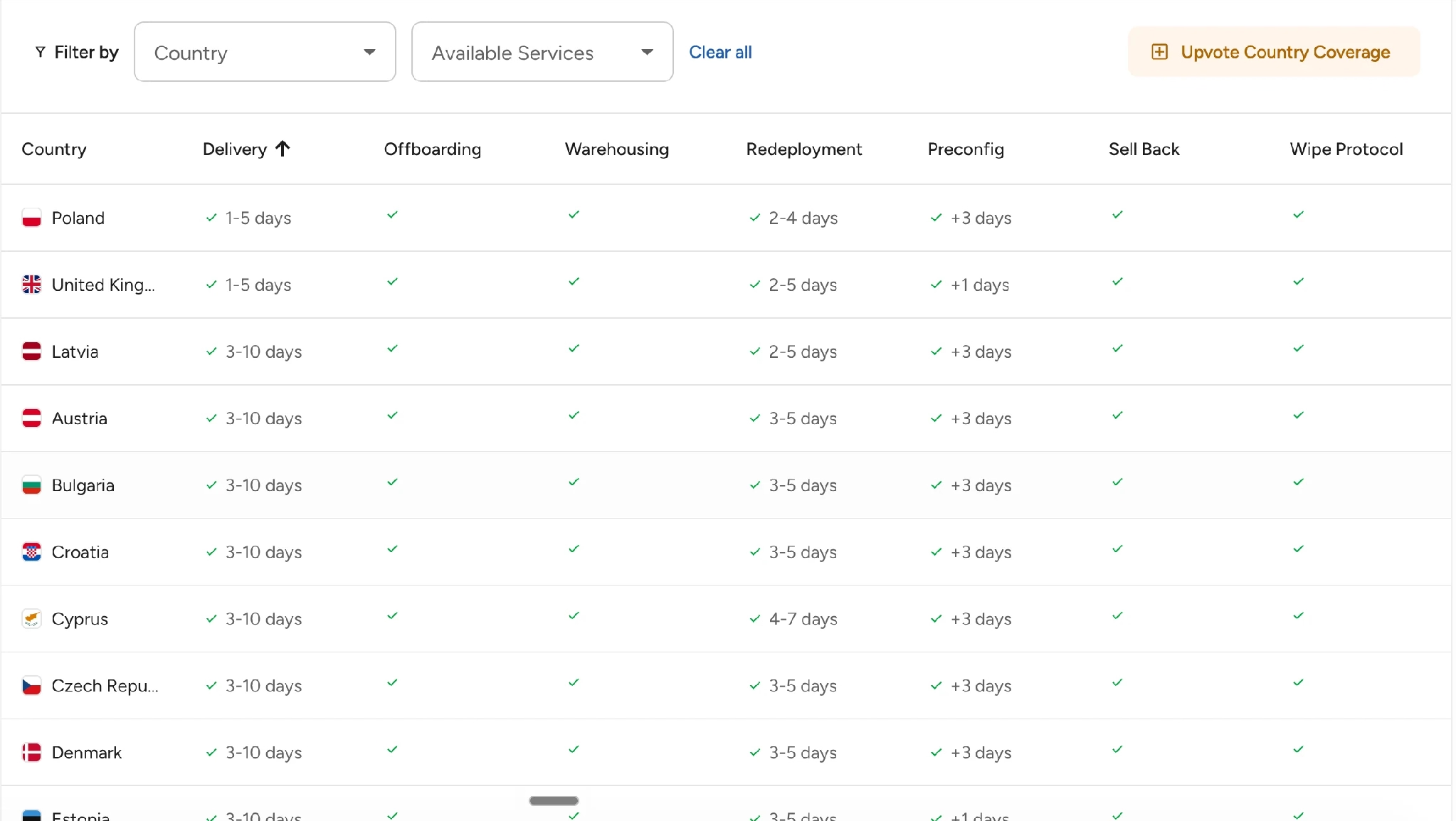
An authorised reseller where the employee lives fills each order, drawing on 600+ partners across 180+ countries. An $1,800 MacBook costs $1,800, benchmarked against that country's Apple Store price. Nothing crosses a border outside the EEA, so duties and customs holds never enter the invoice and laptop procurement stays one line item.
Every Lifecycle Service With a Printed Rate
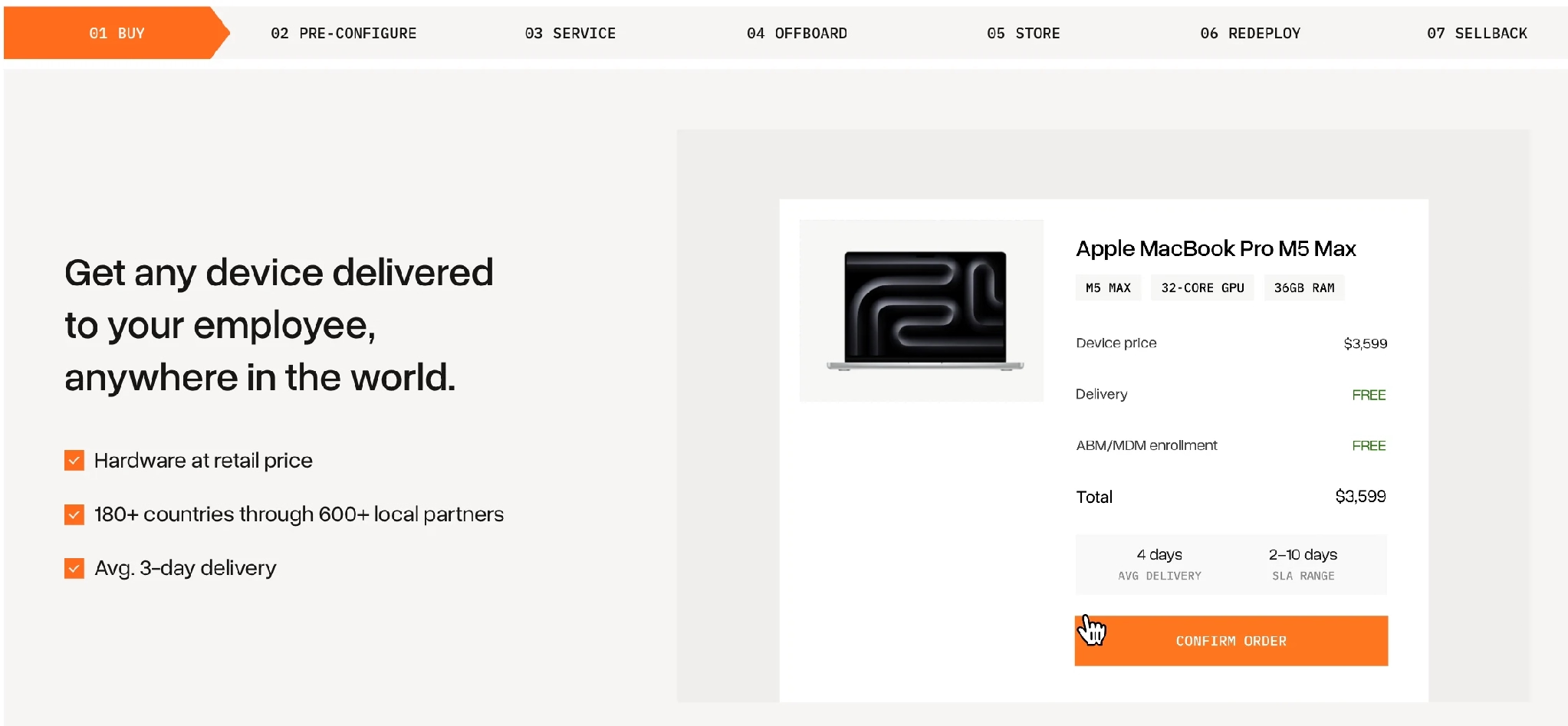
Offboarding runs $70 to $150 a device with the courier and the wipe included, storage is $12 per device per month pro-rata, redeployment is another $70 to $150, and sellback pays 20% to 70% of the original value in cash. A full leaver-to-new-hire move is two charges rather than one. The laptop retrieval service works on hardware bought through any vendor, and putting a stored machine back into service comes to about $180 to $240 against $1,500 to $2,500 for a new one.
Configuration and a Shared Slack Channel, Included
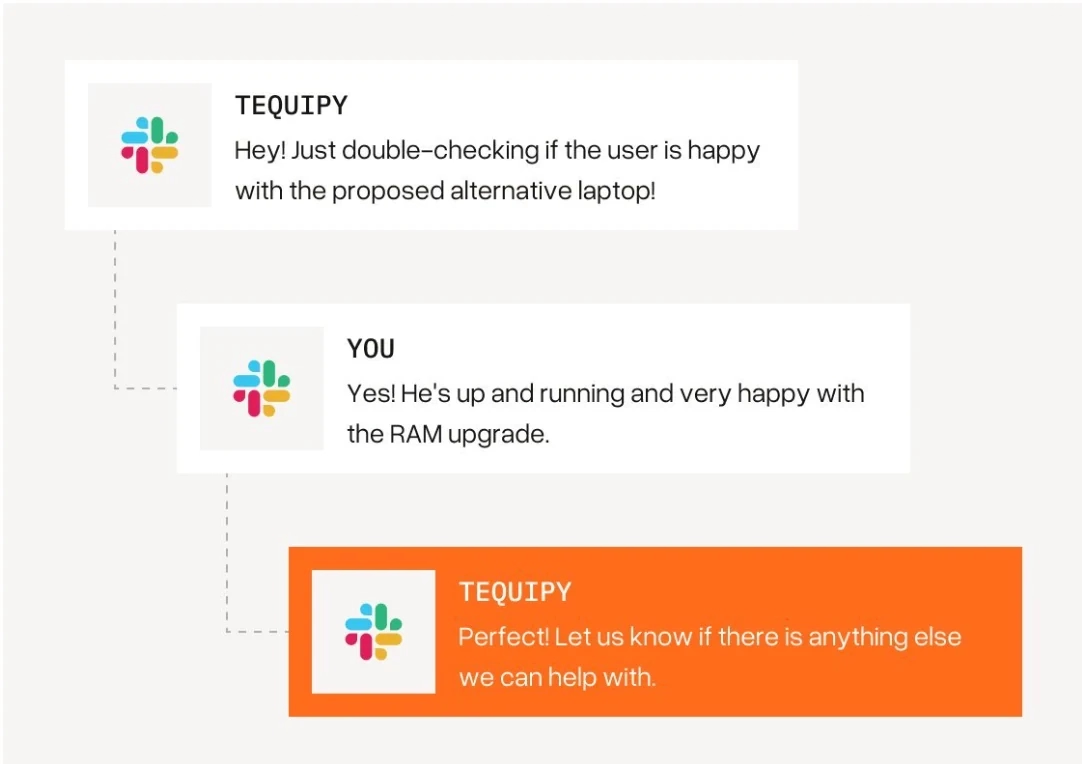
A device bought through Tequipy is configured at no extra charge and leaves already enrolled, through Apple Business Manager for Macs or Windows Autopilot for PCs. That is how zero-touch deployment sits alongside Jamf, Intune, Kandji or JumpCloud. At Connecteam an enrolment checkbox was left unticked on the customer's side, and Tequipy caught it and flagged it in Slack before a batch of machines shipped wrongly configured.
Tequipy Pricing Against a GroWrk Quote
Every figure in the Tequipy column sits on the pricing page with a calculator beside it, and the full platform is described on the device lifecycle management software page. The GroWrk column comes from its own pricing page and FAQ, read in September 2026, and the gaps are there because GroWrk publishes nothing to fill them.
Where Tequipy Falls Short
- There is no SOC 2 report to hand over. Tequipy holds ISO 27001, runs penetration tests with reports available on request, and hosts in Europe. The SOC 2 audit is still open, so a security review naming it specifically needs a current answer from the team.
- The public review base is very small. Tequipy's G2 profile shows an average of 4.8 from three reviews as of September 2026. Three is too thin a base to set against anyone else's fifteen. Ask for reference calls in the countries that matter to you.
- There is no payroll, EOR or HR product here. Tequipy covers the device lifecycle and nothing beyond it. A buyer looking for one supplier to carry both employment records and hardware needs a suite, and this is not one.
Who Tequipy Is Best For
- Globally distributed teams at any fleet size. The rate card does not change at three countries, at fifteen, or past that. Booksy tracks 800+ assets for a workforce above 500, and its case study shows 99% of equipment landing ahead of each start date.
- Teams whose first hire outside the home country is about to land. A domestic process cracks where there is no legal entity, no reseller account and nobody nearby to put a laptop in someone's hands.
- Buyers who want evidence before a signature. Send one order to whichever country worries you most and the coverage argument settles itself. RemoFirst spans 30 countries and protected close to $2,000 per employee in equipment once deliveries, repairs and retrievals moved across.
{{cta-primary}}
CONCLUSION
Does GroWrk Pricing Fit Your Budget?
It fits if your hiring sits in the Americas, your device movement is heavy enough that a per-workstation fee buys real work, and you can spend a sales cycle finding out what the number is. In that case ask for the quote and hold it against the five questions above until every line carries a figure.
It does not fit if you need a twelve-month total this week, if your countries sit outside GroWrk's documented strength, or if the hardware line was the one you set out to cut. TapTap Send folded three purchasing processes into one and now reports $6,500 saved a month. Gigs, at 100 employees, skipped an IT logistics hire and got back 100+ hours a month.
Run one real onboarding through Tequipy in your hardest country while the GroWrk quote is still open, then set the two invoices side by side. Both the rate card and its calculator are open to anyone, the named customers publish their own figures, and our team will take your country list with nothing attached to it.
FAQ
Does GroWrk Publish Its Pricing?
No. The pricing page names two tiers, A La Carte and Flex, lists the features in each, and routes every cost question to a request form. The site carries no device price, no subscription figure and no service rate, and the quoting tool sits behind a login.
Does GroWrk Charge a Monthly Platform Fee?
Only on Flex. A La Carte gives free platform access and charges for each order instead. Flex carries a monthly management fee per workstation managed, which GroWrk defines as a laptop plus peripherals, on a twelve-month initial agreement. Neither tier publishes a minimum device count.
Does GroWrk Charge Extra for Hardware?
Yes, by every public account, though no catalogue price or markup figure is published. A verified G2 reviewer in healthcare calls buying through the platform "often 2-3 times more" expensive than buying direct, in a G2 review. A current GroWrk customer told us a machine costing $1,700 to $1,800 direct was quoted at $2,500 to $2,600.
Are Shipping and Delivery Included in GroWrk Pricing?
It depends on the tier. Logistics is bundled into Flex and billed per order on A La Carte. Per GroWrk's FAQ, stock held in its network reaches an employee within four to five working days, varying by location. One G2 reviewer reports paying overnight shipping charges without getting overnight shipping, in a G2 review.
Can GroWrk Pricing Vary by Country?
Yes, and it is the line buyers underestimate. GroWrk publishes no country-level rate card, and customers writing from Mexico, India and Central Europe describe waits measured in weeks. Tequipy works the other way around, buying each machine from an authorised reseller inside the country where the employee lives, so global device procurement is priced at that market's recommended retail rate wherever the hire sits.

Keep your current setup.
Just test us on one order.
AUTHOR
Before Tequipy, Tomek ran IT at Revolut, scaling from 100 employees in 2 offices to 5,000 across 17. He built the system that kept every laptop accounted for, then founded Tequipy – a platform that handles IT equipment logistics for distributed teams across 180+ countries.
As CEO, he runs operations and covers the founder layer: strategy, product, and the company-building that comes with both.
15 minutes. Your countries, your devices, your setup. No pitch.
.avif)
.avif)