
KEY TAKEAWAYS
- The rating you find first belongs to the wrong product. Deel's G2 page for the device business carries payroll reviews inside it, and Google's own summary of that page talks about payment processing.
- The equipment service has its own profile under the old name. Hofy on Trustpilot sits at 3.3 from 30 reviews, one of which arrived in the last twelve months.
- Praise is about coverage, complaints are about money. Reviewers who like it name cross-border shipping and audit trails. Reviewers who do not name the store fee and the service since the acquisition.
- Tequipy prices the same work in public. Local retail on the hardware across 180+ countries, $70 to $150 to collect a machine, $12 monthly to warehouse one, and $99 a month flat at any fleet size for the platform, waived below 100 devices. Globally distributed teams can total that themselves.
Two products share one name, and the reviews a buyer finds first describe the other one. A search for deel it reviews on 22 September 2026 returned seven organic results. Six of them cover Deel the payroll company or Deel the employer. The last one covers the equipment business and carries payroll entries inside it.
What follows is a review of the equipment service alone, with a count and a date on every figure and a permalink on every quotation. Where the evidence runs thin, that is stated instead of smoothed over.
| Item | Deel IT | Tequipy |
|---|---|---|
| Best for | Teams already running Deel for payroll, contractors or employer of record | Globally distributed teams whose hard part is the physical device |
| Stand out feature | Devices, contracts and payroll in one portal | Local sourcing through 600+ authorized resellers across 180+ countries |
| Service prices | Device at a US list price plus a store fee. Lifecycle management, device management and endpoint protection quoted separately | Recommended retail price with delivery, offboarding $70 to $150, storage $12 a month, redeployment $70 to $150, sellback free |
| Platform fee | Essentials free. Pro is a flat per-seat monthly rate, unpublished | $99 a month flat at any fleet size, free under 100 devices |
| Pros | One supplier for the whole employee lifecycle, a free entry tier, rentals for teams that want operating expense | Published rates, hardware at local retail, no contract, services that run on hardware we did not sell |
| Cons | No rate published anywhere, seats counted per worker, support quality contested since 2024 | No payroll, no employer of record, a small public review base and SOC 2 still in progress |
| Customer support | Marketed as 24/7. Reviewers disagree about what it has been like since the acquisition | A shared Slack channel per customer, no ticket queue |
| Device management | Its own product, sold on top of the Pro seat | None. We enrol devices into the tool you already run |
| Country coverage | 130+ claimed | 180+ claimed, with named customers in the hard markets |
| Contract | None on Essentials, a signed order form on Pro | None at any size |
| Free tier | Ordering and asset tracking only | Full platform under 100 devices, with pre-configuration in the order |
Who Is Deel IT Best For?
The niche is exact, and being exact about it is the most useful thing this article can do. Deel IT is built for companies already standing inside Deel's employer of record or payroll stack. Outside that, the argument for it gets thin quickly.
- Teams already running Deel. Adding equipment to an account that holds contracts and wages removes a supplier instead of adding one. No competitor here can offer that, and we cannot either.
- Contractor-heavy organisations that offboard through Deel. The contract ends, the payment stops and the retrieval starts in the same flow, without anyone opening a second system.
- Finance teams that want hardware as an operating expense. Rentals run 12 or 24 months, extend to 48, and return free at the end of the term.
- Small teams that only need ordering and an asset list. The free Essentials plan does exactly that and charges nothing for it.
Tequipy: An Alternative
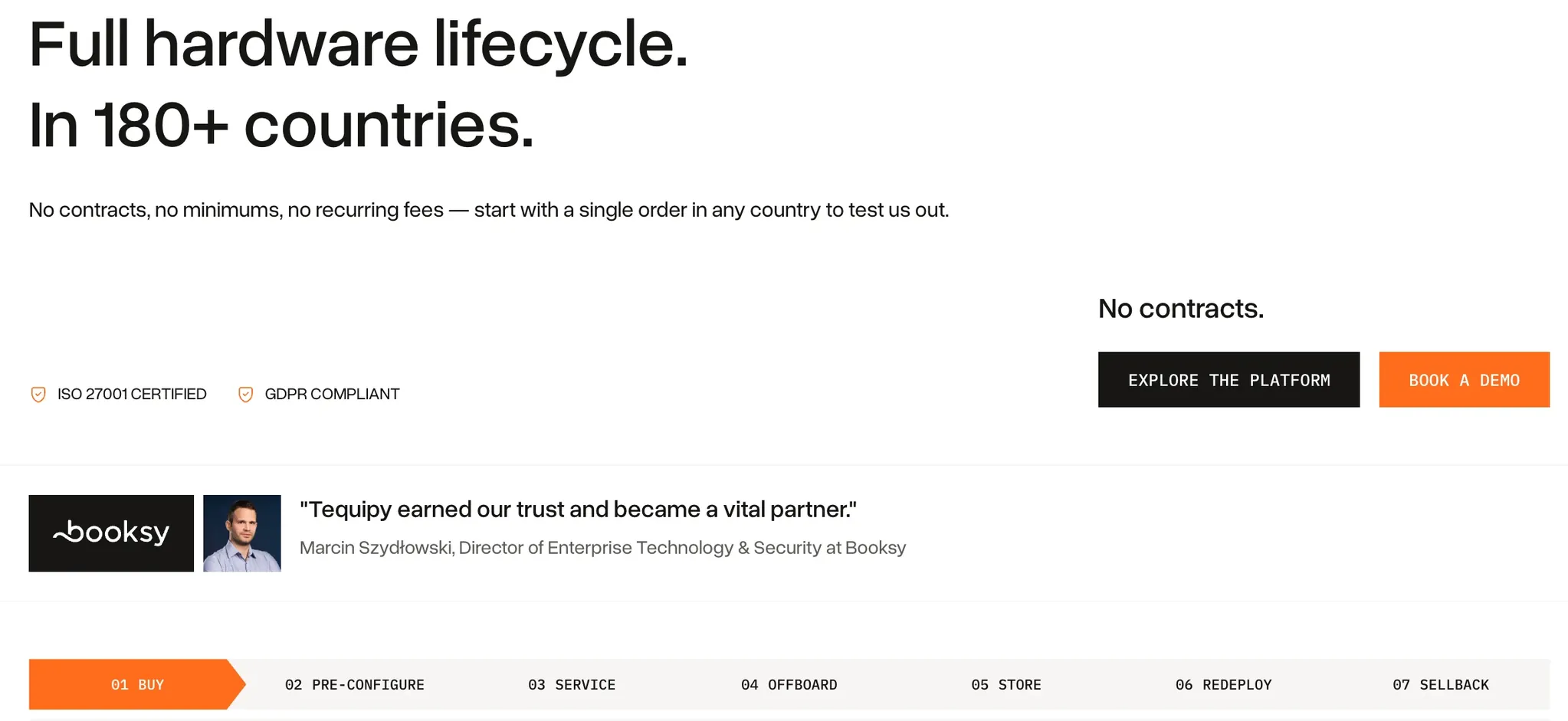
We own this company, so read the next few paragraphs as an advertisement and check the links rather than the adjectives. Tequipy covers the physical device lifecycle and stops there.
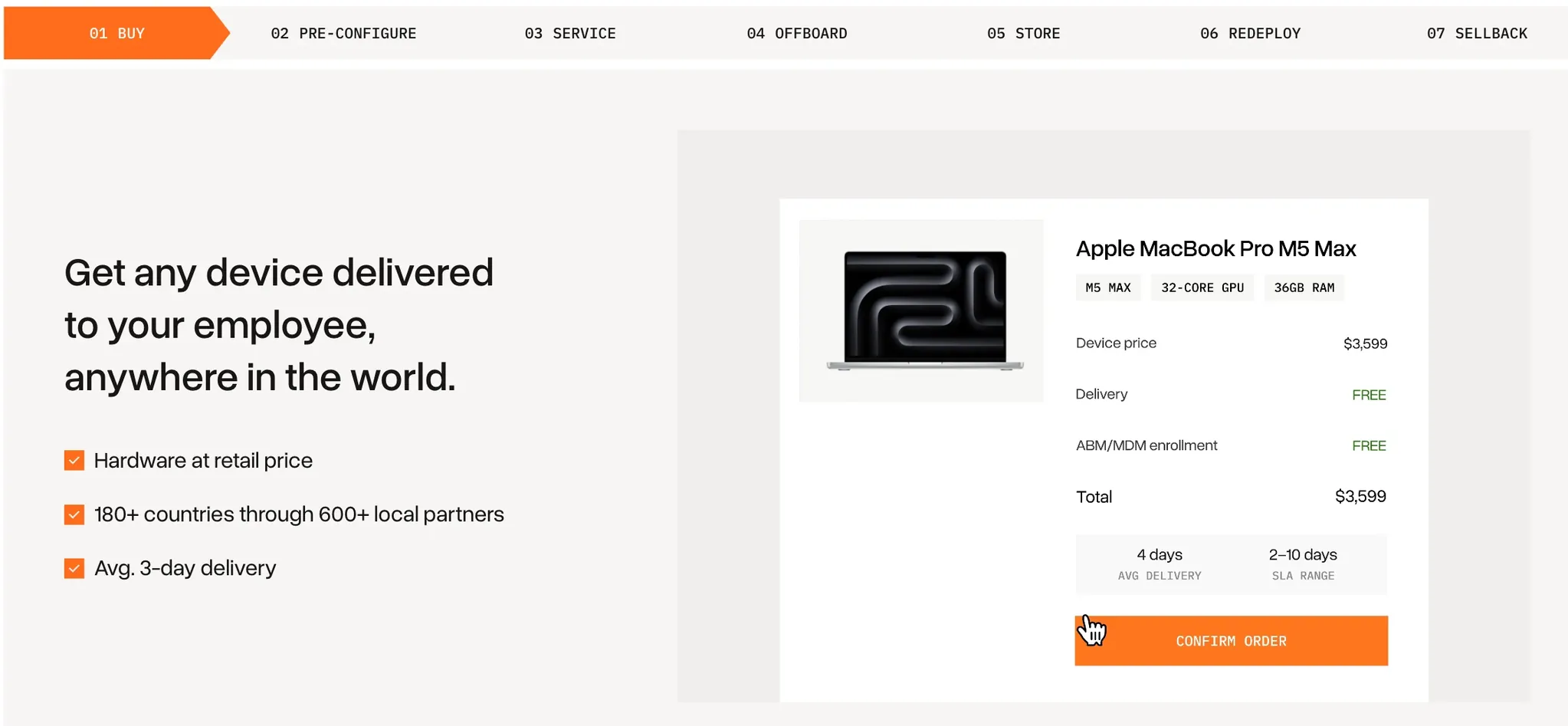
- Recommended retail price with delivery inside it. An $1,800 MacBook invoices at $1,800, bought in the employee's own country.
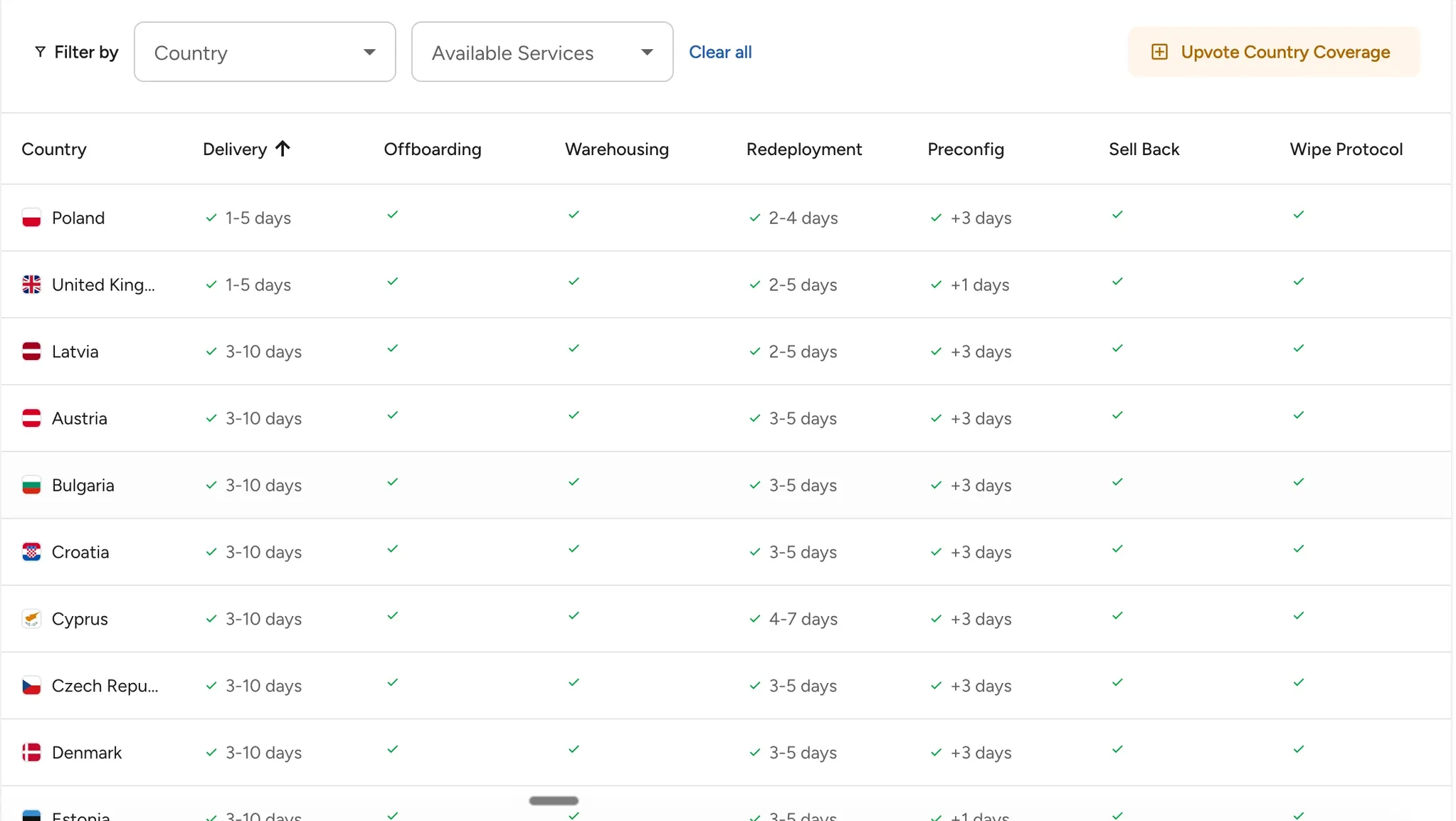
- 180+ countries served by 600+ authorized local resellers, which is what global laptop procurement across 180 countries means once the marketing is removed.
- 3 business days on average and 10 at the outside.
- No contract, no minimum order and no volume requirement.
- ISO 27001 certified, with chain of custody and Blancco certified wipes on every collection.
The rates below are lifted from our own published price list, where anybody can read them without booking anything.
| Item | Deel IT | Tequipy |
|---|---|---|
| Service prices | US list price plus a store fee on hardware. Lifecycle management, device management and endpoint protection sold separately and unpriced | Recommended retail price with delivery included, offboarding $70 to $150, storage $12 a month, redeployment $70 to $150, sellback free returning 20% to 70% as cash |
| Platform fee | Essentials $0. Pro a flat per-seat monthly rate, never published | $99 a month flat at any fleet size, free under 100 devices, optional HRIS sync $199 a month |
| Minimum to start | None on Essentials. A signed order form on Pro | None |
Those rows stay separate for a reason. A per-device collection fee and a monthly subscription answer different questions, and stacking them in one cell produces a comparison nobody can act on.
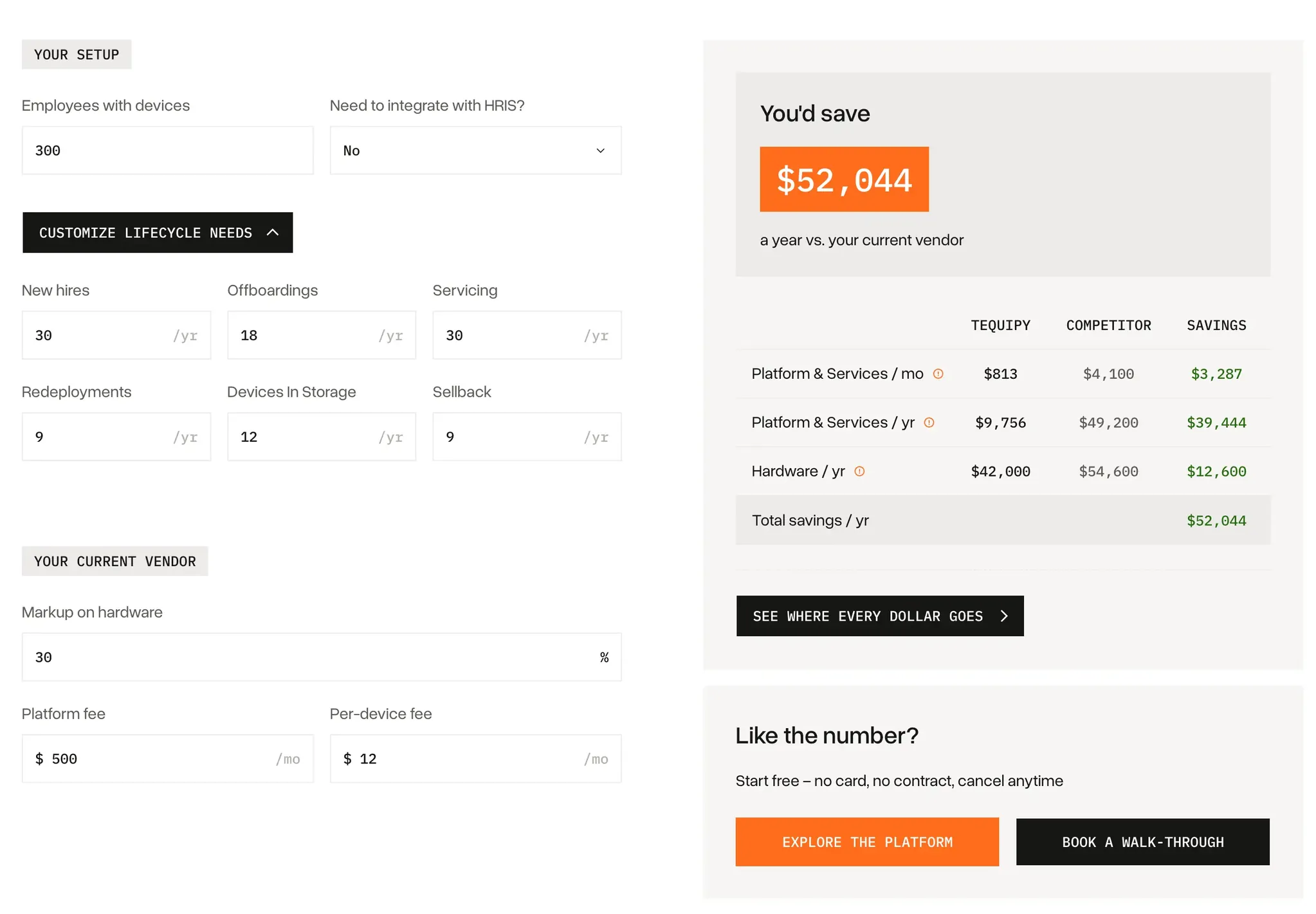
Reviews tell you whether a service works. Our pricing calculator settles the other half, which is whether the bill is worth it. Start with how many employees hold a device and whether an HRIS is connected, then enter a year of volumes: hires, offboardings, servicing, redeployments, devices sitting in storage and devices sold back.
Three final fields describe your current supplier: the percentage added to hardware, the monthly platform charge and the monthly charge per device. The output is a year, side by side, which is the comparison a renewal conversation actually turns on.
{{cta-primary}}
Deel IT Key Features
Three things come up repeatedly in the reviews of this product, and all three are real. Each one also carries a qualifier that the review stars do not show, so both halves are below.
Stand Out Feature #1: One Portal for Payroll, Contracts and Equipment
This is the moat, and it is the reason the positive reviews are positive. A company already paying people through Deel can raise a laptop order from inside the same onboarding flow, against the same worker record, on the same invoice. Nothing gets re-keyed and no second vendor relationship gets opened.
Stefany A., an IT onboarding engineer, describes the value in exactly those terms in a G2 review, crediting the platform with helping to "centralize device and access management for distributed teams" and to cut manual work out of joining and leaving.
Say the limit plainly: Tequipy cannot do this. We connect to an HRIS the way every platform in this category does, and that is a different thing from running the payroll itself. A buyer who wants one contract covering wages, contracts, benefits and hardware is buying a suite, and we do not sell one. If that is the requirement, the rest of this article is background reading rather than a recommendation.
Stand Out Feature #2: Device Management, Endpoint Protection and Pre-Configured Delivery
Machines can arrive already enrolled, which is the single most useful thing a device platform can do for a distributed team. Tyler S., writing in an incentivized G2 entry dated 5 May 2026, puts it as "I enjoy how well MDM, UEM, and Asset Management have been integrated", and credits the consolidated view of devices and their context.
Here is the qualifier the stars do not carry. All three of those capabilities live on the Pro plan, and Deel's own pricing-plan page, dated 13 May 2026, marks device management and endpoint protection as available for purchase on top of the seat rather than included in it. Lifecycle management is listed the same way, at extra cost. On the free Essentials plan none of the three exists at all, so a reviewer praising enrolment and a reader evaluating the free tier are describing different products.
The same review carries a complaint in its own second half, which makes it more useful rather than less. Tyler S. calls the first setup challenging, says it needed extensive training and configuration, and describes the interface as dated next to other vendors.
Stand Out Feature #3: Rentals, and a Free Way In
Two commercial options sit under the product. One is a rental, on a term of either twelve or twenty-four months that can be pushed out to forty-eight, returned free when it ends, with nothing available to buy at that point. Deel sets this out on its device acquisition page, updated 16 March 2026. The other is an ordinary purchase carrying the store fee.
Essentials is the newer of the two stories and it changes how older reviews should be read. It has been live since May 2026, it costs nothing, it needs no contract, and it is switched on for every Deel account. Any review written before that date was written about a product with no free entry point, which is worth remembering when a 2024 complaint about commitment shows up in a search result.
Parity at the claim: a free platform with nothing to sign is how Tequipy sells as well, so that term separates the two companies not at all. What separates them is the contents. On the rental question there is nothing to compare either, because leasing and financing are things Tequipy does not do in any country, which leaves us with no rental product and no end-of-term residual to argue over.
Deel IT Pricing
Reviews and price are the same conversation for this vendor, because the most repeated complaint is the bill. The full treatment sits on a separate page. The short version is two plans and no numbers.
| Item | Essentials | Pro |
|---|---|---|
| Subscription | No subscription fee, no contract required | A flat per-seat monthly rate on a signed order form. Not published |
| Who can order | Admins only | Workers and admins |
| Device management | Not included | Available for purchase on top of the seat |
| Pre-configured delivery | Not included | Included |
| Hardware | US recommended retail price plus a store fee | US recommended retail price plus a store fee |
Deel states the hardware basis itself, on the device acquisition page: the price is built from "the US recommended retail price plus a store fee". The percentage never appears on a Deel page. One customer names it. Patrick Morrison, in a Trustpilot review from May 2024 written about a 39-person UK company, calls it "a flat 25% fee for any purchase on top of the price of the laptop".
Everything else, from the four support tiers to certified erasure, resolves to a quote. Deel IT was evaluated against us by IT and operations buyers in Tequipy sales conversations, and they described the same layering of one charge onto another, which is an internal account with nothing public to link. What a published rate card looks like in this category is covered in IT procurement software.
Deel IT Positives
Four themes carry the positive reviews, and the counts matter as much as the words.
- Cross-border logistics without the admin: the most repeated device-side praise across the whole record, and roughly nine separate mentions of shipping and customs burden disappearing.
- Suite consolidation: around a dozen reviewers describe one account covering payroll, contracts and equipment. This is the theme that shows up in the highest-rated entries.
- Faster onboarding and offboarding: named by an IT onboarding engineer rather than by a marketing lead, which is the version worth weighing.
- A free way in: Essentials ships devices with no subscription and no contract, which was not true of this product a year ago.
Deel IT Negatives
Four themes carry the complaints. Two are well evidenced across many reviewers, one rests on a single detailed review, and the article says which is which.
- Price, and the cost of scale: the strongest and most repeated theme, with more than twenty mentions across reviews and buyer conversations. A G2 reviewer in accounting, writing at 2.5 out of 5 on 30 December 2025 in an incentivized entry, states it as "Deel IT can be more expensive than negotiating directly with vendors or managing logistics internally."
- Support since the acquisition: roughly fourteen mentions describe slower responses and heavier-handed retrieval chasing since Deel bought Hofy in July 2024.
- Security coverage that did not hold: one organic review, covered in detail below. One review is one review, and it is reported here as exactly that.
- Setup effort and a dated interface: two mentions, both sitting inside otherwise positive reviews, which is the most credible place for a complaint to appear.
Customer Reviews
Krzysztof U. gives the clearest version of the upside in a February 2026 G2 entry titled "Global device logistics without the headache", crediting the platform with shipping, managing and retrieving equipment for teams spread across a long list of countries.
The sharpest negative is an organic review with no incentive attached. Gaudenz B., an owner at a mid-market company, scored it zero out of five on 18 June 2026 in a G2 review about security gaps, reporting that a full-fleet reconciliation covered about 28% of devices across all systems, with "active devices running no endpoint protection".
The second negative is about money and about what changed. Itay Varadai's October 2025 Trustpilot entry opens with "Major downgrade since Deel's acquisition" and goes on to describe hardware pricing that has climbed and response times that have slowed. Against thirty reviews on that profile it is one voice, and it is the voice other reviewers keep echoing whenever money comes up. What all of them are buying is described in how remote equipment management works, stage by stage, alongside hardware lifecycle management.
Deel IT Overall
History first, because it explains the mess. Deel acquired Hofy in July 2024, as TechCrunch reported at the time, and relaunched the product as Deel IT that September. Reviews of the same service therefore sit under two company names on two platforms, written either side of an ownership change that reviewers themselves say altered the service.
Reconciling the numbers matters more than listing them. One aggregate, and one only, covers the equipment business by itself: Hofy's page on Trustpilot, verified on 18 September 2026 at 3.3 from 30 reviews, split 80% five-star against 13% one-star, with a single entry inside the last twelve months. A base that thin with a split that wide means the individual reviews carry far more information than the average.
The G2 Deel IT profile shows a much higher score and should not be quoted for this product. Payroll reviews sit inside it, Google's own snippet for the page describes payment processing rather than devices, and the review count moved from 493 to 272 to 290 across three months of checking. Capterra, GetApp, TrustRadius and Gartner Peer Insights carry no Deel IT profile at all, only the parent entity.
So the honest summary is that this product has no trustworthy aggregate score, and any article that hands you one is quoting the payroll business. What the record does support is a pattern: coverage works, consolidation is genuinely valuable, and price is the thing customers write about when they stop being happy. The same treatment applied elsewhere is in Firstbase reviews and allwhere reviews, counted and dated.
How to Choose a Device Lifecycle Management Platform
Three questions separate the vendors in this category, and none of them appears on a comparison grid. Each one can be answered in an email before a demo gets booked.
Feature Consideration #1: Check What the Free Tier Actually Includes
Free plans are a good thing, and no two of them contain the same product. On Essentials a device gets ordered and recorded, and that is the end of it. Pre-configured delivery, device management, endpoint protection and lifecycle services all sit in the excluded column of Deel's own plans page.
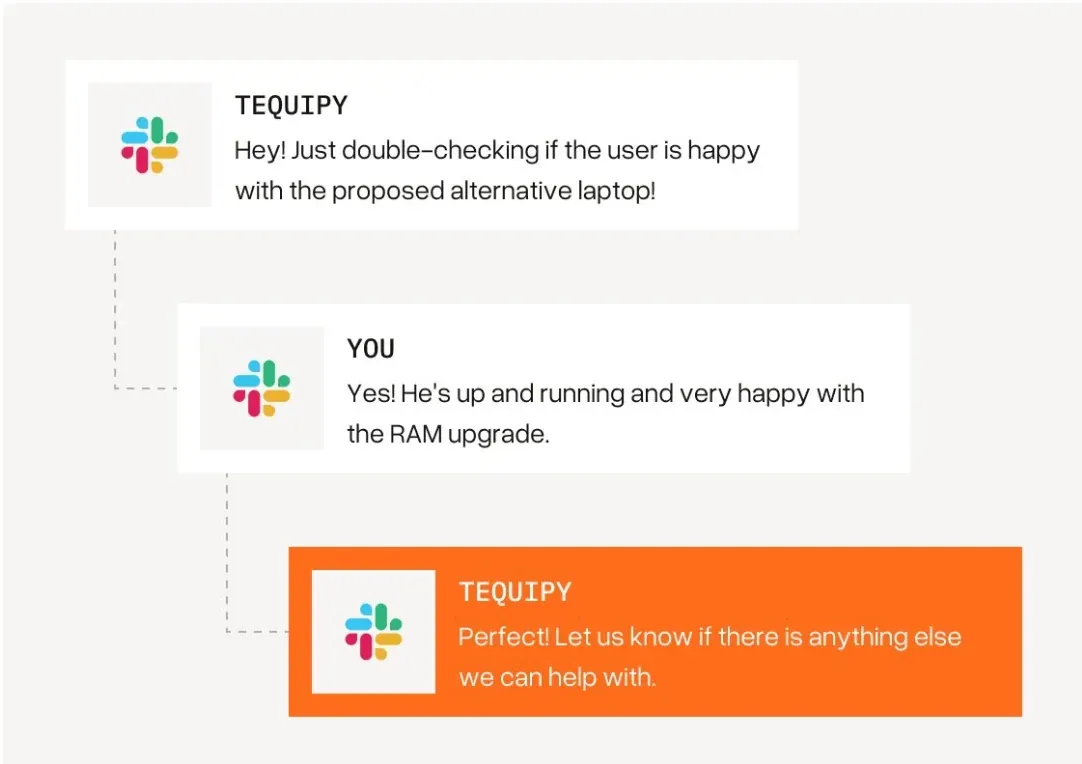
So put the question in terms of the box. What condition is the machine in when the employee opens it on the free tier? Here is our version. Under a hundred devices there is no platform charge at all; the order carries enrolment into whatever management tool you run already; and questions go to a shared Slack channel belonging to your account instead of a ticket form.
Pro tip: put the same three machines out to quote with every shortlisted vendor in one week, and record how long each reply takes as well as what it says. Choose one standard specification, one deliberately absent from the catalogue, and one bound for the worst country on your hiring plan. The third answer is the one that shows you where a supplier network genuinely ends.
Feature Consideration #2: Ask What the Device Price Is Based On
Deel answers this question in public, which is more than most vendors do. The price, its own page says, is built from "the US recommended retail price plus a store fee". That is a clear statement and it has a consequence worth understanding before signing anything: outside the United States, the reference price is one the buyer cannot walk into a shop and check. One customer puts the fee at a flat 25% on purchases.
Our own answer is the local one. An authorized reseller in the employee's country of residence supplies the machine, at that market's recommended retail price, and no customs file or duty charge ever reaches the invoice. Whether it works out cheaper in your particular markets is settled by one same-specification quote and a day of waiting, so run the test instead of arguing about the principle. Costs later in the chain are itemised under IT asset lifecycle management.
Feature Consideration #3: Test the Security Claim Rather Than Reading It
Deel IT markets device management, endpoint protection and a 96% recovery figure. One organic reviewer reconciled his own fleet against those claims and found roughly 28% coverage across all systems, with one active employee's device running unmonitored for about four months before anybody noticed.
That is one review and it should not disqualify a vendor on its own. What it should do is change the question you ask every vendor, including us: request a coverage reconciliation, in writing, showing how many devices in a sample fleet report into every system they are supposed to report into. A vendor that can produce one has answered the question. A vendor that offers a percentage from a marketing page has not.
Tequipy is ISO 27001 certified, keeps full chain of custody on every device, and uses Blancco certified wipes at offboarding, with penetration test reports available on request. We sell no endpoint protection product, so the reconciliation we can produce covers the physical chain rather than the software estate. Both halves of that are worth knowing before a security review starts. Enrolment happens through zero-touch deployment before shipping, and the return leg is the harder half, which is why getting equipment back after a termination exists as its own topic.
Alternative To Deel IT: Tequipy
Everything this article documented points at three things a buyer cannot get from Deel IT today: a rate readable before a call, a device priced in the employee's own market, and a service that can be tested before anything is signed. Those three are the whole of the Tequipy pitch.
Tequipy Key Features
Three capabilities matter most to somebody arriving here from a Deel IT renewal, and the third is the one that decides whether switching is even practical.
Stand Out Feature #1: Local Sourcing in 180+ Countries
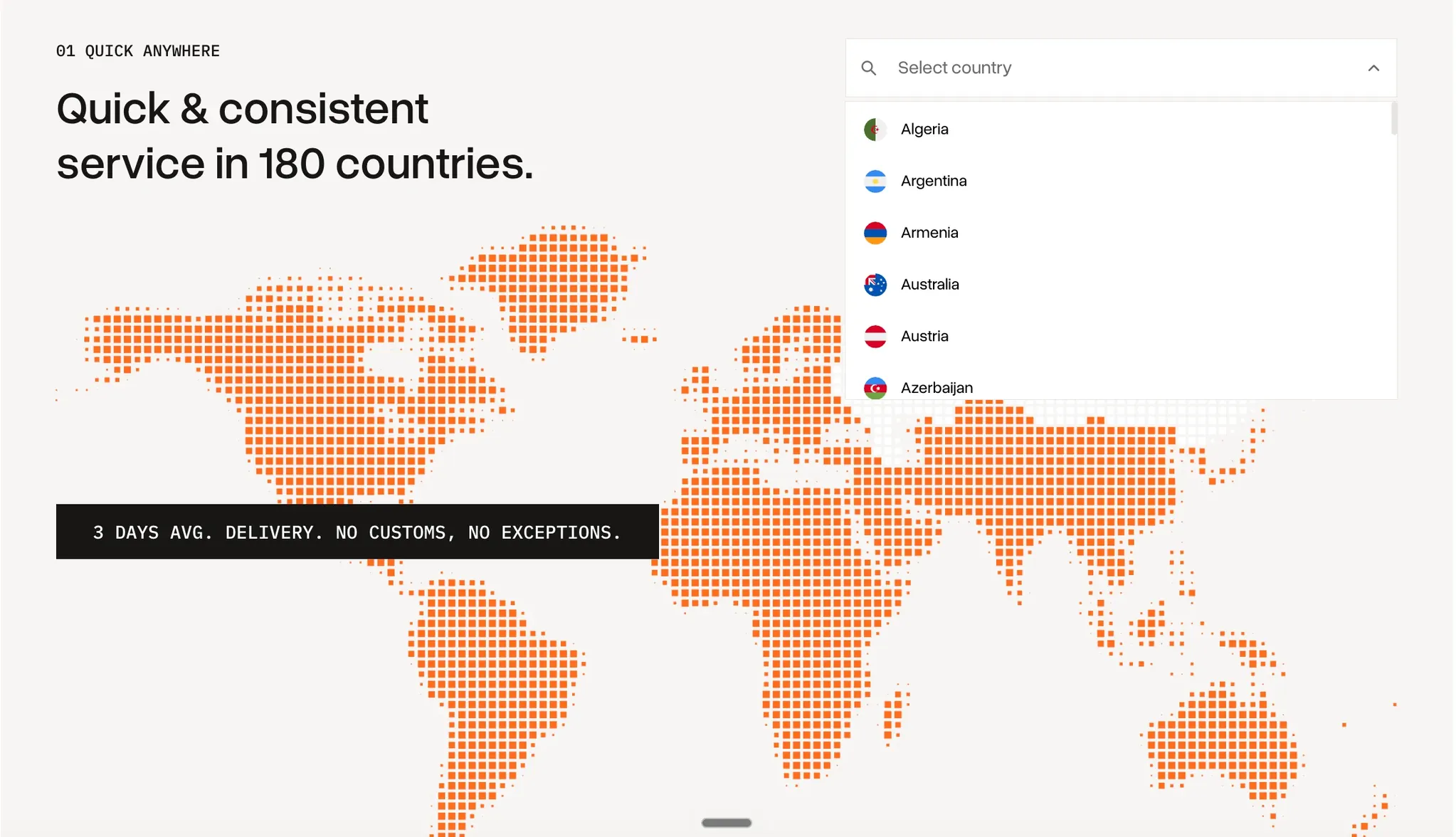
An order lands with an authorized reseller in the employee's own market, chosen from more than 600 partners spread over 180+ countries. Because no shipment crosses a frontier, the customs file, the duty charge and the fortnight in transit all disappear from the process.
Names carry more weight here than totals do. RemoFirst's 30-country collection takes in Colombia, the United Kingdom and Kazakhstan. Booksy's Latin America test came first because that region had failed it before, and the Philippines followed. Machines have reached Ukraine during a war. Brazil, India, the United Arab Emirates, Georgia and Armenia round out the list of markets where a homepage number tells a buyer nothing useful.
Stand Out Feature #2: Every Rate Published Before a Call
Hardware at recommended retail price with delivery included. Offboarding $70 to $150 per device. Storage $12 a month per device. Redeployment $70 to $150. Pre-configuration free. Sellback free, returning 20% to 70% of the original value in cash. One platform charge of $99 monthly, unchanged at any fleet size, dropped entirely below 100 devices.
Those eight lines are the entire commercial model, and they sit on a public page rather than behind a form. A finance lead can total twelve months from them in an afternoon, then hold that total up against whatever a quote comes back with. Nobody has to trust a claim about transparency when the numbers are sitting there to be checked.
Stand Out Feature #3: The Full Lifecycle on Devices We Did Not Sell
Pre-configuration, enrolment into your own device management tool, servicing, retrieval, storage, redeployment and sellback all work on hardware another supplier sold you. No refresh cycle is forced and nothing gets bought twice.
For a team leaving Deel IT this is the clause that makes the move possible at all. A fleet already in the field, bought at a store fee, is still a fleet we can collect, wipe, warehouse and reissue. It also means the two can run side by side while a country or two gets tested, which is the ordinary way this happens rather than a special arrangement.
Tequipy Pricing
| Item | Price |
|---|---|
| Hardware | Recommended retail price, delivery included |
| Platform | $99 a month flat at any fleet size, free under 100 devices |
| HRIS integration | $199 a month, optional |
| Pre-configuration and enrolment | Free |
| Offboarding collection | $70 to $150 per device, by country |
| Storage | $12 a month per device |
| Redeployment | $70 to $150 per device |
| Sellback | Free, returning 20% to 70% of original value as cash |
| Contract | None. No minimum order, no volume requirement |
Where Tequipy Shines
- Hard countries: Booksy tested Latin America first and stayed, RemoFirst collects across 30 countries, and machines have reached Ukraine during a war. Those are the markets where a country count stops meaning anything and a reference customer starts.
- Speed with consistency: 3 business days on average and 10 at the outside, with 99% of devices arriving before the employee's first day. Predictability is the part customers write about, more than raw speed.
- A year you can total in advance: every service carries a public number and nothing is bundled inside a seat, so the annual figure exists before any conversation happens.
Where Tequipy Falls Short
- No payroll, no employer of record, no contractor product. A company that wants one supplier across the whole employee lifecycle will not get it here, and Deel IT genuinely offers that.
- Fewer public reviews, and SOC 2 is not finished. ISO 27001 is certified and penetration tested. SOC 2 is in progress. A security review that gates on SOC 2 today does not clear us today.
Customer Reviews
Our own evidence is published case studies rather than a directory profile, and that is a real limitation as well as a source. Over at Gigs, where more than 100 hours a month disappeared and an IT logistics hire never happened, the people operations specialist Lisa Kiseleva calls us "one of the most responsive and solution-oriented teams I've worked with" in her case study.
Lera Lykholiet at RemoFirst sums up two years in one line in her case study: "now we don't have to worry about device logistics at all." Before that, leavers in Colombia, the United Kingdom and Kazakhstan kept their laptops, which is the job described in what a laptop retrieval service does.
Who Tequipy Is Best For
- IT leads at 200 to 500 person companies hiring into five or more countries: the volume is constant, nobody has spare capacity, and a new market opens most quarters.
- Teams facing a Deel IT renewal: the opening comes when finance audits the seat count and the store fee in the same week and asks what each one bought.
- HR and operations people who own equipment as a side job: self-service ordering and one Slack channel replace a process nobody was hired to run.
- Teams keeping Deel for payroll: running Tequipy alongside Deel employer of record is normal and nothing here asks for an all-or-nothing switch.
{{cta-primary}}
CONCLUSION
Final Word on Tequipy
There is no verdict here, only a fork. A company already paying its people through Deel, ordering modest volumes, has a good reason to keep one portal and should keep it. Consolidation is worth money, the premium is what it costs, and trading it away to save a percentage would be a poor decision.
Where the pain is a courier, a customs form and somebody in Manila waiting on a machine, the comparison is worth running and costs almost nothing. Send one order to whichever country has given you the most grief this year, then lay the two invoices next to each other. Nothing on our side has to be cancelled afterwards. Talk to the Tequipy team, or read every published rate before you do.
FAQ
Is Deel IT the Same as Hofy?
Yes. Deel acquired Hofy in July 2024 and relaunched it as Deel IT that September, which is why reviews of the same service appear under two names.
Why Do Deel IT Ratings Differ Between G2 and Trustpilot?
Because they describe different products. The G2 page mixes Deel payroll reviews into the device business. The Trustpilot page under the Hofy name covers the equipment service alone.
How Many Deel IT Reviews Are There?
The equipment profile held 30 on 18 September 2026, with one from the previous twelve months. The G2 count moved from 493 to 272 to 290 in three months and cannot be relied on.
What Do Deel IT Customers Complain About Most?
Price. The store fee on hardware, per-seat charges and unpriced add-ons appear in more reviews than any other theme, followed by slower support since the 2024 acquisition.

Keep your current setup.
Just test us on one order.
AUTHOR
Before Tequipy, Tomek ran IT at Revolut, scaling from 100 employees in 2 offices to 5,000 across 17. He built the system that kept every laptop accounted for, then founded Tequipy – a platform that handles IT equipment logistics for distributed teams across 180+ countries.
As CEO, he runs operations and covers the founder layer: strategy, product, and the company-building that comes with both.
15 minutes. Your countries, your devices, your setup. No pitch.
.avif)