
KEY TAKEAWAYS
- Allwhere publishes one rate: a United States laptop return kit from $120, shipping included, sized for one device plus one accessory insert. Monitors and furniture are refused.
- Everything else runs through a custom quote. Hardware carries no published price and no markup statement, and the two public buyer accounts of that markup contradict each other.
- The commercial terms are genuinely open: no subscription, no setup fee, no minimum and no lock-in, at any fleet size.
- Coverage stops at 58 listed locations, about 54 sovereign countries once four territories come out. MENA, Africa, the CIS and most of Asia are absent, as are Switzerland, Norway and Iceland.
- Tequipy runs the opposite model for globally distributed teams: hardware at recommended retail price, every service rate published, 180+ countries, and $99 a month flat at any fleet size, free under 100 devices. On that platform line Allwhere is cheaper.
Allwhere pricing is easier to research than it was a year ago and still close to impossible to budget. As of September 2026 the company prints one number anywhere on its website, and that number covers a cardboard box.
Its pricing page, meanwhile, promises "Clear, fixed rates" and "predictable prices that you'll always get upfront" while showing no rate. This guide gathers what a buyer can verify without a sales call: the published price and its limits, the fees Allwhere confirms it does not charge, and the costs that surface only in a quote.
How Much Does Allwhere Cost?

One price, four confirmed zeros and four blanks. Here is the whole published picture, read off Allwhere's pricing, coverage and retrieval pages in September 2026.
Four of those rows are free and stay free however large the fleet gets, which is the strongest part of the model. Tequipy charges no setup fee, asks for no minimum and requires no contract either, then adds $99 a month flat at any fleet size once a fleet passes 100 devices. Over a year that is $1,188 an Allwhere customer never pays.
The gap is the four rows carrying no number at all: hardware, storage, deployment and resale, plus any retrieval outside the United States. A buyer learns what a box costs and nothing about what a laptop costs, which inverts the size of the two numbers in almost every device budget.
The one priced service also carries the one published failure. A British reviewer who left the company its only Trustpilot entry described a collection that, in his words, was "something that could have been arranged within a week, took months," per an August 2025 Trustpilot review.
Tequipy: An Alternative
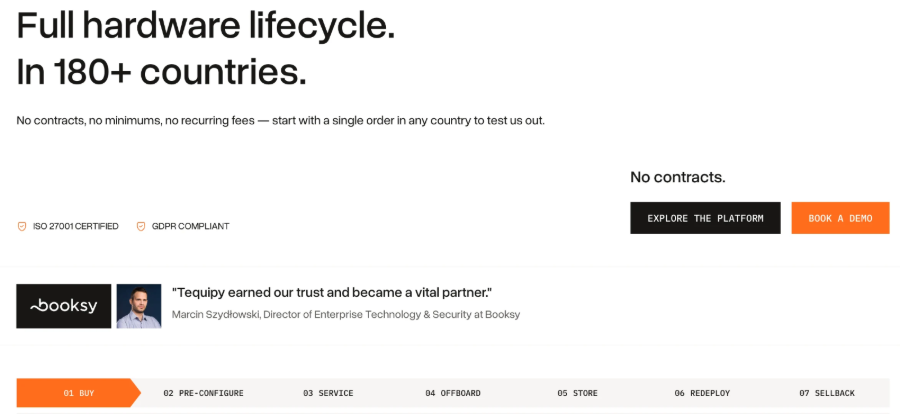
We build Tequipy, so read this as an interested party talking and follow the links. The company exists because a co-founder led IT at Revolut. He took that function from 100 people in two offices to 5,000 across seventeen, moving around 300 employees a week between them, and lost no laptop doing it.
Four differences survive a close reading:
- Hardware at recommended retail price, printed. Orders go to an authorized reseller in the employee's own market, which puts the invoice level with the manufacturer's own store price on the day you buy.
- A public number for every lifecycle job. Collection, storage, redeployment and sellback are costed on the page rather than behind a quote path.
- 180+ countries through 600+ local partners. Only Russia, Belarus and North Korea are excluded.
- One vendor for the entire device life. Buying, configuration, repair, collection, storage, redeployment and resale run from a single asset registry, and every service works on devices bought elsewhere.
Those rates and a calculator sit on the Tequipy pricing page. A leaver who becomes a new starter costs two fees rather than one, since the collection and the redeployment are separate jobs.
{{cta-primary}}
How Allwhere's Pricing Model Works
Allwhere bills per event rather than per seat, and those events fall into three commercial shapes: the one service with a list price, the hardware nobody outside the company can price, and everything else, which arrives through a consultation.
The Laptop Return Kit, the Only Listed Rate
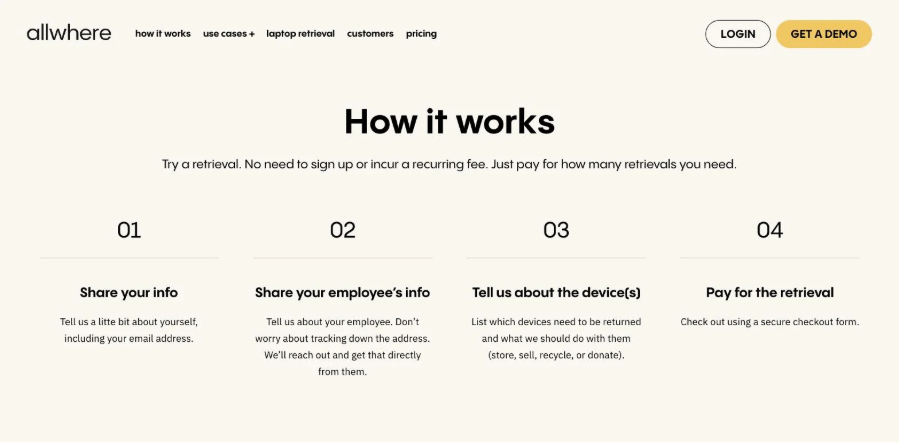
A United States return kit starts at $120 and the shipping sits inside that figure. Allwhere's own retrieval FAQ confirms that every kit ships with a prepaid label, so the employee needs nothing else.
The service does work when it works. An enterprise reviewer in IT services reported that "Our laptop retrieval numbers have increased by at least 60-70% and we no longer have staff having to hunt down laptops", per an October 2023 G2 review. That is the clearest return figure published on this product.
Hardware, the Number Nobody Outside the Company Has
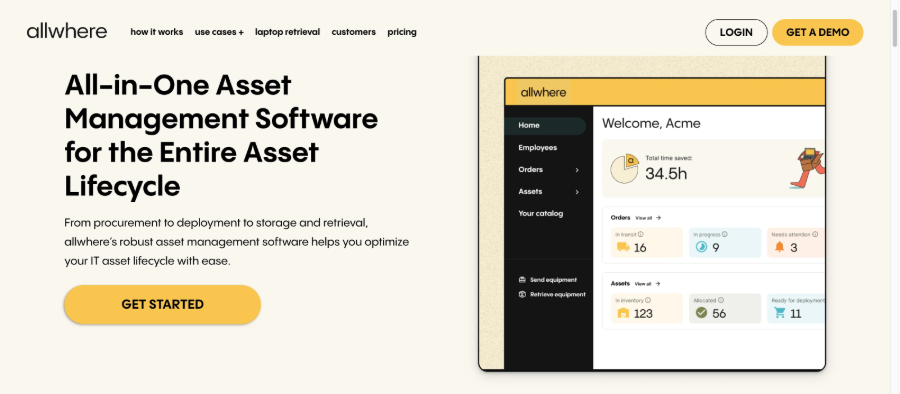
Procurement is the larger half of most device budgets and Allwhere publishes nothing about it: no catalogue price, no percentage over retail, no statement either way.
Public accounts disagree. An IT manager at a 200-person business wrote on r/ITManagers that "the platform is free, they make their money by adding a small % on top of every order / collection", per a March 2025 Reddit post, while noting he had made no purchases yet. A company using Allwhere across the UK and the United States told us it sees no markup on the devices themselves, with services invoiced separately. Treat the markup as an open question and settle it with a quote.
Storage, Deployment and Resale, Priced by Consultation
The rest of the lifecycle has no public number at all. Allwhere routes it through a booked call and sets out what that call produces: a review of "the inefficiencies in your current device lifecycle", then "a tailored ROI snapshot based on your use case", then a demo, a trial account or a first order.
That last row matters. The calculator asks for headcount, growth rate and attrition, then returns a saving rather than a bill, so it cannot build a budget line.
Allwhere Hidden Costs
Nothing here is concealed. These costs simply do not appear until the conversation starts.
- The time a quote takes. Four steps stand between a visitor and a number: consultation, ROI snapshot, demo or trial account, first order.
- Everything the $120 kit refuses. Monitors, furniture and a second device in the same collection fall outside the published rate and back into a quote.
- Retrieval outside the United States. The listed price is domestic, so a leaver in Lisbon or Manila is priced case by case.
- Movement in the rates themselves. A February 2023 reviewer wrote that "Some growing pains have caused issues along the way. Recent price increases are the cause for some concern, but overall, Allwhere remains to be the best option in this field", per a G2 review from 2023.
- A country that is not on the list. Outside the 58 listed locations the work falls back to a local vendor or an employee expense claim, which costs real money that no invoice records.
One, the landed device price for your two commonest configurations in your three largest countries, each beside the manufacturer's own store price that day. Two, whether anything sits on top of that device price, and whether it is a percentage or a flat fee. Three, the collection price per device in every country you employ in, not only the United States.
Four, the price of a monitor or a second device inside one collection. Five, the storage rate per device per month and the minimum billable period. Six, the redeployment price, which is a separate job from the collection and usually a separate charge. Seven, what happens to all of it if headcount falls by a third mid year.
A vendor who answers those inside a day is telling you how it will handle a queried invoice.
Allwhere Pros and Cons
Price is half a purchase decision. Here is what the money buys, set against what the published record cannot tell you.
Pros
- Nothing to pay before the first order. No subscription at any fleet size, no setup fee, no minimum and no contract. Tequipy also charges no setup fee and asks for no minimum or contract, and adds $99 a month flat at any fleet size above 100 devices, so this is the one line where Allwhere is cheaper.
- A published retrieval rate. Most vendors in this category publish nothing at all, so one real figure is worth crediting.
- Measured returns on that service. The 60-70% improvement quoted above is a customer's own number on the exact service the price covers.
- One monthly invoice. Orders consolidate into a single bill, which suits finance teams reconciling several countries.
- Account management people rate highly. A helpdesk engineer named "The robust dashboard to track orders, excellent communication from our account rep (Eliza), and competitive pricing" as the best parts, per a January 2023 G2 review.
Cons
- One published price across a whole lifecycle. Hardware, storage, deployment, resale and international retrieval all carry no number at all.
- A pricing page that promises rates and prints none. The words "Clear, fixed rates" sit on a page containing no rate.
- Hardware pricing is unresolved in public. The two available accounts point in opposite directions and neither comes from a paid invoice.
- A thin and ageing review record. Nine reviews exist in total, eight of them written in 2023.
- Coverage ends at 58 listed locations. MENA, Africa, the CIS and most of Asia sit outside it, as do Switzerland, Norway and Iceland.
- Ordering can be awkward. Half of the eight G2 reviewers name the store or portal experience as the thing they liked least.
Who Is Allwhere Best For?
The fit is narrower than the marketing suggests, and it comes down to geography and scope.
United States Teams With a Steady Trickle of Leavers
This is where the published price applies, where the warehouse network is strongest and where almost every review comes from. A G2 reviewer described the job as letting his company "have a presence in the US to send items to users anywhere in the states", per a January 2023 G2 review. If your headcount is mostly American and laptops keep walking out of the door, the $120 kit is a clean answer.
Teams Buying One Slice of the Lifecycle
Allwhere works well as a specialist. A buyer 23 orders into a two month run told us a second platform still sits alongside it, because in that team's words each vendor "can only do part of the job." A third company told us Allwhere handles its United States collections and nothing else. Both are rational uses, and both mean a second contract.
Companies Hiring Inside the Listed Locations
Read the coverage page as a hiring map rather than a country count. Twenty-eight European entries plus three for the UK and Ireland, eleven in North America, eleven in Latin America, three in Asia and two in Australasia describe a business built around the Atlantic. If your next hires are in Israel, Nigeria, Kazakhstan, Singapore or Switzerland, the pricing question never arises.
Allwhere Customer Reviews
The public record here is small enough to read in fifteen minutes, which is itself a finding.
On G2 the score reads 4.6 out of 5 across 8 reviews, captured in September 2026. Every one of those eight carries an incentivized label from a seller invite, and the newest was written in October 2023.
The Trustpilot profile gives a TrustScore of 3.2 in September 2026, built from one review rated a single star, on an unclaimed page that records nothing at all in the last twelve months. Capterra, GetApp and Software Advice each list the product with none, and TrustRadius carries no profile. Nine reviews, in total, anywhere.
Positives
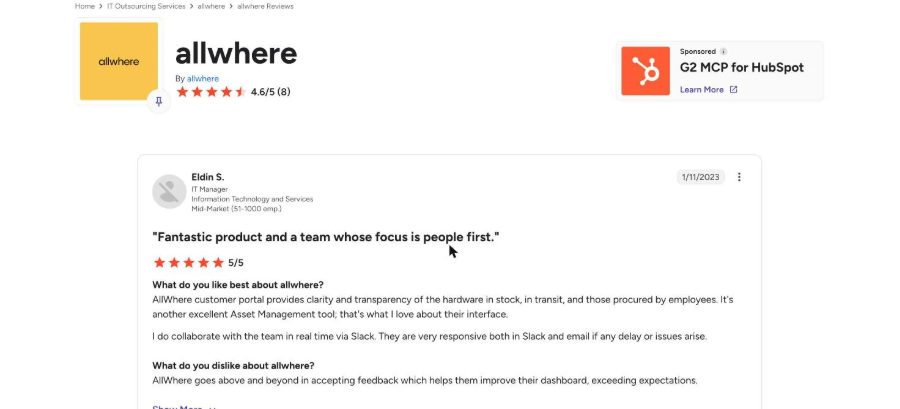
The praise is consistent about what the money replaces. One mid market reviewer wrote that "The service saves us time and money vs an employee doing it and using fedex or UPS", per a January 2023 G2 review. Another put it more bluntly: "Stop using Amazon, FedEx, CDW, and just use Allwhere. That's it", per a 2023 G2 review.
Both compare Allwhere with doing the job yourself through couriers and distributors rather than with another lifecycle vendor. That is the honest scope of the endorsement.
Complaints
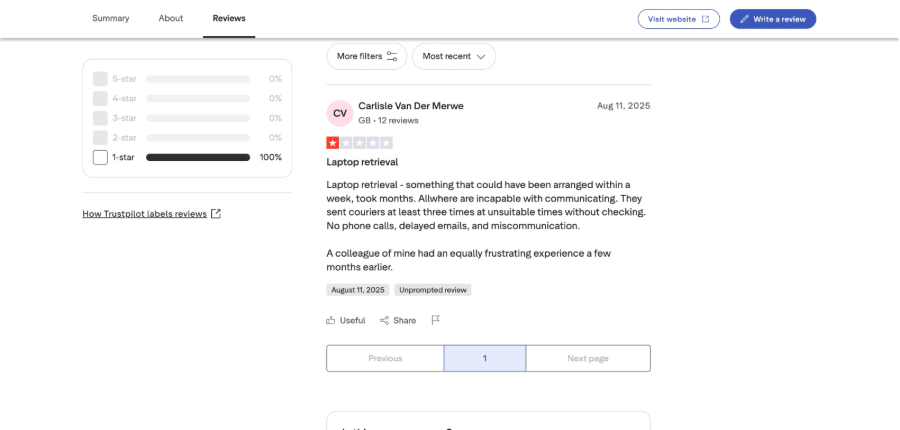
Three themes appear. The first is ordering: an administrator found that "The user interface in the store was a bit spotty and confusing", adding that staff walked him through it, per a January 2023 G2 review. Four of the eight G2 reviewers raise something similar.
The second is capacity. An enterprise IT manager noted that "Sometimes they are too busy and need more resources", framing it as a growth problem, per a 2023 G2 review.
The third is coverage after signature. On r/sysadmin a customer wrote that "We were told they can operate globally but after we signed the contract and submitted a request, we were told it would not be possible to ship there", adding his own caveat that this may have changed since, per a December 2023 Reddit comment. The Trustpilot reviewer quoted earlier reports the same pattern on the service side, with couriers sent three times at unsuitable times without anyone checking first.
Alternative to Allwhere: Tequipy
The question underneath an Allwhere quote is whether the parts it does not price are the parts you spend most on. For a globally distributed team they usually are, because a laptop costs many times what the box around it does. Tequipy publishes both numbers.
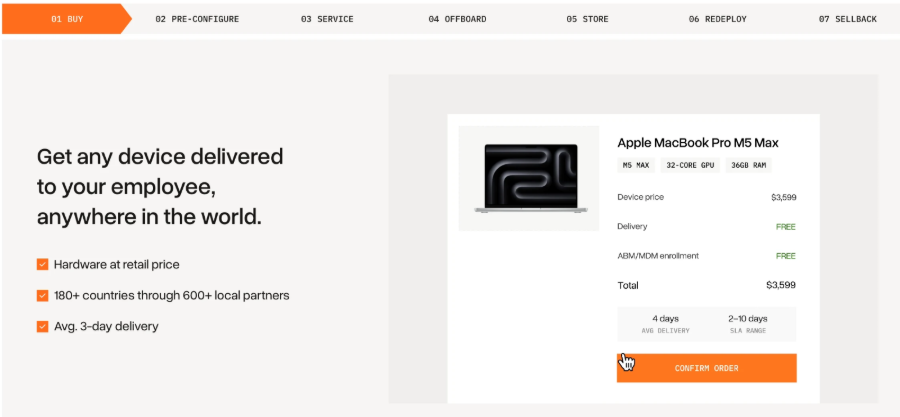
Local sourcing at recommended retail price. Every device is bought in the country where the employee lives, from one of 600+ authorized resellers across 180+ countries, so no parcel crosses a border outside the EEA and no customs charge lands later. Three business days is the global average and ten is the ceiling, through the same global IT procurement network.
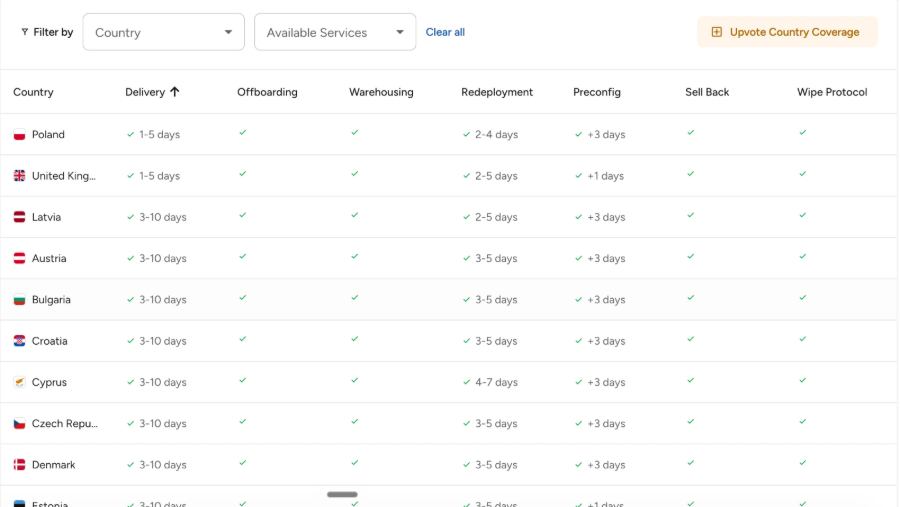
Every lifecycle job priced on the page. Collection, storage, redeployment and resale all show a rate before you order, bill only in the months something moves, and run on hardware bought from somebody else. A courier reaches the leaver's door, grades the machine and wipes it to certificate under our laptop retrieval service, and the same registry handles recovering a laptop from a leaver who has stopped replying. Zero touch deployment is free on devices bought through us.
Named customers give the outcome side. TapTap Send collapsed three separate purchasing routes into one and books about $6,500 of monthly savings against them. RemoFirst protects close to $2,000 per employee at a 100% device recovery rate. Booksy measures 99% delivery ahead of the employee's first day, having handed us Latin America as the opening test. Gigs saves 100+ hours a month and skipped the logistics hire its 20 hiring countries would otherwise have needed.
Where Tequipy Falls Short
- No leasing and no financing, in any market. Devices are bought outright at retail. Payment flexibility stops at a $5,000 credit line, due seven calendar days after delivery, which sits closer to a purchase order than to credit.
- SOC 2 is not finished. Tequipy holds ISO 27001 and can supply penetration test reports on request. Ask the team where the SOC 2 work currently stands before you treat it as a gate.
- Cross border movement runs inside the EEA only. Elsewhere a collected device stays in the country it was collected in, so the realistic options are redeployment in that market or sellback.
- The public review base is small. Three reviews on G2 is not a sample anyone should weigh heavily, so judge the service on a real order instead.
FAQs
Does Allwhere Have a Monthly Subscription Fee?
No. Allwhere states it charges no monthly subscription and no setup cost at any fleet size, and the asset tracking dashboard comes with the service rather than as a separately priced product.
How Does Allwhere Charge Without a Subscription?
It bills pay-as-you-go, per service event rather than per seat, and Tequipy bills the same way. A single collection can be bought without signing up, there is no minimum and no contract term, and the orders you do place consolidate into one monthly invoice.
Does Allwhere Offer Transparent Pricing?
Partly. One rate is public, a United States laptop return kit from $120 as of September 2026. Hardware, storage, deployment, resale and any retrieval outside the United States are quote only.
Can Allwhere Pricing Vary by Location?
Yes. The $120 kit is a United States price and international collections are quoted individually. Coverage itself runs to 58 listed locations, so several regions have no price because they have no service.
Is Allwhere Cheaper Than Tequipy?
On platform fees, yes: Allwhere charges nothing there and Tequipy charges $99 a month flat at any fleet size above 100 devices. On hardware the comparison cannot be made, because only one of the two publishes a device price, and buying locally at recommended retail price in 180+ countries is where the larger number sits.
CONCLUSION
Does Allwhere Pricing Fit Your Budget?
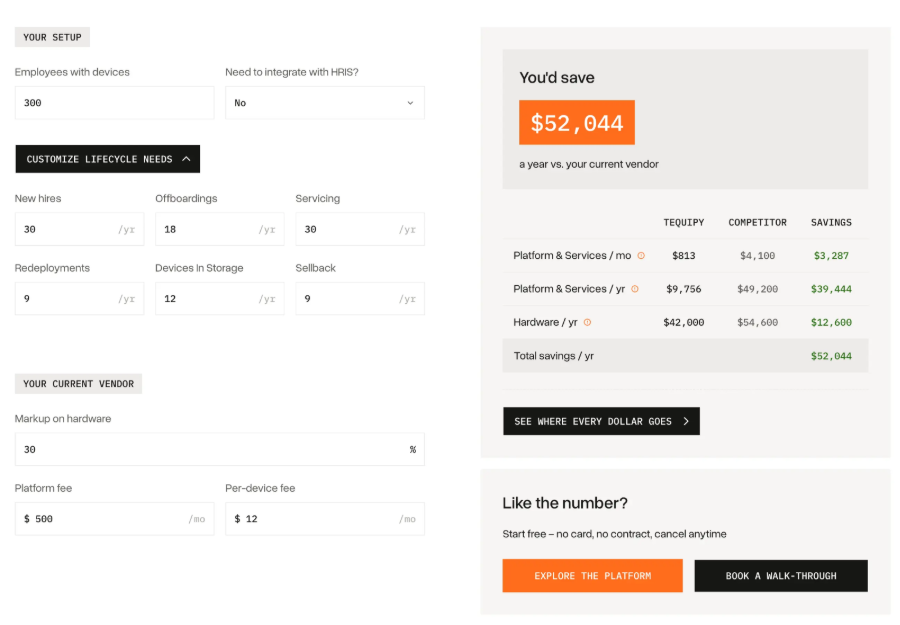
It fits if your people are mostly in the United States, your main job is getting laptops back, and you buy hardware elsewhere. At that shape, $120 a collection with no subscription behind it is a fair deal.
It fits less well if your hiring map runs past the 58 listed locations, if hardware is the biggest line in your budget, or if you need a number before a call. Price the same list both ways: send the seven questions above to Allwhere, then build the other column yourself from our published rates and named customer results. The rest of the category sits in our Allwhere alternatives guide, and you can send your country list to us with nothing attached.
{{cta-primary}}

Keep your current setup.
Just test us on one order.
AUTHOR
Before Tequipy, Tomek ran IT at Revolut, scaling from 100 employees in 2 offices to 5,000 across 17. He built the system that kept every laptop accounted for, then founded Tequipy – a platform that handles IT equipment logistics for distributed teams across 180+ countries.
As CEO, he runs operations and covers the founder layer: strategy, product, and the company-building that comes with both.
15 minutes. Your countries, your devices, your setup. No pitch.