KEY TAKEAWAYS
- This article is about fleet.co, the Paris company that leases laptops. It has nothing to do with vehicle fleet software or with the endpoint agent from fleetdm.com, both of which own most of this search term.
- Fleet suits a Western European small or mid-sized business that wants a predictable monthly line. Laptop, device management and helpdesk arrive on one invoice, with the laptop financed over 36 months.
- Tequipy suits a buyer who would rather own the machine. One invoice, no financier, no residual value, hardware at recommended retail price across 180+ countries, and every standard service rate published.
- Workwize, Deel IT, GroWrk, Allwhere and Firstbase each answer a narrower question: European automation, the Deel payroll stack, global logistics with device management attached, United States pay as you go, and an all-inclusive per-seat annual line.
A monthly rate is not the price. Thirty-six of them is, and that arithmetic is the reason anyone searches for Fleet alternatives in the first place. Fleet is fleet.co, founded in Paris in 2019, and it rents company hardware on an operational lease financed by outside partners. Globally distributed teams that outgrow that model usually want the same three things: to own the asset, to get out without a settlement figure, and to hire somewhere the lease paperwork does not reach.
Six vendors are compared below. One of them is ours, which is declared at the top of its section and again at the bottom of the page.
How We Selected the Top Fleet Alternatives
Feature grids are close to useless here, because every vendor in this category claims procurement, deployment, retrieval and resale. What separates them is the commercial shape underneath, so each candidate was measured on four tests where a lease behaves differently from a purchase.
What you own at the end. After three years of payments, is the laptop yours, returnable, or buyable at a price somebody else sets? This is the single biggest difference between a lease and a purchase, and it never appears on a comparison grid.
What leaving early costs. Headcount plans change. A vendor that charges nothing to stop and a vendor that calls in the remaining rentals are selling different levels of risk, whatever the monthly figures look like.
Coverage against footprint. A country count is a marketing number. A named customer, or a reviewer writing the country name, is evidence. Only the second kind survives contact with a hiring plan.
Whether the price is published. A rate you can read is a rate you can budget against. Where a vendor publishes nothing, that is recorded plainly rather than filled in with a guess.
Pro tip: before you compare any two vendors, write down what you would pay to exit each one in month 14. Not the monthly rate, not the headline discount. The exit figure, in writing, from the contract or the salesperson. On a purchase it is zero. On a lease it is the rest of the term, and that single number reorders most shortlists.
Best 6 Fleet Alternatives Compared for 2026
Ratings below come from each vendor's own review profile, as of October 2026, because the review record in this category moves and some of it belongs to the wrong company entirely.
| Tool | Best For | Stand Out Feature | Price Starting Point | Ratings |
|---|---|---|---|---|
| Fleet | Western European small and mid-sized businesses wanting one monthly line | Laptop lease, with device management and helpdesk from the same vendor | A 36-month operational lease, or buying with no minimum. No device prices published; TechCrunch reported 2022 leases from 54.90 to 99.90 euros a device monthly | 4.1 from about 131 on Trustpilot, no G2 profile, Capterra page 404 |
| Tequipy | Teams that want to own the hardware and hire outside Western Europe | Local sourcing through 600+ authorized resellers in 180+ countries | Recommended retail price with delivery included. Platform free for up to 100 devices, then $99 a month flat. HRIS integration $199 a month, optional | 4.8 from 3 on G2 |
| Workwize | Europe-first teams that want ordering to run itself | More than 100 HRIS integrations driving zero-touch enrolment | $8 per seat plus a $540 platform fee (Basic) on its own comparison page, with a 150 user entry requirement on the cheapest tier | 4.2 from 23 on G2 |
| Deel IT | Companies already running Deel for payroll or employer of record | Devices, contracts and payroll inside one portal | From $49 per user per month (Starter, includes MDM and endpoint protection), plus a store fee on hardware that customers put at 25% | 3.3 from 30 on Trustpilot |
| GroWrk | Global logistics with device management attached | Zero-touch enrolment into Intune, Autopilot, Kandji and Apple Business Manager | Free A La Carte tier billed per order. Flex is an undisclosed monthly fee per workstation | 4.4 from 36 on G2 |
| Allwhere | United States teams working inside its listed markets | Role-based equipment kits plus a documented customer API | Device at vendor cost plus a 4% service fee on every transaction, per its published Pricing Guide | 4.6 from 8 on G2, every one incentivized |
| Firstbase | Buyers who want one annual per-seat line covering everything | All-inclusive per-seat pricing covering freight, duties, storage and disposal | Annual: $27,500 for 12 months, 100 users and a committed pool of platform tasks on AWS Marketplace. One buyer's 2023 platform fee: $45,000 | 4.7 from 51 on G2 |
Read that table by the commercial shape rather than the feature column. Fleet leads with a lease and now also sells outright. Deel IT, Workwize, GroWrk and Firstbase sell devices and also rent or lease them. Tequipy and Allwhere sell outright and offer no lease. Ours publishes what each standard step of the work costs before anybody picks up a phone, which is the section immediately below.
{{cta-primary}}
Tequipy: Best for Teams That Want to Own the Hardware
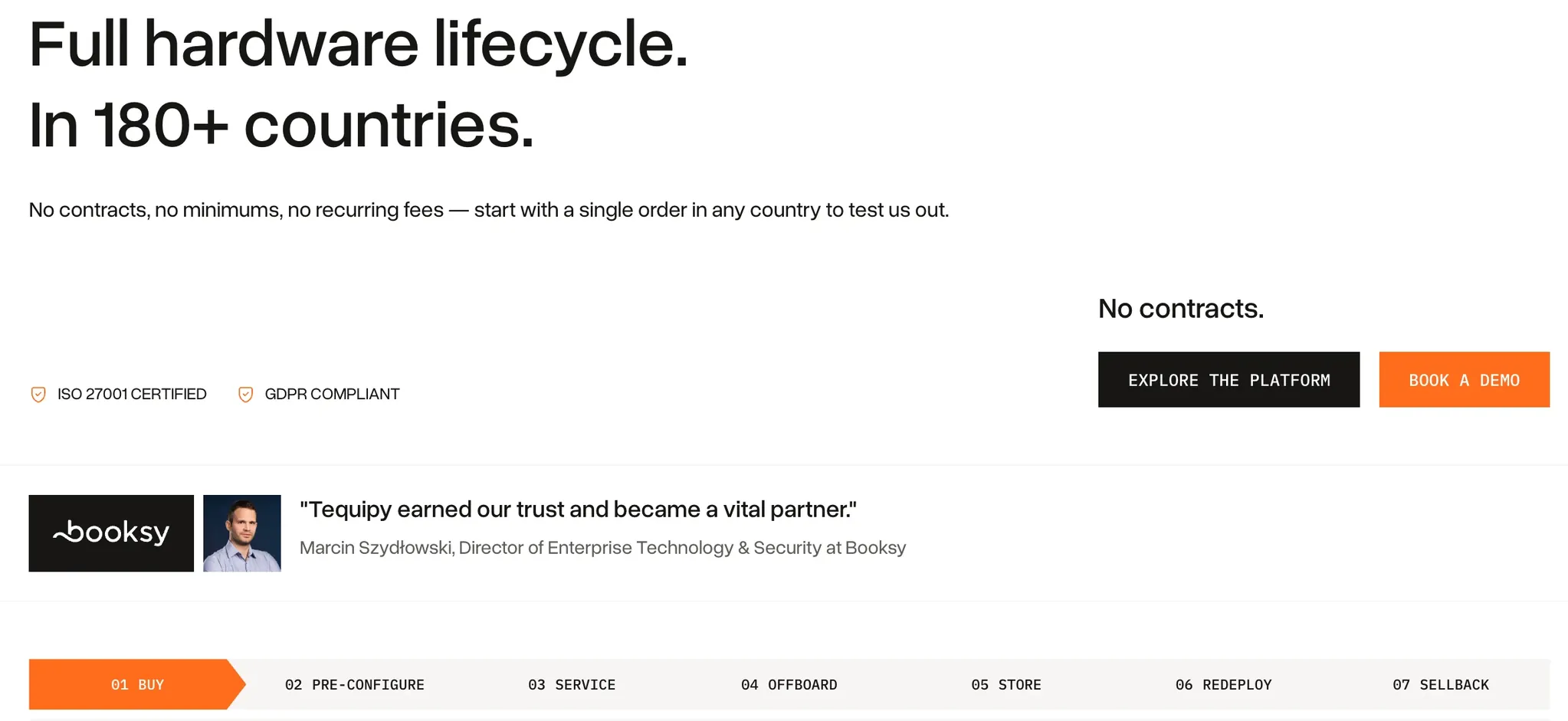
Declare the bias: this company is ours. Everything below is checkable through the links, and the weaknesses section further down is not decorative. Tequipy buys devices at retail price in the employee's own country, delivers them enrolled, and handles everything that happens to them afterwards. It holds ISO 27001 certification.
Tequipy Key Features
Three things decide whether a Fleet customer should look at us at all. The first is about ownership, the second about geography, and the third about whether you can total a year without a sales call.
Stand Out Feature #1: You Own the Device From the First Invoice
One order, one invoice, and the laptop becomes a company asset that day. There is no financier in the transaction, no residual value calculated at the end, and nothing to buy back in three years because you already bought it. When the device stops being useful it goes to sellback, which returns 20% to 70% of the original value in cash rather than costing you a settlement.
One piece of payment flexibility exists: a credit line of $5,000, settled within 7 calendar days of delivery. Our internal commercial documentation describes it as a payment mechanism and not as financing, which is the correct reading. It behaves like a purchase order, carries no interest, and has no term to run.
Be precise about what this does and does not mean. Tequipy does not lease or finance hardware, in any country, in any form. For a buyer who leases, this is a purchase against a lease. Fleet now also sells outright with no minimum, but leasing is still its core and it publishes no device prices. A reader who genuinely wants the capital expense off the balance sheet is better served by Fleet. Buying outright is covered in bulk laptop buying at retail prices, and the resale end sits in selling back old laptops for cash.
Stand Out Feature #2: Local Sourcing in 180+ Countries
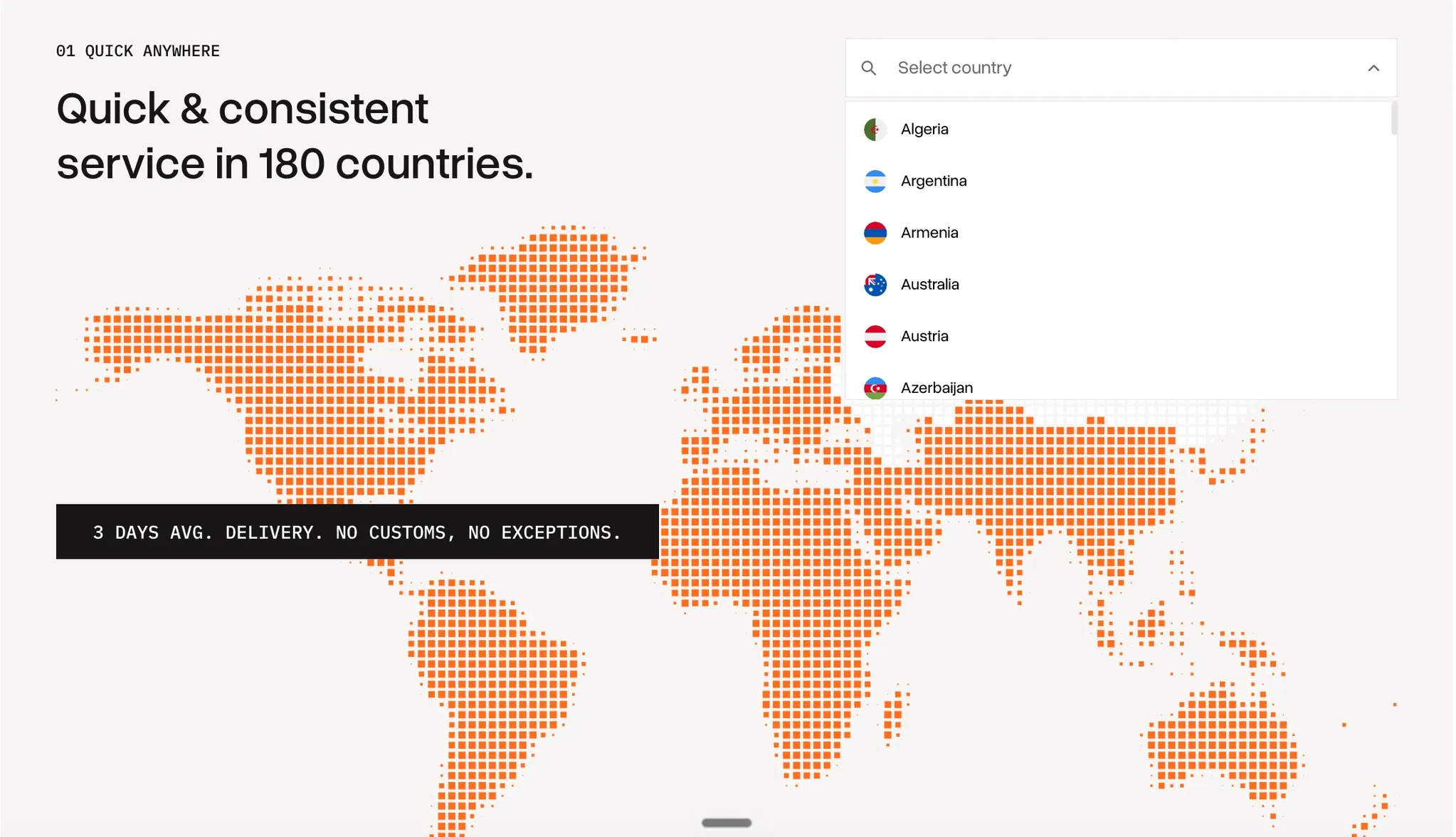
Purchasing happens locally, at one of 600 or more authorized partners operating in the country where the employee actually lives. Because the machine never leaves that country, or at most crosses an open border inside the EU, there is no customs file to complete, no duty to absorb and no fortnight lost in transit.
Names beat totals, particularly in the markets nobody publishes case studies about. RemoFirst's 30-country operation reaches Kazakhstan and Georgia. Booksy's Latin America trial came after other suppliers failed the region, and Colombia and the Philippines followed at short notice. That gap between a marketing total and a working route is the whole point of global laptop procurement without customs.
Stand Out Feature #3: Every Service Priced on a Public Page
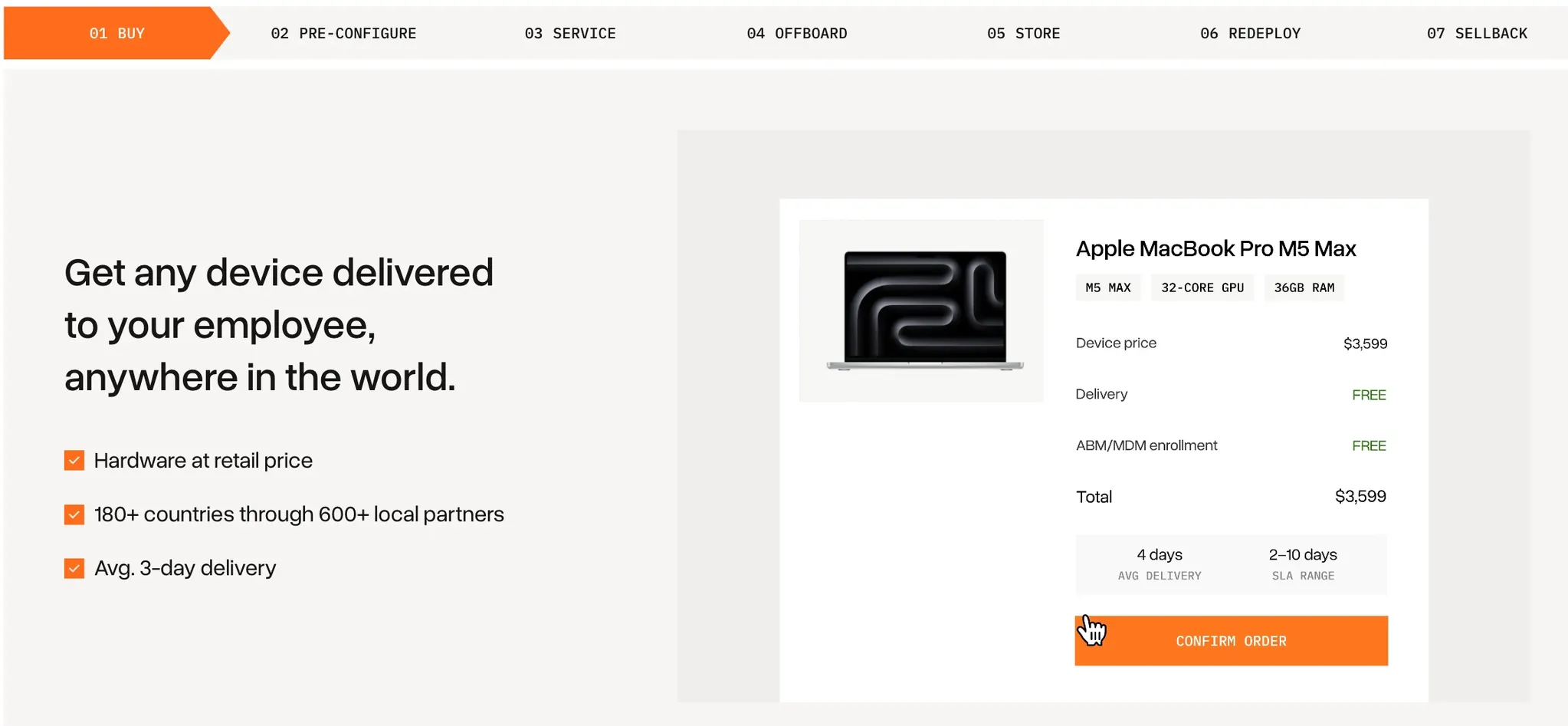
Offboarding, storage, redeployment and sellback each carry a number on our public rate card. Not a range that arrives after a discovery call, not a bundle inside a seat charge. A finance lead can total twelve months of device work from that page alone.
Two operational figures sit behind the prices. 99% of devices reach the employee before their first working day, and every company device has come back at offboarding so far. Delivery averages 3 business days and tops out at 10. Those are our own tracked figures across the published case studies, and they are the numbers to hold us to.
Tequipy Pricing
| Item | Price |
|---|---|
| Hardware | Recommended retail price, delivery included |
| Platform | Free for up to 100 devices, then $99 a month flat |
| HRIS integration | $199 a month, optional |
| Pre-configuration and enrolment | Free; manual pre-configuration priced separately |
| Offboarding collection | $70 to $150 per device, by country |
| Storage | $12 a month per device |
| Redeployment | $70 to $150 per device |
| Sellback | Free, returning 20% to 70% of original value as cash |
| Contract | None. No minimum order, no volume requirement |
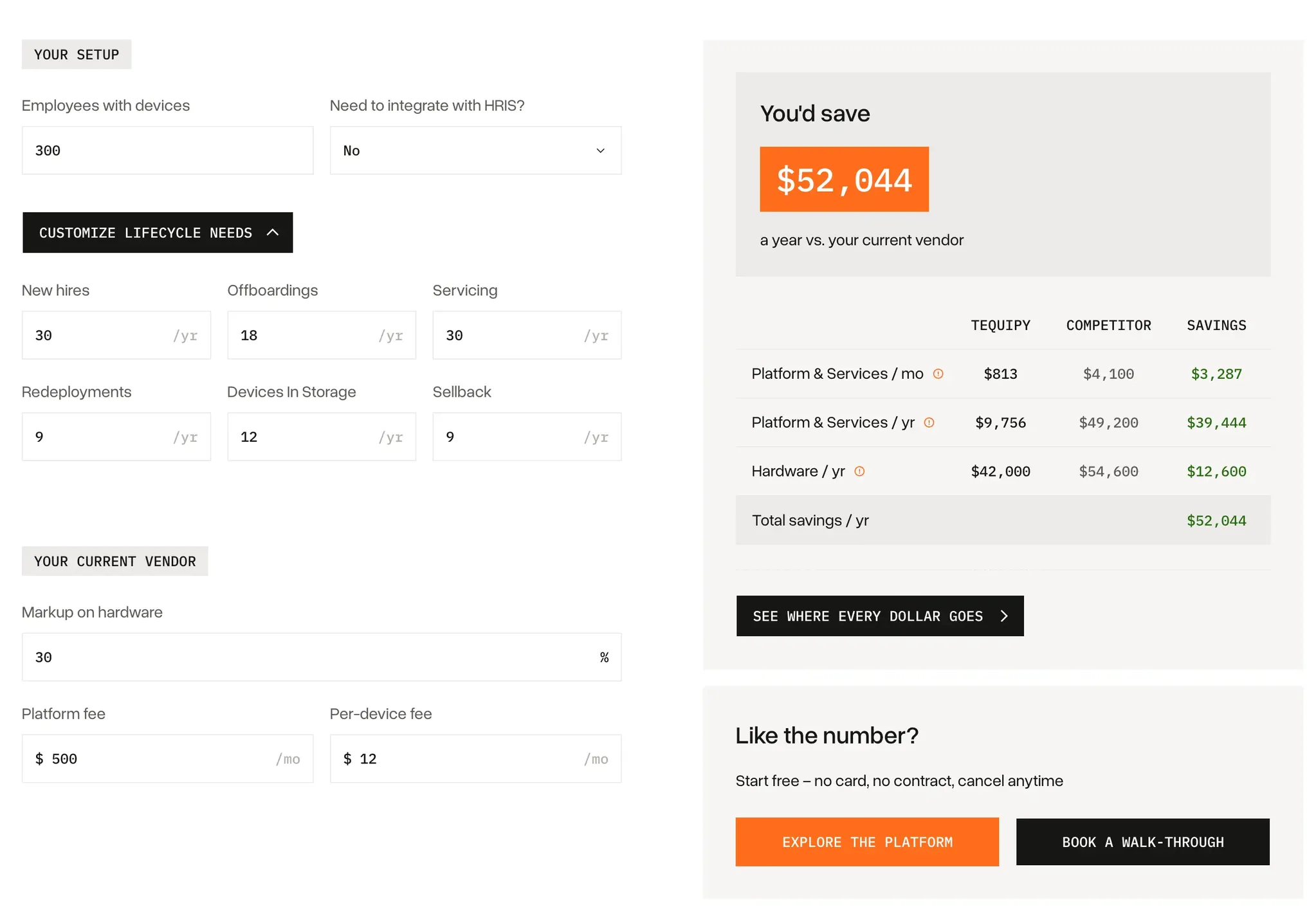
On one Fleet customer's figures, the same laptops cost less on Tequipy. Seven $2,000 laptops come to $14,000 at retail on Tequipy, delivery included. That customer told us Fleet's prices run 20 to 30% above retail, so by our estimate the same seven cost $16,800 to $18,200 there: $2,800 to $4,200 more. Fleet publishes no device prices, so ask it to quote the same spec. In our pricing calculator, a 100-person team's year of platform and services comes to $2,856, plus $199 a month for the HRIS integration. Enter what Fleet charges you and see for yourself.
One warning about comparing the two sides. Fleet's only published service figure, on its cybersecurity page, starts at €11.50 per device per month, with each proposal tailor made. Its IT management and Fleet Secure services bundle its own device management, security tools and support, now 24/5, Monday to Friday. Our platform fee buys platform access alone, because Tequipy sells no device management product and no helpdesk. So the honest comparison names what Fleet's extra charge buys rather than pretending the two charges answer the same question.
Where Tequipy Shines
- An owned asset on day one: the machine belongs to the company from the first invoice, so there is no settlement figure, no residual and no conversation in month 37.
- Proof outside Western Europe: Colombia, the Philippines, Kazakhstan, Georgia and Ukraine are named markets with named customers behind them, which is where most vendors in this category stop being able to help.
- A total cost you can read: every standard service rate is public, so the annual figure exists before any call and can be checked against a quote line by line.
Where Tequipy Falls Short
- Fleet holds SOC 2 and we do not yet. Ours is in progress, and a demo call is the right place to ask how far it has come. Tequipy is ISO 27001 certified and penetration tested, and a security review that gates on SOC 2 today clears Fleet and does not clear us.
- We sell no device management, no endpoint detection and no helpdesk. A twenty-person company with nobody running IT gets more from Fleet's bundle than from us, and should buy it.
- No leasing or financing, in any country. A team that wants laptops as a monthly operating cost will find Fleet or Firstbase closer to what it needs.
Tequipy Customer Reviews
Our public evidence is case studies rather than a directory profile, and a small review base is a genuine limitation worth naming before the quotes. Lisa Kiseleva, people operations at Gigs, describes the team in Gigs' case study as "one of the most responsive and solution-oriented teams I've worked with", after the company saved over 100 hours a month and skipped an IT logistics hire.
At Booksy, the enterprise technology and security director Marcin Szydlowski put the first regional test on the record in his own case study: "They managed it perfectly, which gave us the confidence to start using their services for other geographies as well."
Who Tequipy Is Best For
- IT leads at 200 to 500 person companies working across five countries or more: the order flow is constant and a new market opens most quarters.
- Teams hiring outside Western Europe: this is where a lease provider's delivery partners thin out and where our named customers sit.
- Finance teams that want an asset rather than a rental line: owning the machine changes the depreciation conversation and removes the exit negotiation entirely.
Workwize: Best for Europe-First Automation
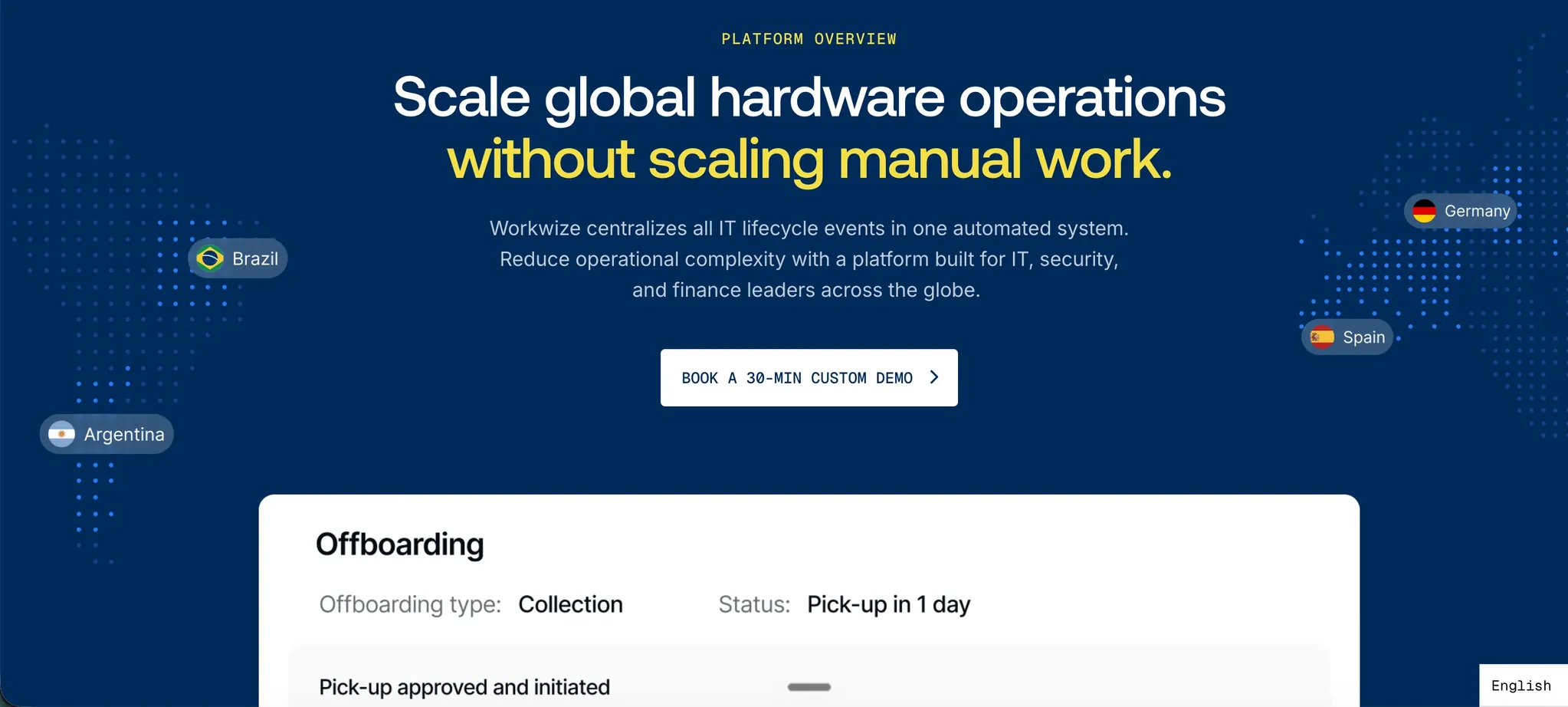
Amsterdam is home for Workwize, which closed $13M in Series A funding during January 2025 and builds the most heavily automated offering in this group. Fleet sells a financed bundle. Workwize sells the promise that nobody on your team types an order into anything ever again.
Key Features
Integration Depth
More than 100 HRIS integrations sit on its pricing page, covering Workday, HiBob, BambooHR, Personio, Rippling, Okta and Entra ID, with enrolment running through Jamf, Intune and JumpCloud. A leaver in the HR system triggers the courier booking and the certified wipe without anyone opening a ticket.
Warehouses Plus a Reseller Network
Two fulfilment routes exist: a local reseller, or stock the customer bought in advance and parked in one of 14 regional hubs. Those hubs reach into South Africa, the Philippines, Brazil, India, the Emirates and Singapore. At the far end, resale is claimed to recover as much as 45% of what the device originally cost. The company carries SOC 2 Type II and ISO 27001.
Pricing
| Item | Price |
|---|---|
| Tiers | Basic, Professional and Enterprise, covering 3, 5 and unlimited regions |
| Entry requirement | 150 users on the Basic tier |
| Per-seat price | $8 per seat plus a $540 platform fee (Basic), on the vendor's own comparison page |
| Hardware markup | About 30%, per one Reddit buyer's report |
| Contract length | Not published |
Where Workwize Shines
- Reviewers praise the automation above everything else: ten of them single out how far the integrations reach, meaning the unbroken chain from an HR record to an enrolled machine.
- Supplier count genuinely drops: seven reviewers describe procurement, warehousing and collection moving into a single relationship.
- SOC 2 Type II and ISO 27001 are already in hand, which shortens a security review considerably.
Where Workwize Falls Short
- Shipping beyond the core markets draws more criticism than anything else, across thirteen separate mentions, clustering in parts of the European Union, Australia, India and South America.
- The 150 user entry requirement is a gate, not a description of who the product suits. Below that line the cheapest tier is simply unavailable.
- The pricing stacks: a markup, then a platform charge, then shipping, warehouse and package lines. One buyer on Reddit reports paying roughly 30% on hardware plus platform fees and says it should have been one or the other.
Customer Reviews
Ethan X. gives both halves in a July 2025 G2 entry, praising a supplier network that is "excellent in Europe and North America" and then noting "there have been a few delays when shipping to the Middle East" in the same review. The counterweight is an October 2025 Trustpilot entry that names unreasonably high pricing as one of its complaints. Note also that all 17 Capterra entries and the 14 G2 reviews posted in September 2026 are invited and incentivized, so they carry less weight than the numbers suggest.
Who Workwize Is Best For
- Companies in Europe past the 150 seat line that never want a manual order again: the storefront and the HR triggers earn their keep at that volume.
- Teams whose security review demands SOC 2 Type II today.
A longer treatment of this vendor sits in Workwize alternatives compared for 2026.
Deel IT: Best for Teams Already on Deel Payroll
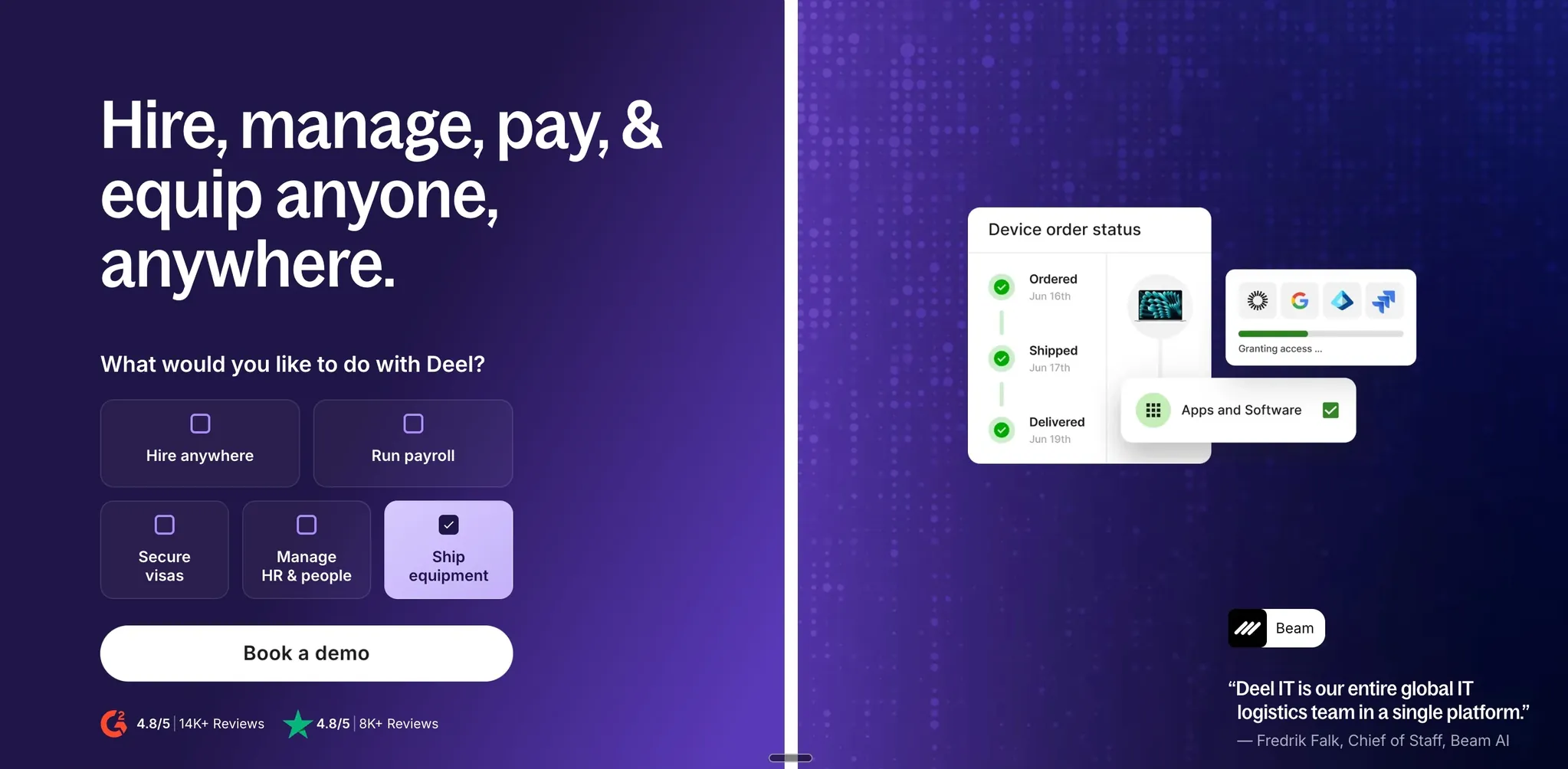
Deel IT started life as Hofy, which Deel acquired in July 2024 and relaunched under its own name that September. Coverage is put at 130+ countries. Its device business is sold from within the same account that already handles wages, contracts and employer of record work for a great many remote-hiring companies.
Key Features
One Portal for the Whole Employee Lifecycle
Contracts, wages, benefits and equipment sit in one account, so an onboarding raises a laptop order without anyone opening a second system. This is the only genuine moat in the group and no standalone device vendor can copy it.
Full Lifecycle Plus Device Management
Purchasing, Apple Business Manager and Autopilot enrolment, repair, collection, warehousing, reissue and certified erasure are all present, with device management and endpoint protection included in the Starter bundle at $49 per user per month.
Pricing
| Item | Price |
|---|---|
| Published rates | Three bundles at $49, $139 and $149 per user per month on its pricing page |
| Hardware store fee | US retail price plus a store fee, which a customer on Trustpilot puts at 25% |
| Platform fee | Per seat per month, counted on headcount |
| Free tier | Essentials: ordering and asset tracking, no pre-configuration, no device management |
| Rentals | 12 or 24 months, extendable to 48, free return, no buy-out |
Where Deel IT Shines
- Existing Deel customers remove a supplier instead of adding one, and that saving is real even before anything is negotiated.
- Border paperwork becomes somebody else's job wherever the service works well: reviewers give it credit for moving hardware out and pulling it back across many countries.
- The certificate list is long, covering SOC 1, SOC 2, SOC 3 and ISO 27001.
Where Deel IT Falls Short
- Hardware prices and the store-fee percentage are not published, which makes a full annual budget, hardware included, impossible to build without booking a call first.
- The meter counts workers rather than machines, so a company whose headcount outruns its device count pays for the difference every month.
- The core job can go wrong: a zero out of five G2 review from June 2026, written by an owner at a mid-market firm, reports onboarding breaking again and again for new starters.
Customer Reviews
Logistics is where the praise gathers. A February 2026 G2 entry from Krzysztof U. credits the platform with getting equipment out to scattered teams in many countries and getting it back again afterwards.
Complaints cluster on money and on what changed after 2024. An October 2025 Trustpilot entry opens with "Major downgrade since Deel's acquisition" and reports hardware pricing that has climbed steeply. Treat the G2 aggregate for this vendor with care, because Deel payroll reviews sit inside that profile; the Trustpilot profile, now titled Deel IT (Previously Hofy), is the cleaner reading.
Who Deel IT Is Best For
- Anyone whose wages, contracts or employer of record work already runs through Deel.
- Finance teams that want payroll and devices from one supplier rather than a second vendor relationship.
The history since the rename is traced in Hofy alternatives after the Deel acquisition.
GroWrk: Best for Global Logistics With Device Management
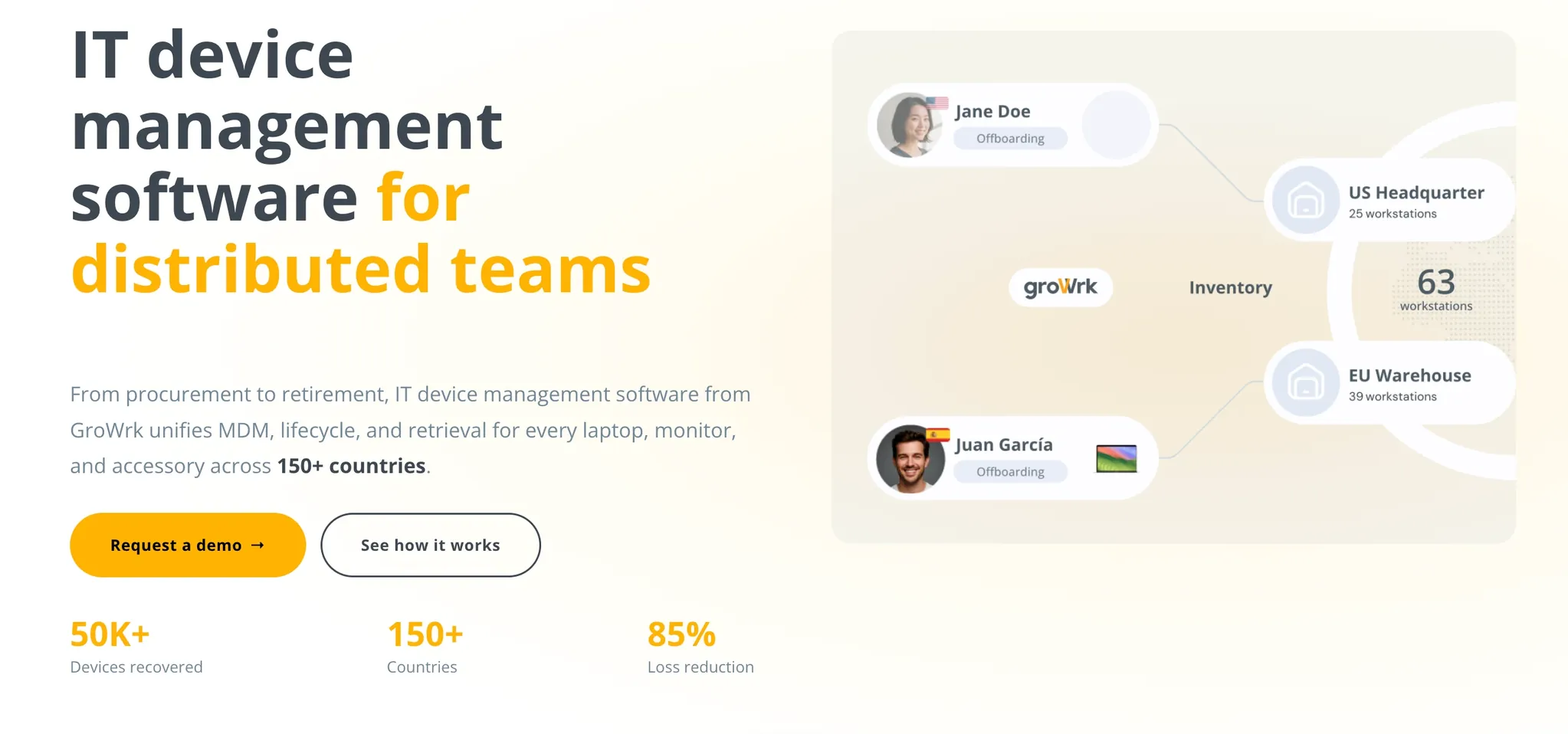
Founded in 2019 and run remote-first from San Diego, GroWrk puts its coverage at 150+ countries through 600 or more certified resellers. For a Fleet customer who buys outright, it is the closest thing to the same bundle without a finance contract underneath it.
Key Features
Enrolment and Integrations
Zero-touch enrolment runs into Intune, Autopilot, Kandji and Apple Business Manager, alongside more than 40 integrations spanning HiBob, BambooHR, Google Workspace, UKG, Workday and Okta, plus an API.
In-Country Storage and Resale
Devices are warehoused inside the country they were used in rather than shipped to one central site. Buying, repair, collection, reissue and resale at retirement all run through the same platform, which carries SOC 2 Type 2.
Pricing
| Item | Price |
|---|---|
| A La Carte | Free platform, billed per operation, nothing to sign |
| What A La Carte excludes | Zero-touch enrolment, HRIS integrations, a named account manager, buy-back and end-of-life services |
| Flex | A monthly management fee per workstation, amount undisclosed |
| Flex term | A 12-month initial agreement |
| Hardware markup | 15% on its own comparison page, 25% to 45% reported in practice |
| Third-party estimate | About $12,000 a year to start, per SelectHub |
Where GroWrk Shines
- Nothing draws more praise than the support: eighteen reviewers on G2 raise it, and what they mean is a named account owner sitting in a shared channel.
- Deliveries into Latin America carry the strongest evidence of anything on the record, seventeen mentions deep, with Chile, Colombia, Brazil, Argentina and Uruguay all written out by name.
- A free tier with nothing to sign, which makes a single-order trial possible. Parity note: billing per order with no commitment describes Tequipy as well, so nobody is differentiated by it.
Where GroWrk Falls Short
- Late deliveries top the complaint list on every platform it appears on, fifteen mentions in all, with Central Europe, Mexico and India coming up again and again.
- Buying direct is cheaper, according to eleven buyers in reviews and sales calls, one of whom puts the difference at two to three times.
- What reviewers enjoy is the paid product: an A La Carte buyer gets none of the automation and no account owner of their own.
Customer Reviews
A director of standards and compliance values the sameness of it after three years, writing in a September 2024 G2 review: "My team members whether they are in Chile, Colombia, Brazil, Argentina, Uruguay … I can expect they'll receive similar service."
Timing is the counterweight. Writing on Trustpilot in December 2025, one customer had already spent over a month waiting on a single laptop somewhere in Central Europe.
Who GroWrk Is Best For
- Teams concentrated in the Americas that also need enrolment handled.
- Buyers ordering a few times a year, assuming the features the free tier excludes genuinely are not on the list.
More on that vendor sits in GroWrk alternatives for global IT teams.
Allwhere: Best for United States Retrievals
Based in Brooklyn and funded by a $9.5M seed round in July 2022, Allwhere lists 54 countries on its coverage page, though 15 of the 50 countries on its Beta grid are procurement only, with no retrieval, deployment or storage. Commercially it is the nearest thing here to an outright purchase, with no lease, no commitment and no minimum order. Parity, stated on their side of the page: those three terms describe Tequipy too, so neither of us earns anything by advertising them.
Key Features
Role-Based Equipment Kits
Kits are defined by role, so a new engineer and a new salesperson each trigger their own bundle without anyone rebuilding the order. A documented customer API sits alongside it for teams that want to drive the flow from their own systems.
Domestic Retrieval
Its strongest evidenced capability is United States collection and redeployment, which is where its reviewers concentrate.
Pricing
| Item | Price |
|---|---|
| Published rates | A per-region Pricing Guide in its help centre |
| Contract | None |
| Minimum | None |
| Markup | No margin on the device, which passes through at vendor cost, but a 4% service fee on every transaction works as one |
Where Allwhere Shines
- Commercial terms with nothing to sign, which makes a single order a complete evaluation.
- United States retrievals are the best-supported part of its record.
Where Allwhere Falls Short
- Coverage is under a third of the countries Tequipy operates in, which decides the question for a team hiring across Asia or the Caucasus.
- The review base is eight entries, all seller-invited and all written in 2023, so it says little about the service today.
- One public negative exists and it is about the core job: a single Trustpilot entry from August 2025 describes a retrieval that took months.
Customer Reviews
Its G2 page holds eight entries, each one arriving through a seller invitation and each one written in 2023. Those are fair to read and unfair to average, so open the individual reviews rather than quoting the number on top of them.
Who Allwhere Is Best For
- United States teams hiring inside its listed markets, where retrieval is the main job.
- Buyers who want per-transaction billing and do not need coverage beyond that list.
The longer version is in Allwhere alternatives for distributed teams.
Firstbase
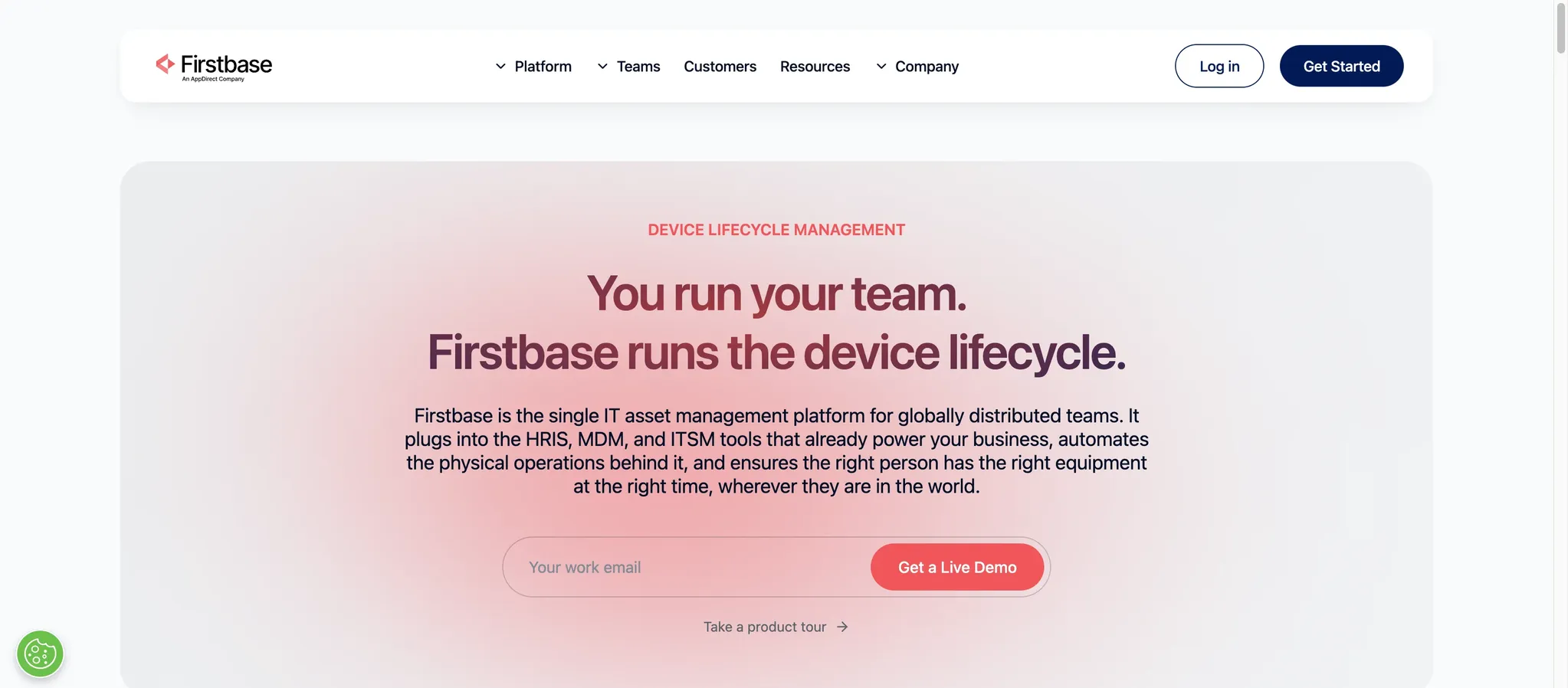
As of October 2026, Firstbase lists its Starter Edition on AWS Marketplace at $27,500 for 12 months and 100 users, with each platform task beyond the committed pool at $1.00. Founded at the end of 2019, Firstbase was bought by AppDirect in December 2024. It sells all-inclusive per-seat annual pricing that folds hardware, freight, duties, storage and disposal into one line across a claimed 150+ countries. That makes it the closest thing here to Fleet's predictable figure with no finance company underneath it when you purchase outright.
Its G2 profile shows 4.7 from 51 entries. On price, PriceLevel reports one buyer's 2023 platform fee of $45,000, alongside a $125,000 services commitment, which says something about the scale the model is built for. Firstbase alternatives for distributed teams goes further.
Reasons to Consider an Alternative to Fleet
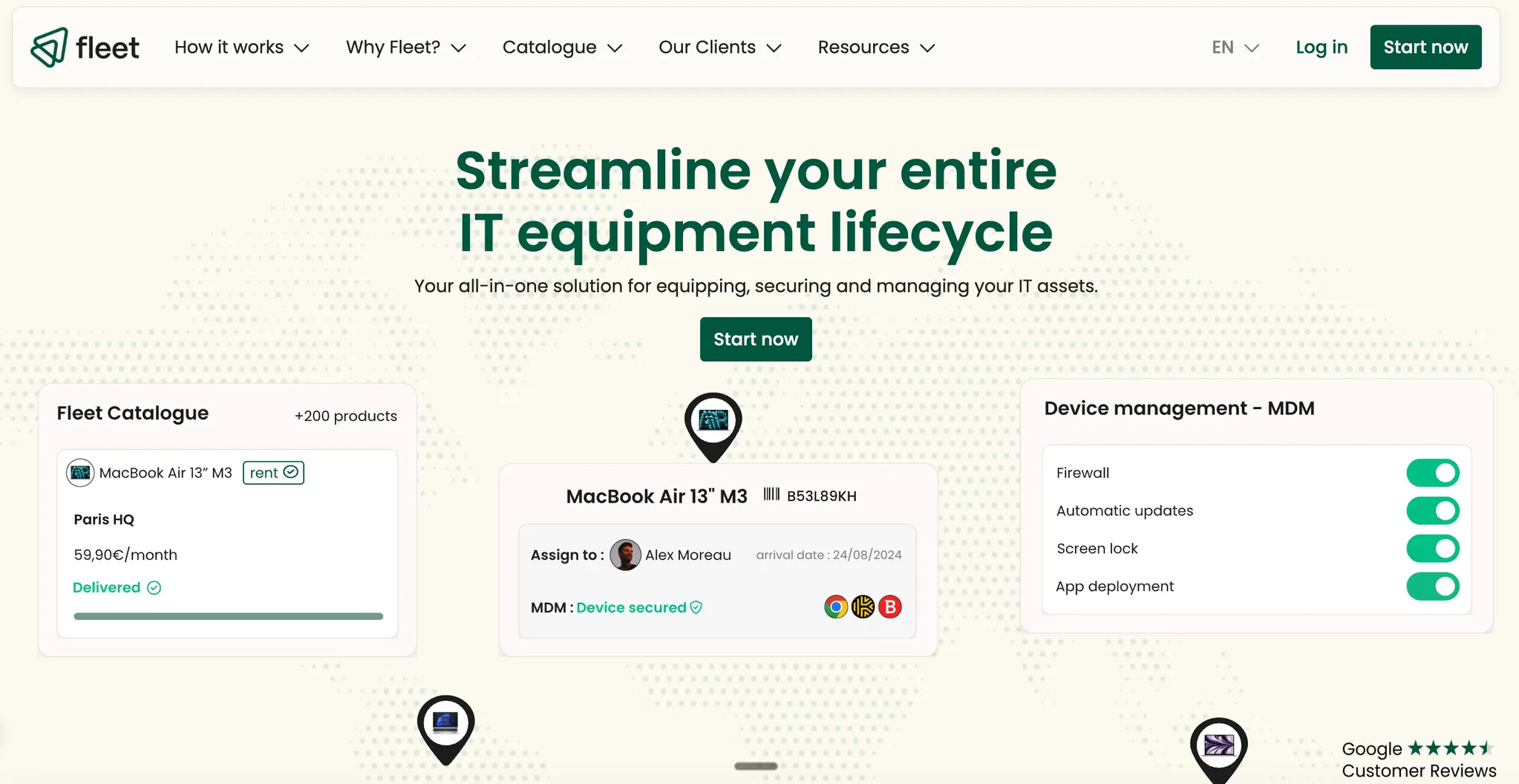
Concede the strengths first, because they are real and because two of them are things we cannot match. Fleet holds both ISO 27001 and SOC 2, which is one certification more than Tequipy carries today. Our SOC 2 audit is under way, and its latest status is worth asking for on a demo call. Fleet's Trustpilot record runs at 4.1 from about 131 reviews, and Trustpilot itself flags the company as having no history of soliciting them, which makes the one-star criticism more credible. Its customer support draws consistent, named praise in France, Spain, the United Kingdom and Germany.
Three structural things should still make a buyer pause.
Reason #1: The 36-Month Lease Is the Product, and Leaving Early Costs the Rest of It
The default commitment is a 36-month operational lease financed by third-party partners, which means the contract terms belong to a financier rather than to Fleet. One reviewer sets out the mechanics of an early return in detail on Trustpilot: all remaining rentals fall due, the hardware cannot be bought back, and the process took three months while tickets went unanswered. He later updated the entry to say nobody had contacted him despite a public reply promising it.
The financial structure has confused buyers before. When one reviewer complained that the offer had been presented as rental rather than leasing, Fleet's own reply confirmed it is a financial lease. Nothing dishonest happened there, but a buyer who reads rental and signs a three-year financing agreement has misread something expensive.
Reason #2: The Cost Lands at the End, Not in the Monthly Rate
Start with published arithmetic rather than a complaint. A 14 inch MacBook Pro was listed at 99.90 euros a month in TechCrunch's 2022 report, and Fleet no longer publishes device prices. Over 36 months that totals 3,596 euros, against a retail price of roughly 2,250 euros for the same machine that year. The gap covers financing, support, warranty handling and a refresh at the end, so it is a financed bundle rather than a markup, and calling it one would be unfair.
The end of the term is where buyers say the surprise lives. One reviewer reports being quoted 35% to 40% above the price of new hardware to buy back machines that had been in use for about a year, in a January 2026 entry that also calls the mandatory 36-month commitment senseless. Another describes the same double-charge shape: thirty-six rentals first, then the residual value.
Reason #3: 120 Countries Claimed, About Ten in the Investor's Release
Fleet's February 2026 funding announcement claimed delivery to 120+ countries in under 48 hours, and its website, relaunched in September 2026, now markets 150 countries and a 3-day average delivery. The same announcement says the company operates actively in around ten to twelve European countries plus the United States. The announcement's two statements sit inside one document, which is why this is the fairest criticism available on this keyword: nobody had to dig for a contradiction, and neither number is hidden.
The delivery record is genuinely mixed rather than bad. Reviewers in Germany and elsewhere report next-day arrival, and one wrote that first devices arrived before staff could be told they were coming. Against that, a founder waited five weeks for a replacement laptop in a December 2025 entry, and a company evaluating Tequipy while running Fleet for procurement reported typical delivery of about two weeks. That last one is a buyer evaluation with no public link, offered as a single data point rather than as a pattern.
The practical reading: inside Fleet's core markets the service is well reviewed. Outside them, ask for a reference customer in the exact country before you sign anything, and read laptop lifecycle management after delivery for what you are actually buying.
{{cta-primary}}
CONCLUSION
Final Word on Tequipy
Send the right reader back to Fleet without hedging. A twenty-person French company with nobody running IT, wanting one monthly bill covering the laptop, the device management and the helpdesk, is well served there and would be worse off with us. We sell none of those last two things, and our SOC 2 is not finished yet, so ask for its progress when you book a demo.
The fork is ownership. If you would rather hold the asset, know the exit cost is zero, and hire into markets where a lease partner has no presence, the comparison is worth running properly. Start with one order in the country that has caused you the most trouble, keep Fleet running alongside it, and compare the two invoices. Talk to the Tequipy team whenever a pilot suits you.
What changed on October 21, 2026
- Fleet: buying now has no minimum, device prices are no longer published, and its site claims 150 countries.
- Fleet: its cybersecurity service starts at €11.50 per device a month, as of October 2026; Trustpilot shows 4.1 from 131.
- Deel IT: public bundles from $49 per user per month, Starter including MDM and endpoint protection.
- Workwize: $8 a seat plus a $540 platform fee on Basic, and ISO 27001 beside SOC 2 Type II.
- Allwhere: 54 countries, and a Pricing Guide with vendor-cost devices plus a 4% service fee.
- Firstbase: $27,500 for 12 months and 100 users on AWS Marketplace, as of October 2026.
FAQ
Is Fleet a Leasing Company or a Reseller?
Mainly a leasing company, which now also sells devices outright with no minimum. Its default offer is a 36-month operational lease financed through third-party partners, and its own public reply to a reviewer describes the agreement as a financial lease.
How Long Is a Fleet Contract?
Thirty-six months per device for a lease, with a hardware refresh at the end. A purchase carries no minimum commitment. Reviewers report that returning equipment early makes all remaining rentals due, and that the devices cannot be bought back at that point.
Which Fleet Alternatives Let You Buy Outright?
All six sell devices outright: Tequipy, Workwize, Deel IT, GroWrk, Allwhere and Firstbase. Workwize, GroWrk and Firstbase also offer leases, Deel IT rents for 12 or 24 months, and Fleet itself now sells with no minimum. Tequipy sells at recommended retail price with delivery included and does not lease or finance hardware anywhere.
Is This the Same Fleet as the Device Management Tool?
No. This article covers fleet.co of Paris, which leases company hardware. The endpoint agent at fleetdm.com and the various vehicle fleet products are different companies entirely.
Keep your current setup.
Just test us on one order.
AUTHOR
Before Tequipy, Tomek ran IT at Revolut, scaling from 100 employees in 2 offices to 5,000 across 17. He built the system that kept every laptop accounted for, then founded Tequipy – a platform that handles IT equipment logistics for distributed teams across 180+ countries.
As CEO, he runs operations and covers the founder layer: strategy, product, and the company-building that comes with both.
15 minutes. Your countries, your devices, your setup. No pitch.