KEY TAKEAWAYS
- Remote equipment management platforms handle the full hardware lifecycle (procurement, MDM enrollment, delivery, storage, and retrieval) without requiring an IT team to juggle multiple vendors per country.
- Country coverage is the #1 differentiator. Most vendors deliver reliably in the US and Western Europe. Very few deliver consistently in APAC, MENA, and CIS markets.
- Pricing models vary widely: some platforms charge hardware markups of 25–50%, annual per-seat fees, and minimum seat thresholds. Others operate on pay-as-you-go, no-markup models.
- Tequipy is the strongest option for distributed teams hiring in difficult or underserved markets – with local sourcing in 180+ countries, 3-day average delivery, and hardware at retail price.
The average distributed company touches 10 or more vendors – local resellers, courier services, Amazon, cross-border freight forwarders – just to get a single device to a new hire in the right country on time. According to one industry survey, 42% of new employees do not have the equipment they need on their first day.
Remote equipment management tools exist to fix that. This guide compares the best platforms in 2026 across the metrics that actually matter for distributed teams: country coverage, lifecycle scope, delivery speed, pricing transparency, and MDM integration depth.
Best Remote Equipment Management Tools Compared for 2026
If your team hires across multiple countries – especially outside Western Europe and North America – the difference in country coverage and delivery reliability between these platforms is significant. Tequipy is the only vendor in this list with documented delivery to markets like Kazakhstan, Azerbaijan, the Philippines, Colombia, and Ukraine at the same SLA as London or New York.
{{cta-primary}}
Tequipy: Best for Global Teams Hiring in Difficult Markets
Tequipy is an IT asset management and logistics platform built by the former Head of IT at Revolut – who scaled the company's IT operations from 100 employees across 2 offices to 5,000 across 17 worldwide. That origin matters. The platform reflects what it actually takes to run hardware logistics at global scale, not what looks good on a feature page.
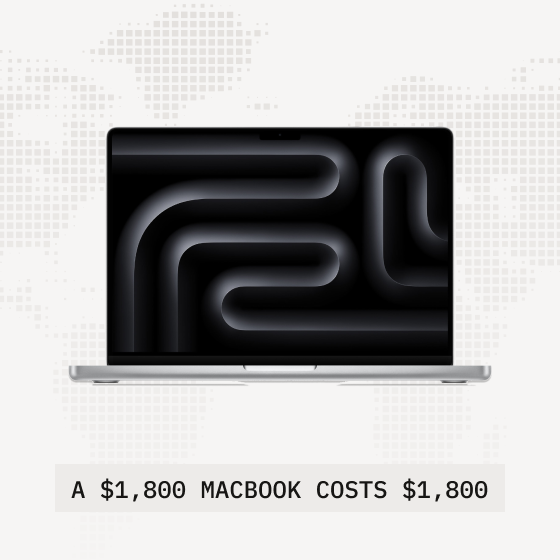
Tequipy sources every device locally in the employee's country through 600+ authorized resellers across 180+ countries. There is no cross-border shipping. No customs. No duties. Devices arrive pre-configured with MDM enrollment in an average of 3 business days. Hardware is sold at recommended retail price – a $1,800 MacBook costs $1,800, not $2,600.
Trusted by ElevenLabs, Booksy, DeepL, ICEYE, TapTap Send, RemoFirst, and Gigs.
🔗 See all case studies on tequipy.com/case-studies/
Tequipy Key Features
600+ Local Resellers Across 180+ Countries
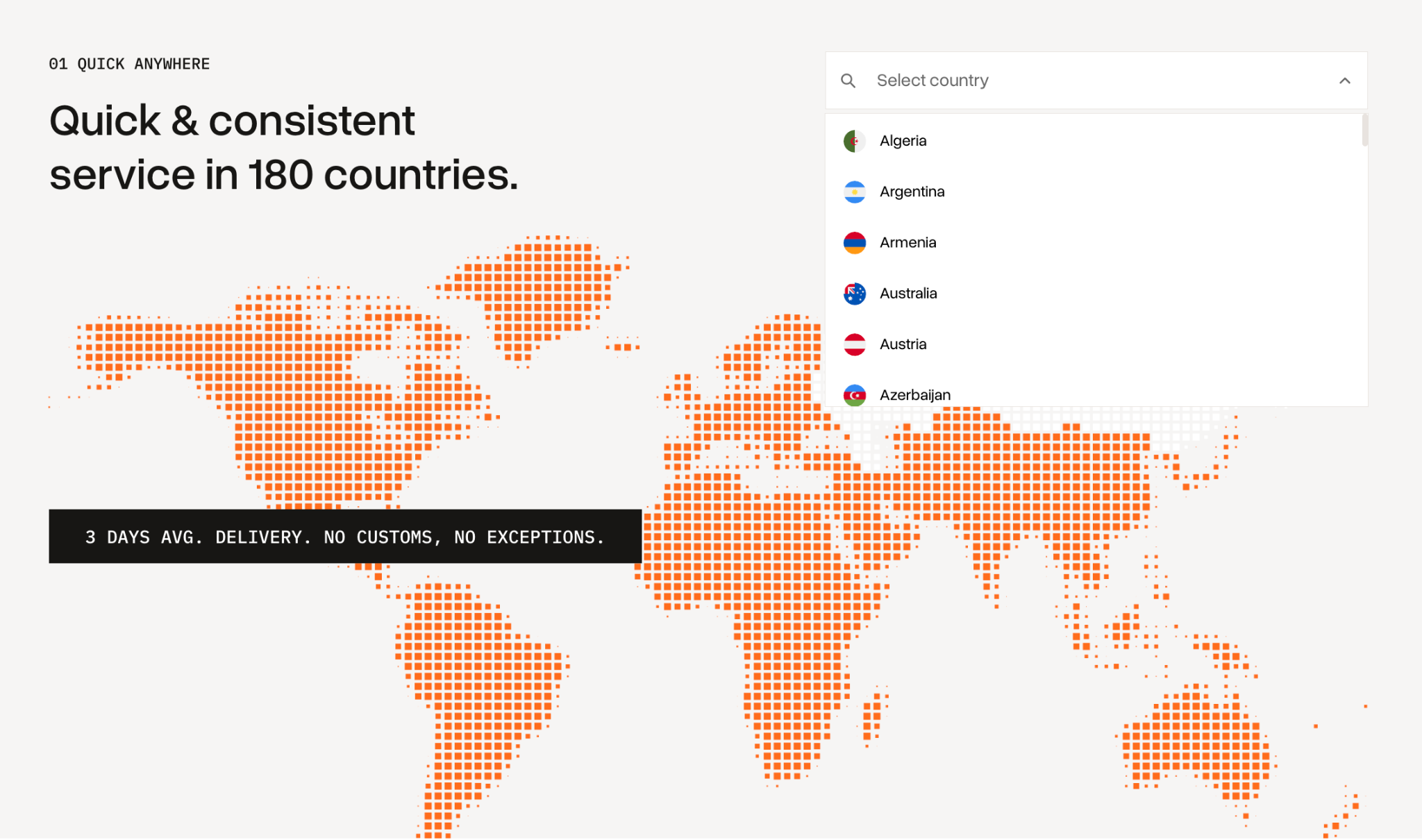
Most vendors ship from central or regional warehouses. When a device needs to reach Almaty, Bogotá, or Manila, that means international freight, customs clearance, and unpredictable lead times.
Tequipy works differently. Every device is sourced from an authorized local reseller in the employee's country. There is no cross-border shipment, which eliminates customs delays, import duties, and the logistical fog that makes global procurement unreliable.
The result: 3-day average delivery globally, with a hard ceiling of 10 business days anywhere in the world – including markets that competitors either do not cover or cover inconsistently. RemoFirst, which employs people across 30 countries including Kazakhstan, Colombia, and Ukraine, achieved 99% on-time delivery before employee start dates after switching to Tequipy. The market standard for that metric is 58%.
Opening a new country on Tequipy takes minutes. No new vendor search, no new payment setup, no new contract. The country is already live on the platform.
Key coverage highlights: Philippines, Brazil, India, Colombia, UAE, Georgia, Armenia, Azerbaijan, Kazakhstan – markets that routinely cause problems for other vendors.
🔗 Explore Tequipy's global coverage
Full Device Lifecycle in One Platform
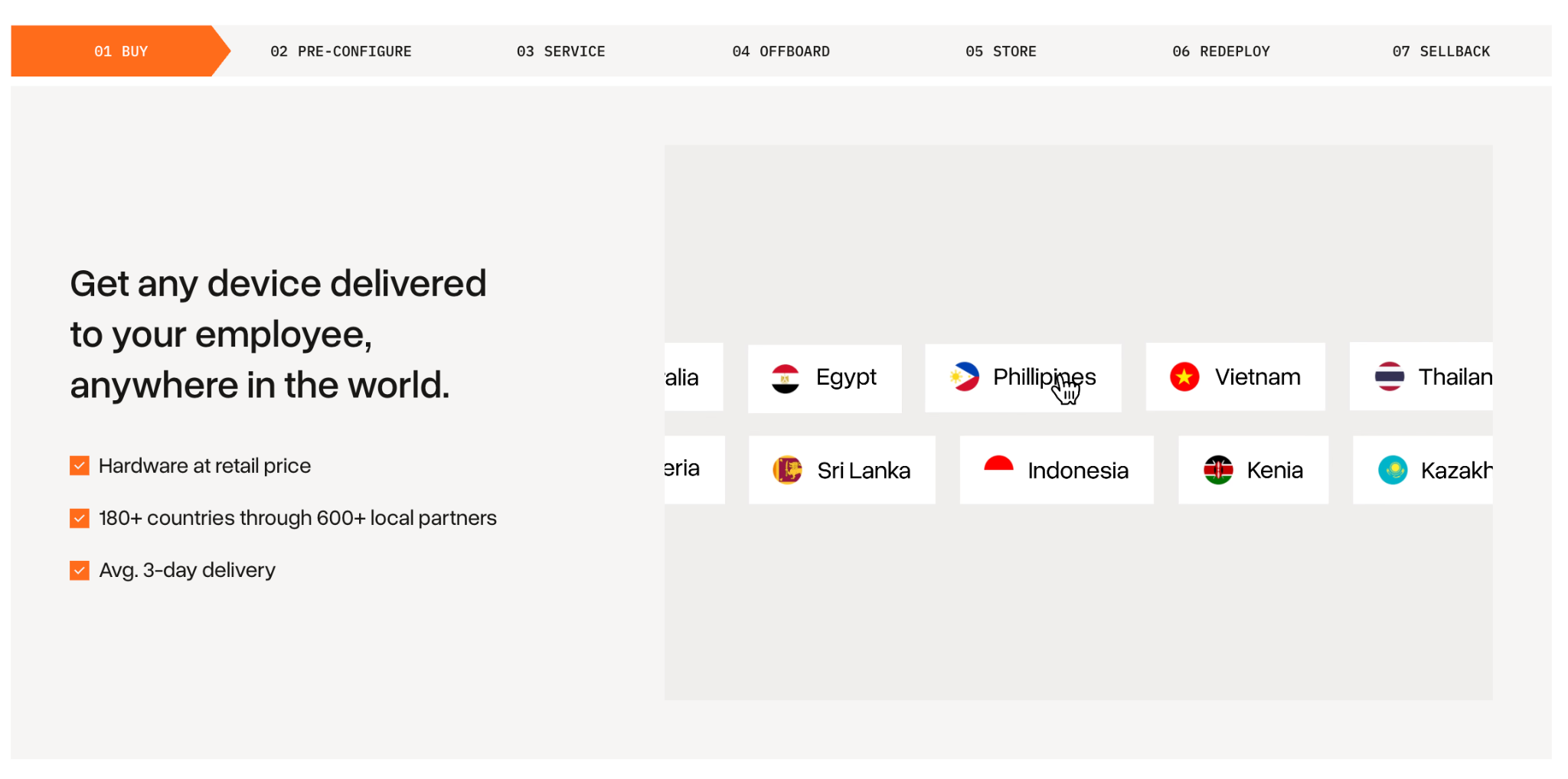
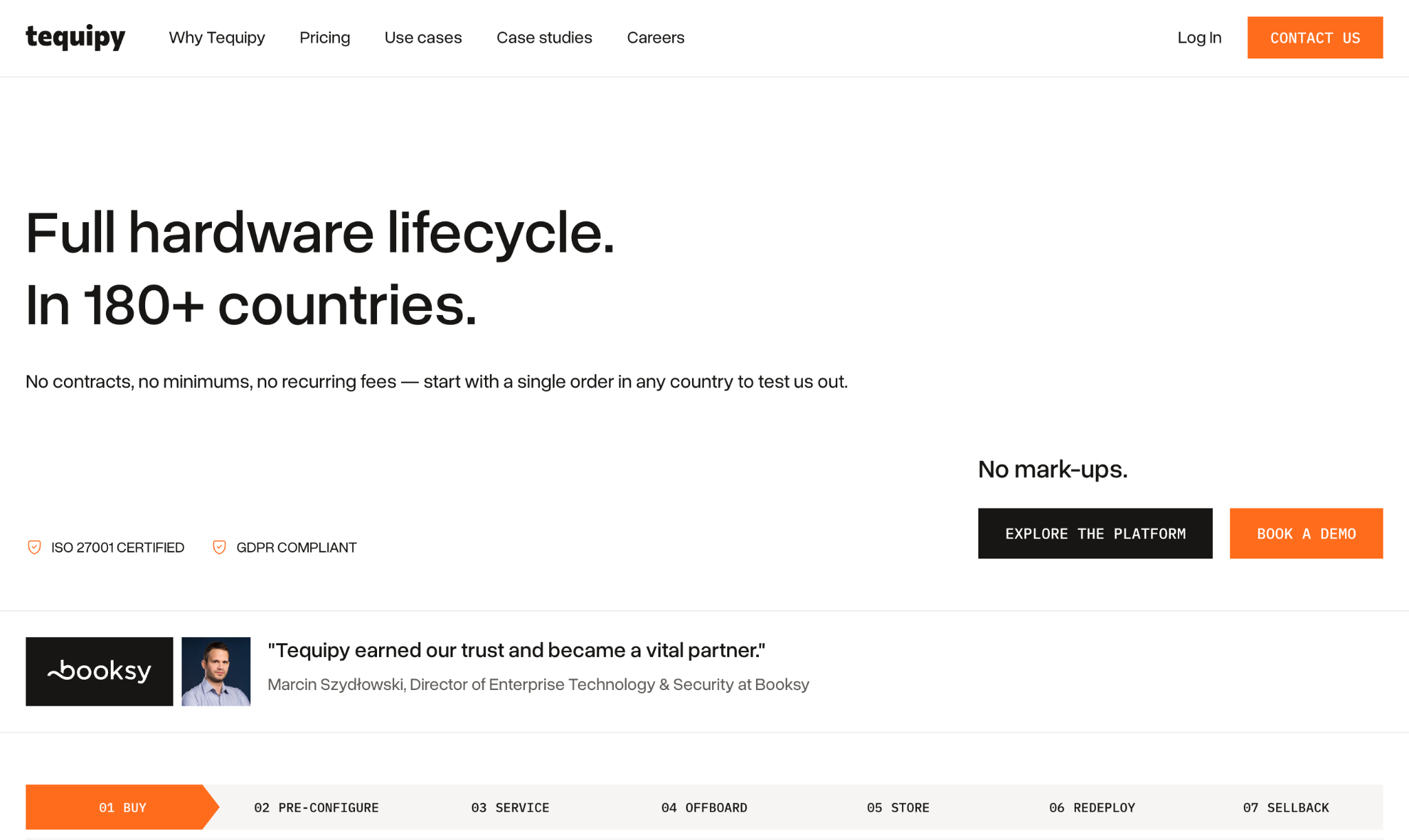
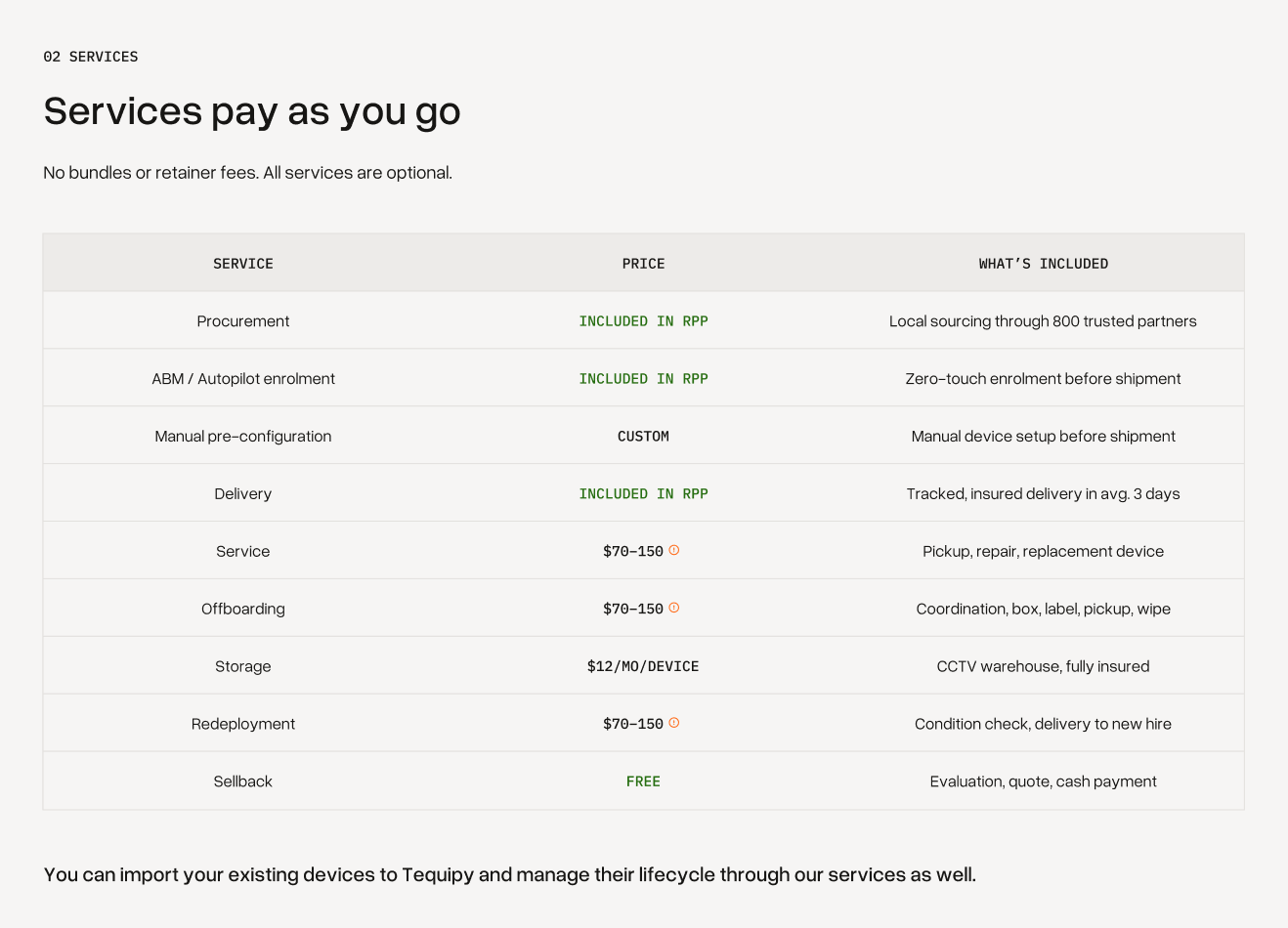
Tequipy covers seven services end-to-end:
Buy → Pre-configure → Service → Offboard → Store → Redeploy → Sellback
Every stage is available through the same platform. Pre-configuration includes ABM/MDM enrollment for Jamf, Intune, and JumpCloud – with zero-touch where available, manual where it is not. Every service works on hardware bought through Tequipy and on devices purchased elsewhere. There is no lock-in to Tequipy-procured equipment.
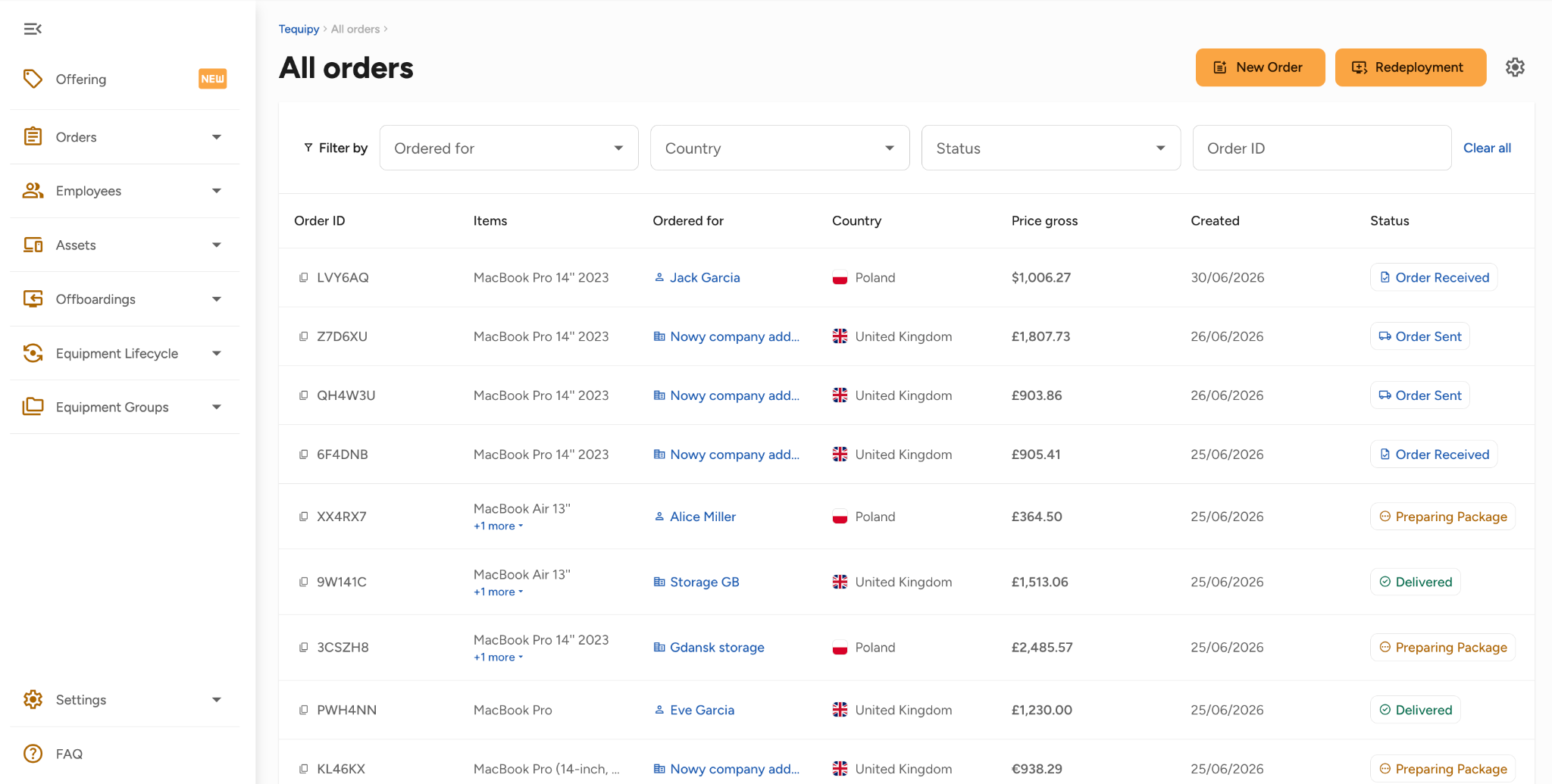
Asset tracking is built in. Every device is tied to an employee record with serial number, MDM status, purchase price, location, condition, and full history. When someone leaves the company, the offboarding workflow triggers a collection request, data wipe, and – if needed – storage or redeployment to the next hire.
The recovery rate across all Tequipy customers is 99% at offboarding, compared to the 71% market standard documented by Capterra. RemoFirst estimates this translates to roughly $2,000 per employee in prevented asset losses.
🔗 See how TapTap Send consolidated three procurement processes into one platform
Dedicated Slack Channel, Minutes-Level Response Time
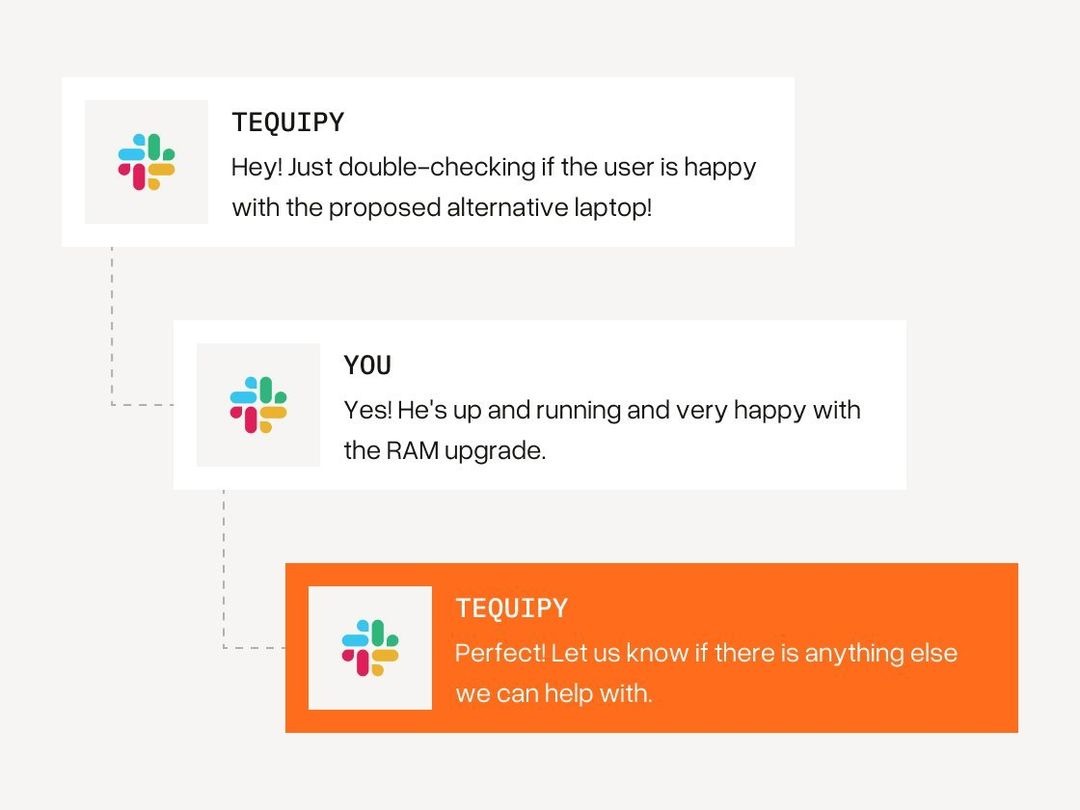
Every Tequipy customer gets a dedicated Slack channel staffed by the same team throughout the relationship. No ticketing portals, no tier-1 support queues, no rotating account managers. The same people handle procurement in the Philippines, a keyboard replacement in Berlin, and an offboarding in Kazakhstan.
This is not a minor operational detail. For lean IT teams – the ones who manage global hardware without adding headcount – the difference between a 4-hour ticket response and a 10-minute Slack message is the difference between a new hire starting on time and sitting idle on day one.
Lisa Kiseleva, People Operations Specialist at Gigs, put it directly: “They're hands-down one of the most responsive and solution-oriented teams I've worked with. No unnecessary back-and-forth, no complex processes – just practical, fast help whenever we need it.”
🔗 Read the full Gigs case study
No monthly per-seat fees. No long-term contracts. Pay for what you use, when you use it. For a $1,800 MacBook, you pay $1,800 – not the $2,600 quoted by Workwize or the $3,300 effective price reported at Deel IT for equivalent configurations.
Where Tequipy Shines
- Hard-to-reach countries: Consistent, documented delivery in markets that routinely cause problems elsewhere – Kazakhstan, Colombia, Philippines, Azerbaijan, Ukraine. Not theoretical coverage. Proven delivery.
- Speed without pre-stocking: 3-day average global delivery comes from in-country sourcing on demand. No capital tied up in warehouse stock, no storage fees on inventory waiting for a future hire.
- Cost transparency: Hardware at RRP, pay-as-you-go services, no recurring fees until you exceed 100 devices. The full cost of an onboarding is knowable before you place the order.
Where Tequipy Falls Short
- Fewer native HRIS integrations: Tequipy connects with major HR systems (HiBob, BambooHR and Workday), but some vendors offer 80+ native HRIS integrations out of the box. Teams that need deep, automated HR workflow triggers across many systems may find Workwize better suited until Tequipy's integration catalog expands.
- No leasing model: Tequipy operates on a purchase model only. Companies seeking a Device-as-a-Service or CapEx-to-OpEx conversion via hardware leasing should evaluate Fleet or Firstbase instead.
Tequipy Customer Reviews
"What sets them apart is their incredible responsiveness and true global reach. When we suddenly needed to equip new hires in places like the Philippines or Colombia, Tequipy delivered quickly and at a fair price, which was always a challenge before." – Marcin Szydłowski, Director of Enterprise Technology; Security, Booksy
"We've been partnering with Tequipy for over two years, and their support has been invaluable. It's taken a huge burden off our internal teams – now we don't have to worry about device logistics at all." – Lera Lykholiet, People Operations Specialist, RemoFirst
Who Tequipy Is Best For
- IT and Ops teams at 100–2,000 employee companies hiring across 3+ countries, especially in APAC, MENA, LATAM, or CIS markets where other vendors consistently underperform.
- Lean IT teams (1–3 people) who need to scale device logistics without adding headcount. Gigs managed 100+ employees across 20 countries without growing their IT team.
- Companies outgrowing a competitor – particularly those on Deel IT or Workwize who are frustrated by hardware markups, per-seat fees, or ticket-based support.
- Teams that want to test before committing. No contract. No minimum. The standard entry point is one order in one country – ideally the country where your current setup has failed the most.
🔗 Book a 15-minute intro call with the Tequipy team
Workwize
Workwize is an Amsterdam-based IT asset management platform with $15.4M raised, ~120–140 employees, and a Series A led by Klass Capital in January 2025. It covers the full device lifecycle across 100+ countries, with particularly strong US coverage and 80+ native HRIS integrations including Workday, HiBob, Rippling, BambooHR, and Okta.
The platform requires a minimum of 150 FTE and charges per-seat monthly fees ($19.50/seat/month at the Professional tier), which means a 150-person team pays roughly €35,000/year before a single device ships. Hardware is also marked up – independent user reports consistently put effective pricing at 25–30% above retail, with some configurations higher.
Key Features
HRIS Integration Depth
Workwize's 80+ HRIS integrations are its strongest honest differentiator. Automated employee onboarding, offboarding triggers, and access management are genuinely well-executed for teams already running complex HR stacks. If deep, native automation across many HR systems is the priority, this is where Workwize leads.
MDM and Zero-Touch Deployment
Full support for Jamf, JumpCloud, Intune, Autopilot, and ABM enrollment. Pre-configured devices arrive enrolled. This is table-stakes for the category, but Workwize executes it reliably.
Lifecycle Scope
Workwize covers procurement, deployment, repairs, retrieval, data wiping, redeployment, and resale. A dual-channel ordering model means some orders fulfill from regional warehouses (1–5 day SLA) and others from local resellers (SLA varies). The 1–5 day headline SLA applies only to devices already in your pre-purchased warehouse stock.
Pricing
Where Workwize Shines
- HRIS automation breadth: 80+ integrations with major HR platforms enables genuine workflow automation at scale.
- US market execution: Multiple independent reviewers confirm reliable delivery and service in the United States specifically.
- SOC 2 Type II: A hard requirement for some enterprise compliance teams that Tequipy has not yet completed.
Where Workwize Falls Short
- Minimum 150 FTE threshold: The platform is explicitly not designed for smaller teams. Companies below this size or looking to test before committing will hit a wall before placing their first order.
- Coverage outside US gaps in practice: Despite a "100+ countries" claim, user evidence shows delivery and retrieval failures in non-US markets, including EU and APAC. One Capterra reviewer noted "limited geos for offboarding" specifically.
Customer Reviews
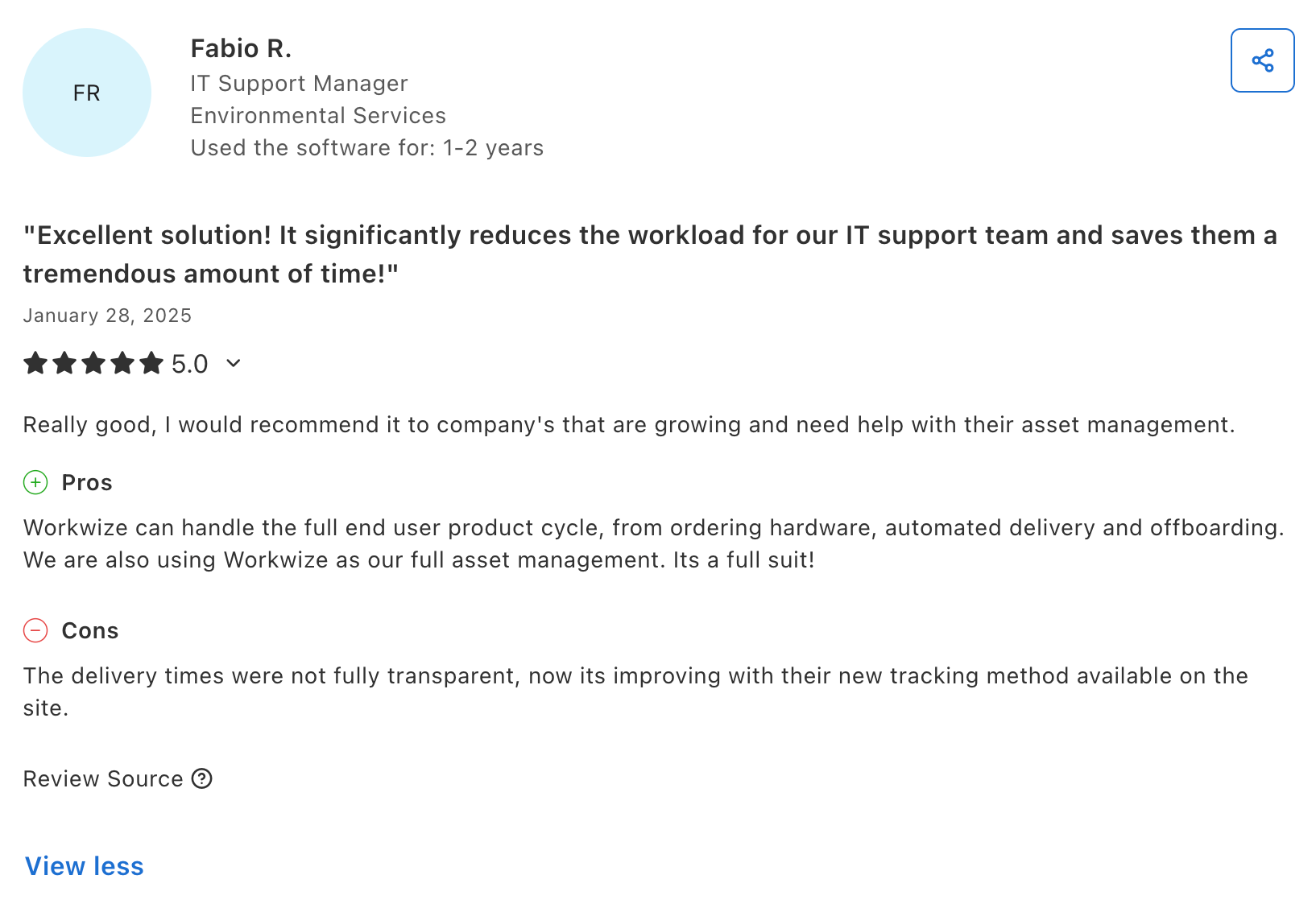
“Workwize can handle the full end user product cycle, from ordering hardware, automated delivery and offboarding. It's a full suit!” – Fabio R., Capterra (5/5)
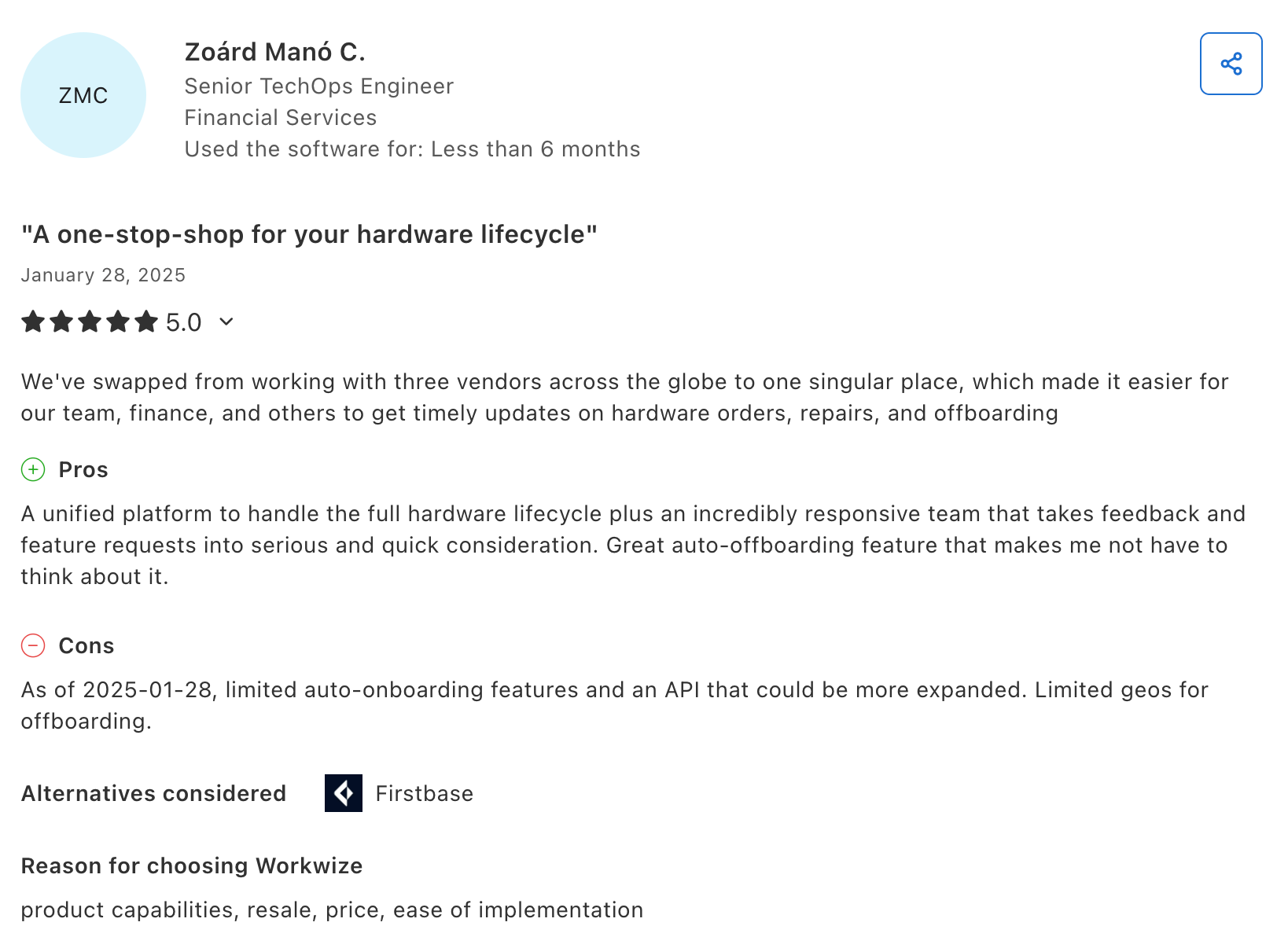
“As of 2025-01-28, limited auto-onboarding features and an API that could be more expanded. Limited geos for offboarding.” – Zoárd Manó C., Capterra
Who Workwize Is Best For
- 150+ FTE companies concentrated in the US who want deep HRIS automation and are comfortable with per-seat annual licensing.
- Teams with a hard SOC 2 Type II requirement and time to complete a multi-week implementation.
GroWrk
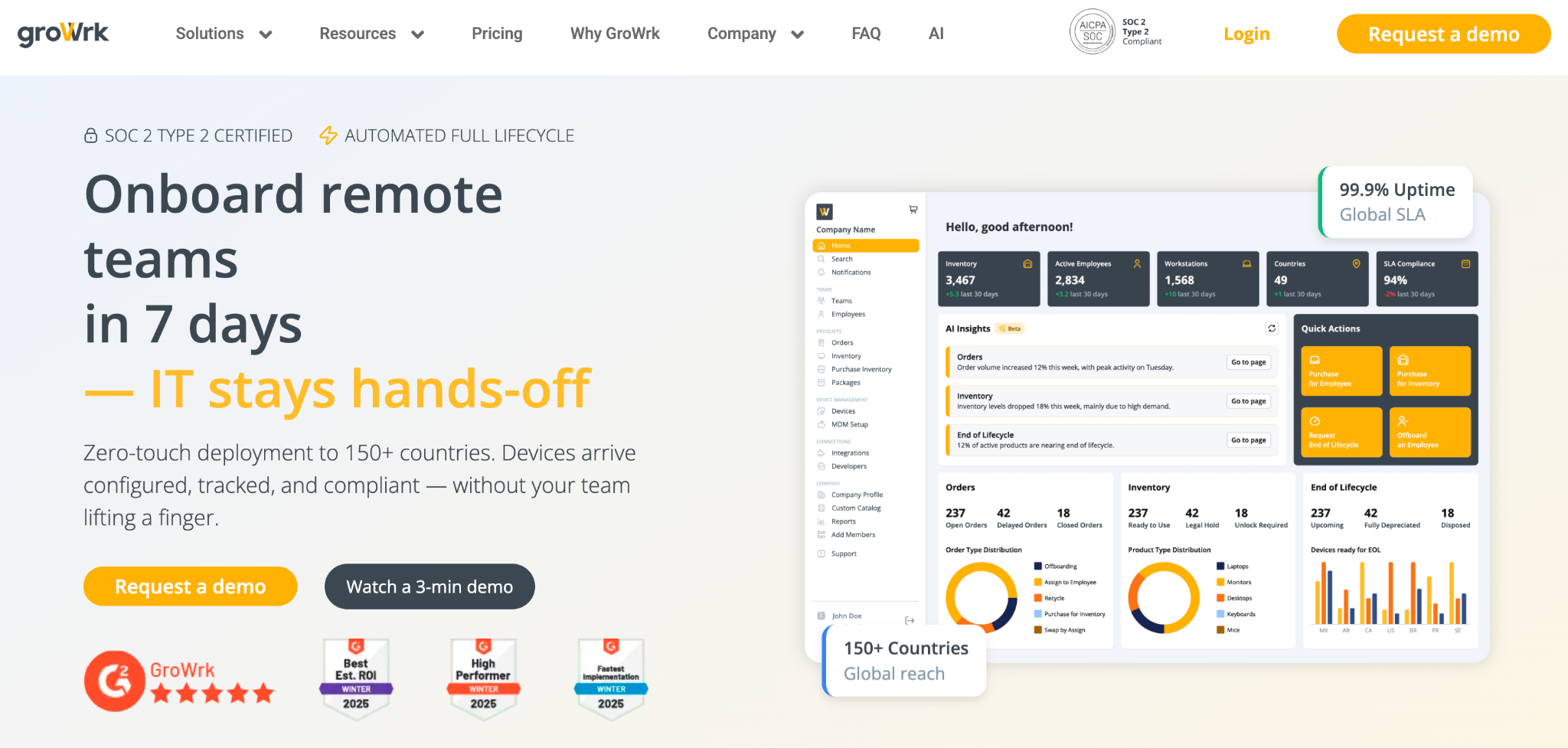
GroWrk is a San Diego-based remote IT logistics platform founded in 2019, now at roughly 80–90 employees and cash-flow positive since 2022. It claims coverage in 150+ countries and serves 20,000+ employees, with particular strength in LATAM – the region where its user evidence is most consistent and positive.
Every Flex tier customer gets a dedicated Account Manager / CSM and a shared Slack channel. G2 reviewers praise the support team more than any other feature – 18 out of 33 reviews specifically mention customer service as a positive.
Key Features
LATAM Coverage and Network
GroWrk's most documented strength is coverage across LATAM: Chile, Colombia, Brazil, Argentina, Uruguay, and Mexico all appear in positive user reviews. For US-headquartered companies with significant LATAM hiring, GroWrk's established network in that region is a genuine advantage over vendors who treat LATAM as an afterthought.
Dedicated CSM Model
Every Flex customer gets a named Account Manager. This matters for IT managers who prefer a relationship over a Slack channel – particularly at larger companies with complex, ongoing needs. The downside: account manager rotation is the most-cited complaint in negative reviews.
Full Lifecycle + AI Helpdesk
GroWrk covers procurement, MDM enrollment, deployment, storage, redeployment, ITAD, and a 24/7 AI-powered support tier ("GroWBot"). The sellback program exists but user reports suggest buyback values are low (one Tequipy prospect was quoted $50 for a 4-year-old MacBook Pro).
Pricing
GroWrk does not publish pricing. A discovery call is required for any accurate number.
Where GroWrk Shines
- LATAM network: US + LATAM coverage with positive documented user experience in multiple countries.
- Customer support culture: Dedicated CSMs, shared Slack, and a support team that reviewers consistently praise.
Where GroWrk Falls Short
- Outside LATAM, execution is uneven: Documented delivery failures in Egypt, Mexico (partner issues), Central Europe (1+ month delay), and India (consistent 2-week lead times despite marketing claims). One Tequipy prospect terminated their GroWrk contract due to delivery failures in Egypt.
- No pricing transparency: No public pricing means no way to budget without a sales call. Makes side-by-side evaluation difficult.
Customer Reviews
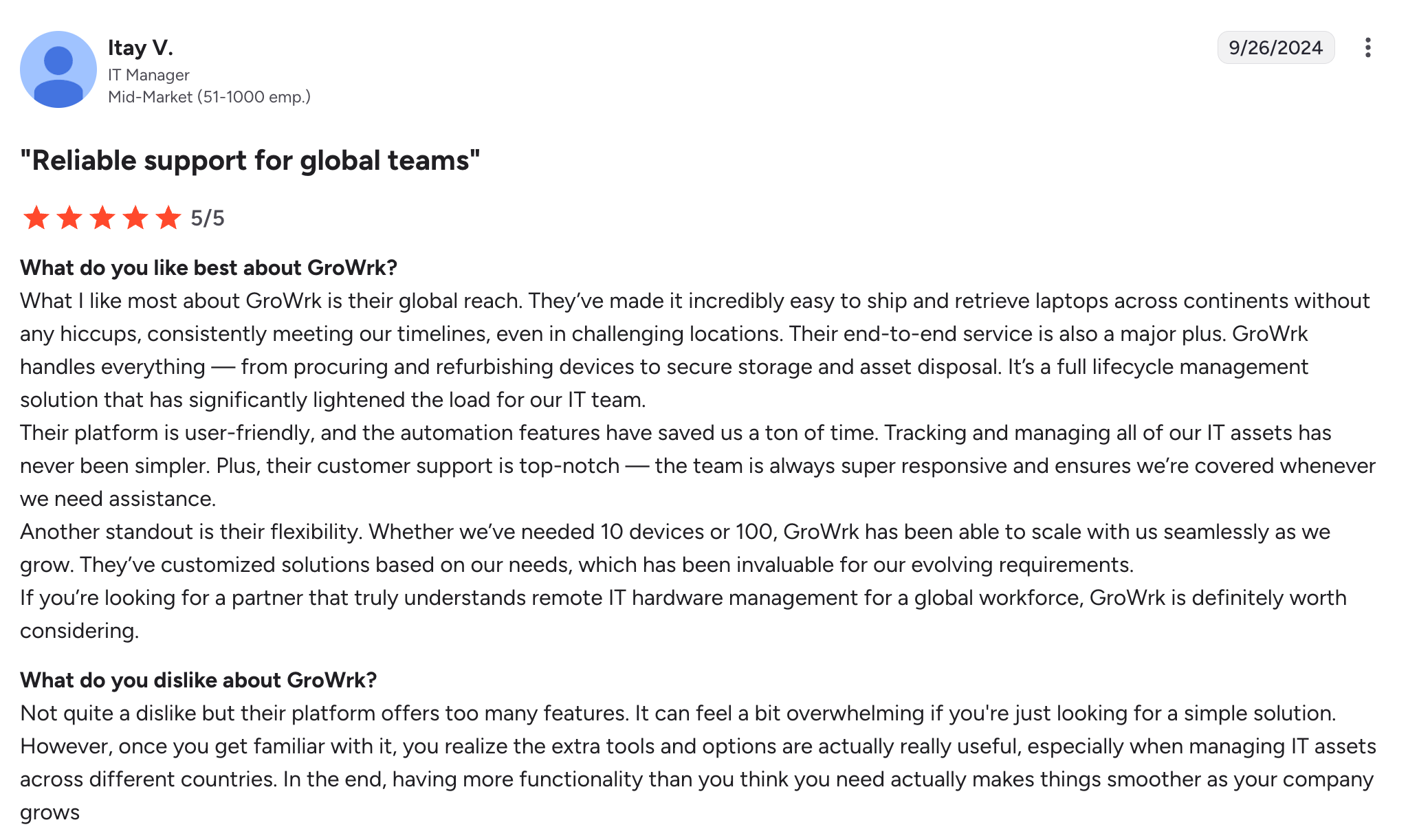
“GroWrk handles everything – from procuring and refurbishing devices to secure storage and asset disposal. It's a full lifecycle management solution.” – Itay V., G2 (Sep 2024)
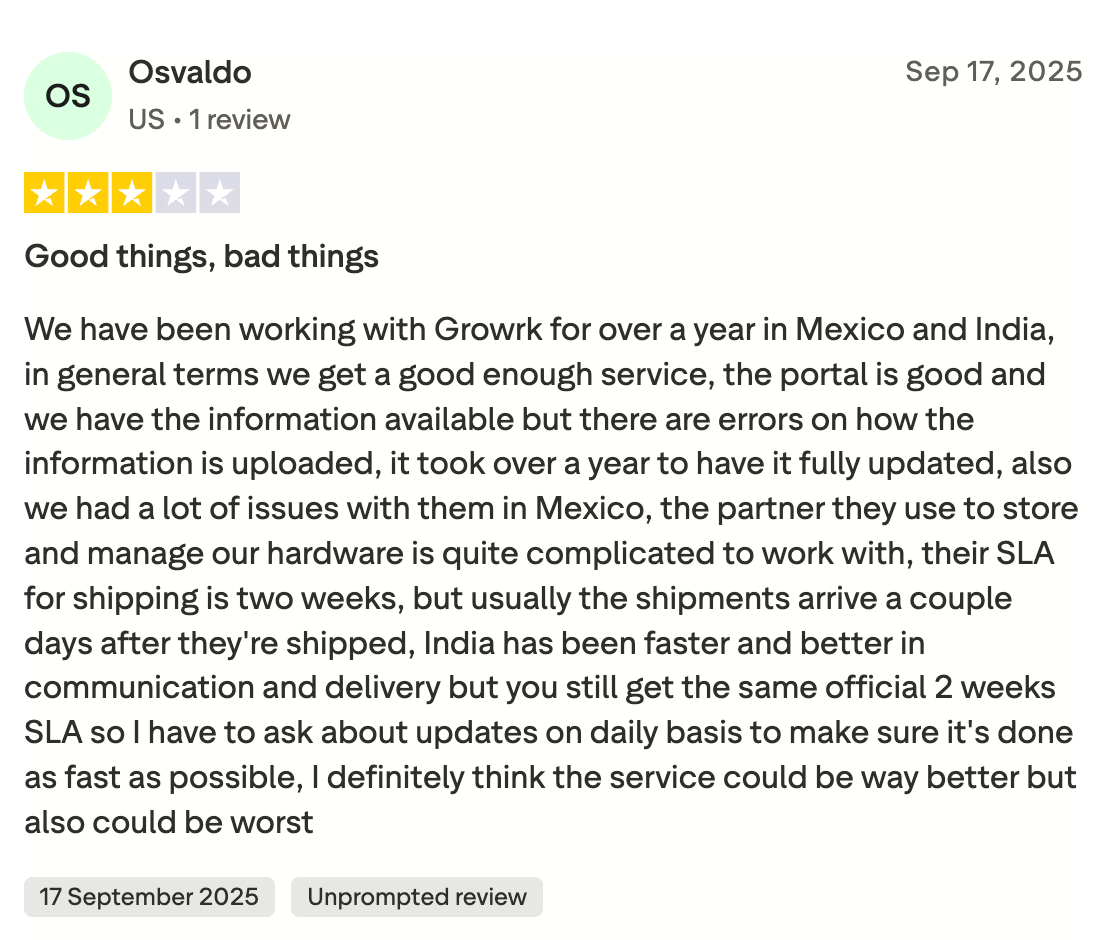
“We had a lot of issues with them in Mexico – the partner they use to store and manage our hardware is quite complicated to work with.” – Osvaldo, Trustpilot
Who GroWrk Is Best For
- US-headquartered companies with heavy LATAM hiring who want a dedicated support relationship.
- Teams that value a named account manager over self-service speed.
Deel IT (prev. Hofy)
Deel IT is the rebranded hardware arm of Hofy, acquired by Deel in mid-2024. It covers full device lifecycle management across 130+ countries and integrates natively with the broader Deel platform – EOR, payroll, contractors, and HR all in one system.
That native integration is Deel IT's clearest, most honest advantage. If a company is already using Deel for employer-of-record or global payroll, Deel IT becomes another tab in the same portal. For everyone else, the case gets harder to make.
Key Features
Native Deel Ecosystem Integration
If your company already uses Deel for EOR, payroll, or contractor management, Deel IT connects onboarding and offboarding events automatically. Device procurement triggers when a hire is added in Deel. Recovery triggers when an employment record closes. This is a meaningful workflow advantage for teams deeply embedded in the Deel ecosystem.
MDM, IAM, and Endpoint Protection
Deel IT offers pre-configured ABM/Intune/Autopilot enrollment and also sells its own MDM module ($14/device/month) and IAM module (from $16/user/month). SOC 1/2/3 and ISO 27001 certifications are in place.
130+ Country Coverage
Official claim is 130+ countries. In practice, user evidence shows coverage gaps outside the US and EU – particularly LATAM, India, and CIS markets – where devices sometimes arrive late or not at all.
Pricing
A 130-person company on the Standard tier pays $15,600 in platform fees upfront, before ordering a single device. Hardware is then marked up on top of that. A $2,000 laptop has been quoted at $3,300 in hard-to-reach countries.
Where Deel IT Shines
- Deel ecosystem consolidation: One vendor for EOR, payroll, contractors, and IT. If that consolidation matters more than cost, this is a real advantage.
- Enterprise compliance credentials: SOC 1/2/3 + ISO 27001 + certified data erasure.
Where Deel IT Falls Short
- Hardware cost: A 25% published floor, with real-world comparisons frequently showing 40–50% above RRP. In LATAM and APAC, effective markups can reach 65–100%.
- Upfront annual billing: The full contract value is paid at signing – before a single device ships. This creates significant lock-in, particularly for companies mid-year.
Customer Reviews
“Deel IT has a 25% margin on laptops. But in real life, it's even more like 40–45%. We compare what we are buying and the same configuration.” – Tequipy sales call notes (sourced from prospect evaluating both vendors)
"For this year, basically we cannot really move to different platforms since we technically have leftover money on the deal." – User describing annual billing lock-in (Tequipy sales call notes)
Who Deel IT Is Best For
- Companies already using Deel for EOR or payroll who want IT logistics in the same platform.
- Teams that need SOC 2 and are comfortable with annual, upfront pricing structures.
Firstbase
Firstbase is a US-based IT asset management platform acquired by AppDirect in December 2024. It claims coverage in 150+ countries with a two-tier model: direct warehouses in the US, UK, EU, and Canada; third-party regional partners in APAC, LATAM, and MEA. One genuine differentiator: Firstbase is the only major vendor that allows companies to ship their own existing inventory (BYOD) into its warehouse network in Tier 1 markets and manage it through the platform – without forcing procurement through Firstbase's own catalog.
G2 rating: 4.8/5 (50 reviews). The acquisition by AppDirect has created some uncertainty about the platform's roadmap.
Where Firstbase shines
BYOD and own-inventory management: Firstbase is the only major vendor here that lets companies ship their existing hardware fleet into its warehouse network and manage it through the platform: without forcing procurement through Firstbase's catalog. Useful for teams mid-transition who do not want to write off existing inventory just to consolidate onto a new platform.
Tier 1 market depth: In the US, UK, EU, and Canada, Firstbase runs direct warehouses with the full service range: custom imaging, zero-touch deployment, full ITAD, and flexible 30/60/90-day hold policies.
Where Firstbase falls short
Tier 2 markets get a materially different service. Firstbase publicly documents a two-tier model in its own support documentation, but does not surface it prominently in marketing. In APAC, LATAM, and MEA: BYOD intake is not supported, custom imaging is unavailable, repairs are limited to Firstbase-supplied devices, returns cover laptops and docks only, and ITAD is absent in five LATAM warehouses (Brazil, Mexico, Argentina, Colombia, Guatemala). Hold policies are not offered outside Tier 1.
The "150+ countries" headline gives no indication of this. A buyer who assumes consistent service across the full coverage map will hit these gaps after signing, not before.
Who Firstbase is Best for
US/UK/EU-concentrated companies with an existing hardware fleet they want to centralize, or teams that need Tier 1 coverage with a flexible procurement model.
Allwhere
Allwhere is a Brooklyn-based IT logistics platform that covers 48 countries across North America, LATAM, Western Europe, ANZ, and select Asia markets (India, Japan, Philippines, Singapore). It raised a $9.5M seed round in 2022 from D.E. Shaw's venture arm and has roughly 46–48 employees.
Strongest documented performance is in the US, with reviewers describing next-day dispatch and clean portal visibility. The platform is built on a pay-as-you-go, no-platform-fee model with no long-term contracts – similar positioning to Tequipy, but with a narrower geographic footprint. MENA, Africa, CIS, and most of Asia outside four countries are not covered.
G2: 4.6/5 (8 reviews). Trustpilot: 1 review, 1 star.
Best for: US-headquartered companies hiring primarily within Allwhere's 48-country list and needing clean, fast US retrieval operations.
Fleet
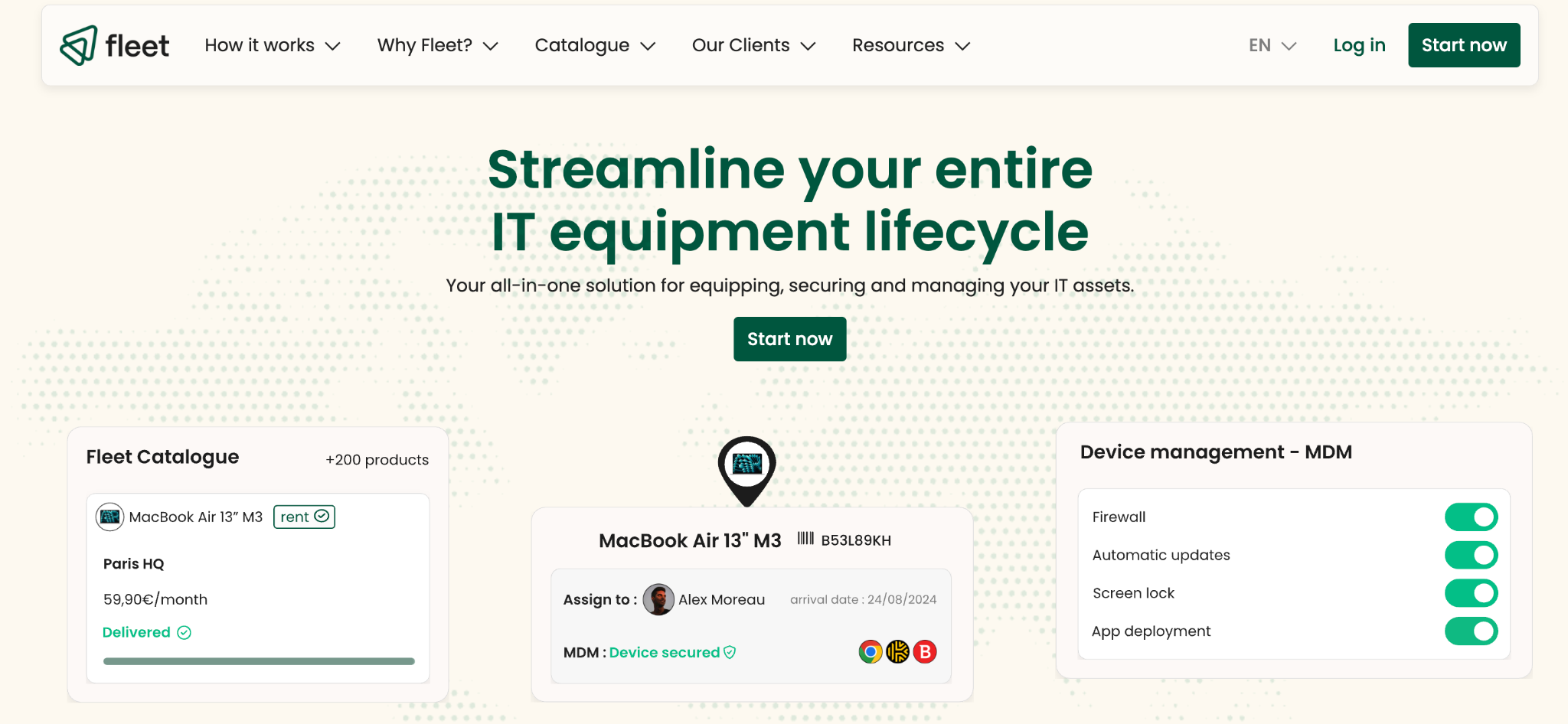
Fleet is a Paris-based Device-as-a-Service platform founded in 2019, valued at €100M following a February 2026 LBO by ISAI Expansion. It operates a 36-month operational leasing model – companies do not own the hardware; they lease it. At end-of-contract, devices are collected and Fleet handles refurbishment, donation, or recycling.
Fleet claims delivery to 120+ countries in under 48 hours and actively operates in roughly 10 European countries plus the US. It also sells its own MDM product and a cybersecurity bundle. The leasing structure converts hardware CapEx to OpEx, which some finance teams prefer. For companies that want outright ownership, Fleet is not the right fit.
Trustpilot: 4.2/5 (120+ reviews). Strong European user base.
Best for: EU-headquartered companies wanting a leasing model, CapEx-to-OpEx conversion, and operational focus in Western Europe and the UK.
How to Choose the Right Remote Equipment Management Tool
Country Coverage: Verified, Not Marketed
Every vendor in this list claims global or near-global coverage. The claim is not the evidence. Before committing, map your actual hiring countries – including where you plan to hire in the next 12 months – against each vendor's documented coverage.
"Documented" means countries where you have found positive user evidence, not the vendor's own marketing page. If you hire in Kazakhstan, Armenia, Colombia, or Egypt, ask each vendor for a specific reference from a customer in that country.
Tequipy's standard sales motion is deliberately designed around this: test in your hardest country first, with no contract and no minimum. Booksy tested Tequipy in LATAM – their most difficult region – before expanding to their full global footprint. “They managed it perfectly, which gave us the confidence to start using their services for other geographies as well.”; (Full case study)
Pricing Model: Total Cost, Not Headline Price
The comparison that matters is not per-device price. It is total annual cost including: platform fee, hardware markup, per-service fees, minimum seat requirements, and contract commitment.
A vendor quoting "no monthly fee" may charge 30% above retail on every device. A vendor charging €19.50/seat/month may mark hardware at RRP. Run the math against your actual order volume.
For reference: a 150-person company ordering 30 devices per year at $1,800 each would pay roughly $16,200/year in hardware markups alone at a 30% markup – compared to $0 in markups at RRP. Add in $35,000/year in platform fees (Workwize Professional at 150 FTE) versus $1,188/year (Tequipy at $99/month flat), and the gap compounds fast.
Lifecycle Scope: Are All Seven Stages Covered?
A remote equipment management tool that handles procurement but not retrieval shifts the hard problem onto your team's shoulders. The full lifecycle – procurement, pre-configuration, delivery, servicing, offboarding, storage, redeployment – should be available in the same platform, in every country you operate in.
Particular attention to: offboarding and retrieval coverage. Most vendors narrow their service map significantly for this stage outside Tier 1 markets. Check specifically whether your countries of operation are covered for retrieval, not just deployment.
🔗 See how RemoFirst achieved 100% device recovery across 30 countries with Tequipy
Manage Your Global Device Fleet with Tequipy
The best remote equipment management tool for your team depends on where you hire. If your footprint is concentrated in the US and Western Europe and you want deep HRIS automation, Workwize or Firstbase are credible options.
If you hire across difficult markets – APAC, MENA, LATAM, CIS – and need consistent delivery, fair pricing, and a team that responds in minutes rather than days, Tequipy is the better fit.
No contract. No minimum. Onboarding takes under 24 hours. Start with one order in one country.
{{cta-primary}}
FAQ
What is remote equipment management?
Remote equipment management is the process of procuring, deploying, tracking, servicing, and recovering company hardware for employees who are not based in a central office. It covers the full device lifecycle – from a new hire's laptop arriving pre-configured on their first day to secure retrieval and data wiping when they leave.
What do remote equipment management tools actually do?
They centralize the physical hardware lifecycle in one platform. Instead of managing separate vendors for procurement, shipping, MDM enrollment, and retrieval in each country, one platform handles all stages – with a single dashboard, single billing relationship, and single support contact. The best tools reduce IT admin time by 25–100+ hours per month for distributed teams.
How do you manage IT equipment for remote employees across multiple countries?
The most reliable approach for teams in 3+ countries is a platform with local sourcing – devices bought in-country via authorized resellers, rather than shipped cross-border. This avoids customs delays, import duties, and inconsistent transit times. 3-day average delivery is achievable at scale with local sourcing; 4–6 week delivery is common without it.
What is the difference between RMM and remote equipment management?
RMM (Remote Monitoring and Management) tools handle software-level device management: patch deployment, security policy enforcement, remote access, and monitoring. Remote equipment management platforms handle the physical layer: sourcing, shipping, MDM enrollment, storage, and retrieval. The two categories complement each other – RMM manages what's on the device, remote equipment management handles the device itself.
How do you retrieve company equipment from remote employees in other countries?
The best platforms handle end-to-end retrieval: scheduling a courier pickup at the employee's home address, providing packaging materials, transporting the device to a local warehouse, performing a certified data wipe, and returning the device to inventory for storage or redeployment. The industry average for successful device recovery at offboarding is 71%. Tequipy's documented rate is 100% across all customers, as cited by Capterra research on offboarding best practices.
What is the best platform for managing IT equipment globally?
For teams with significant hiring in difficult markets – APAC, MENA, CIS, LATAM – Tequipy is the strongest documented option. For US-centric teams wanting deep HRIS automation and a per-seat SaaS model, Workwize is a credible alternative. The right answer depends on where you hire and how you prefer to pay.
Keep your current setup. Just test us on one order.
AUTHOR
Before Tequipy, Tomek ran IT at Revolut, scaling from 100 employees in 2 offices to 5,000 across 17. He built the system that kept every laptop accounted for, then founded Tequipy – a platform that handles IT equipment logistics for distributed teams across 180+ countries.
As CEO, he runs operations and covers the founder layer: strategy, product, and the company-building that comes with both.
15 minutes. Your countries, your devices, your setup. No pitch.